Divide Mature Clumps
Every 3–4 years, lift and gently divide congested root clumps in early spring, replanting fist-sized sections with several shoots each to maintain vigor and create new plants.

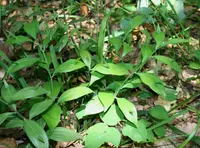
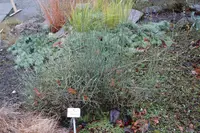
Mouse thorn (Ruscus hypoglossum) is an evergreen subshrub grown mainly for its unusual, leaf-like stems and neat, compact habit. It stays low and tidy, making it suitable for small spaces or shaded corners. The plant is native to woodlands in southern and central Europe, where it grows in deep to partial shade under trees. It has glossy, dark green cladodes, which are flattened stems that look like leaves, and small flowers that can be followed by red berries. It is a slow-growing, long-lived plant that tolerates low light and inconsistent care, which makes it relatively straightforward to care for mouse thorn in most homes.

Care Difficulty
Easy Care

Light Preference
Partial Shade

Water Requirements
Moderate Water

Temperature Preference
Cool Climate

Hardiness Zone
7–9

Soil Texture
Loamy, Clay, Organic-rich

Soil pH
Acidic (5.5–6.5), Slightly acidic (6.5–7.0)

Soil Drainage
Moist but well-drained

Fertilization
Minimal (feed rarely)
Scan your plant to receive care tips personalized for your specific plant
Available on iOS and Android
This evergreen shade plant prefers gentle, indirect light rather than strong direct sun.
This plant prefers evenly moist but not saturated soil, with short dry periods between waterings.
This species is quite cold hardy but grows best in mild, stable temperatures.
This species tolerates typical indoor humidity and does not usually need special moisture in the air.
This plant prefers loose, humus-rich soil that drains freely but does not dry out instantly.
This species is suitable for container growing and adapts well to long-term pot culture.
This shade-tolerant understory plant needs only light feeding to maintain steady growth.
Ruscus hypoglossum needs only light, maintenance pruning to stay tidy and healthy.
This rhizomatous shrub prefers to stay undisturbed, so plan repotting or transplanting carefully.
This species is usually propagated vegetatively, as seed germination is slow and less predictable.
This evergreen is generally cold hardy in mild to moderate winters and needs limited intervention.

Plant Health Check
Not sure what's wrong with your plant? Check your plant's health inside the app.
What look like leaves on this species are actually cladodes, which are flattened stem segments that take over photosynthesis while the true leaves remain tiny and scale-like.
Its small greenish flowers appear directly in the middle of the cladode surface, an unusual position that makes identification easier compared with many other understory shrubs.
Only female plants develop the characteristic bright red berries, because the species is dioecious, meaning male and female flowers grow on separate plants.

This species is native to shaded woodlands of southeastern Europe and parts of the Mediterranean, where it forms long-lived, slowly spreading colonies through underground rhizomes that can persist in the same site for many decades.
Flowering is often sparse and may go unnoticed because the flowers are very small and tucked along the cladodes. Limited light, recent repotting, or heavy pruning can further reduce bloom. Patience is important, as blooming is naturally modest.
Keep your plants happy and healthy with plant identification, disease detection, and easy care guidance.