Stable Water Depth
Maintain a consistent water depth of 10–30 cm above the crown by topping up containers or ponds weekly, since rapid fluctuations stress the plant and reduce rhizome vigor.

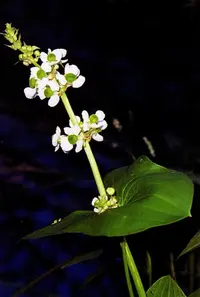
Broadleaf arrowhead (Sagittaria latifolia) is a hardy aquatic perennial commonly found in shallow ponds, marshes, and slow-moving streams. It forms clumps of upright, arrow-shaped leaves that emerge from underwater rhizomes. Flowers appear on tall stalks above the foliage, usually white with three petals, giving the plant a clean and simple look in the water garden. The plant spreads gradually and can form dense stands in suitable wet conditions. Sagittaria latifolia is generally easy to grow if it has constant moisture, full sun to light shade, and nutrient-rich, mucky or clay soil. Understanding how to care for broadleaf arrowhead starts with providing stable water levels and avoiding strong water currents.

Care Difficulty
Easy Care

Light Preference
Full Sun

Water Requirements
Aquatic

Temperature Preference
Cold Hardy

Hardiness Zone
4–10

Soil Texture
Loamy, Silty, Organic-rich

Soil pH
Acidic (5.5–6.5), Slightly acidic (6.5–7.0)

Soil Drainage
Waterlogged tolerant

Fertilization
Minimal (feed rarely)
Scan your plant to receive care tips personalized for your specific plant
Available on iOS and Android
Sagittaria latifolia thrives in bright, open conditions near water margins.
This aquatic species is adapted to consistently wet or shallowly submerged conditions.
This hardy aquatic plant tolerates a wide temperature range in outdoor ponds and wetlands.
This emergent aquatic prefers high ambient humidity but tolerates typical outdoor air if roots stay submerged.
This species grows best in saturated, organic-rich substrates that stay constantly wet or shallowly flooded.
This aquatic is suitable for containers when grown in ponds or water gardens with permanently wet soil.
Sagittaria latifolia usually needs minimal fertilization when planted in nutrient‑rich, natural ponds or marshy beds.
Sagittaria latifolia benefits from light, maintenance pruning to keep growth tidy and healthy in ponds or water gardens.
This species is more often transplanted within water gardens than traditionally repotted, since it forms clumps and tubers in shallow substrates.
Sagittaria latifolia is commonly propagated by division of clumps or tubers, with seed used mainly for naturalization projects.
In most temperate climates, Sagittaria latifolia is cold hardy and needs minimal winter care once established in ponds or wet soil.

Plant Health Check
Not sure what's wrong with your plant? Check your plant's health inside the app.
The broad, arrow-shaped leaves act like small sails, catching light above competing marsh plants while channeling rain and splash water toward the crown and roots.
This species produces separate male and female flowers on the same inflorescence, with showy, pollen-rich male flowers at the top and seed-forming female flowers lower down, which supports efficient pollination by visiting insects.
Its starchy underground tubers and seeds are eaten by ducks, geese, muskrats, and other wetland animals, making it a significant food source in North American marsh and pond ecosystems.
Indigenous peoples across North America traditionally harvested the plant’s tubers as a staple wild food, sometimes calling it duck potato, and used specialized digging sticks or their feet in shallow water to dislodge the buoyant tubers so they would float to the surface for easy collection.
This species is very attractive to pollinators. The white, three-petaled flowers provide nectar and pollen for bees, hoverflies, and some butterflies, especially in summer. In pond or bog gardens, it can significantly increase local insect activity.
Keep your plants happy and healthy with plant identification, disease detection, and easy care guidance.