Renew Plants Regularly
Treat this plant as a short-lived perennial and start fresh plants from seed every 2–3 years to avoid woody, exhausted clumps with reduced flowering.

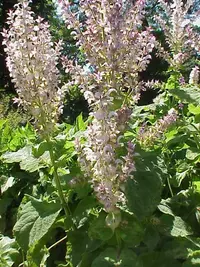
Clary sage, Salvia sclarea, is a short-lived perennial or biennial herb grown for its aromatic foliage and tall flower spikes. It belongs to the mint family and has a bushy, upright habit.
Plants form large, soft, wrinkled leaves at the base and send up branching stems with pastel pink, lilac, or white bracts that attract bees and other pollinators. It is native to parts of southern Europe and western Asia, where it grows in dry, sunny habitats.
Clary sage is generally considered undemanding if given full sun, well-drained soil, and moderate moisture. These traits make it relatively simple to care for clary sage in many temperate gardens.

Care Difficulty
Easy Care

Light Preference
Full Sun

Water Requirements
Low Water

Temperature Preference
Cool Climate

Hardiness Zone
5–9

Soil Texture
Sandy, Loamy, Rocky

Soil pH
Slightly acidic (6.5–7.0), Neutral (7.0)

Soil Drainage
Well-drained

Fertilization
Minimal (feed rarely)
Scan your plant to receive care tips personalized for your specific plant
Available on iOS and Android
This sun-loving biennial thrives in open, bright positions for strongest flowering.
This species prefers drying slightly between waterings rather than consistently moist soil.
This plant performs best in moderate, not tropical, conditions.
Humidity is rarely critical for this Mediterranean species, which thrives in drier air.
Salvia sclarea prefers lean, well-drained, slightly alkaline soil that does not stay wet.
This species can grow successfully in containers when the pot is prepared for its deep root system and tall, top-heavy growth.
This aromatic herb benefits from modest feeding to support strong foliage and flowering without becoming overly lush.
Thoughtful pruning supports compact growth and sustained flowering in Salvia sclarea.
This biennial or short-lived perennial is usually grown in beds, so transplanting is more common than container repotting.
New Salvia sclarea plants are most often raised from seed under simple conditions.
This species is fairly cold hardy in many temperate climates but benefits from basic winter preparation in colder areas.

Plant Health Check
Not sure what's wrong with your plant? Check your plant's health inside the app.
Salvia sclarea usually behaves as a biennial, forming only a leaf rosette in its first year and then sending up tall flowering spikes with showy bracts in the second year before dying back.
Its leaves and inflorescences are covered with glandular hairs that release aromatic compounds, which help deter herbivores and attract pollinating insects at the same time.
The pale pink to lilac bracts are more visually prominent than the small flowers themselves and act as visual signals to guide pollinators toward the nectar-rich blooms.

Historically, clary sage seeds were used in Europe as so-called "clear eye" seeds, because their mucilaginous outer coat becomes slippery in water and was applied to help lift small particles from the surface of the eye, a property later documented and discussed in early pharmacognosy texts.
This species behaves as a short-lived perennial or biennial. In many climates it flowers heavily in the 2nd year, then declines. Allow self-seeding to maintain a patch, or replant every 2–3 years.
Keep your plants happy and healthy with plant identification, disease detection, and easy care guidance.