Windproof staking
Install sturdy stakes and loosely tie stems in 2–3 places before mid-summer so tall growth stays upright in wind and rain instead of splitting at the base.

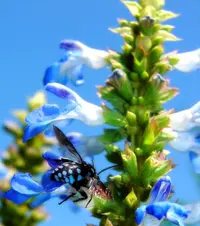
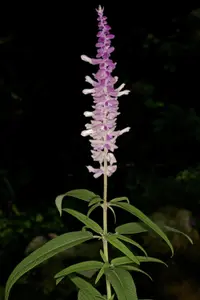
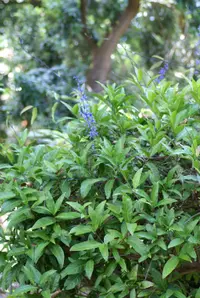
Bog sage, Salvia uliginosa, is a tall, upright perennial herb from wet habitats in South America, especially Argentina and Brazil. It forms loose clumps of square stems with narrow, slightly serrated leaves and airy spikes of clear sky-blue flowers that attract bees and butterflies.
In gardens it is often used in borders or near ponds where soil stays evenly moist. It tends to spread by rhizomes, so it can fill space over time. With its tolerance of damp ground, fast growth, and strong flowering, it is generally easy to grow if given enough sun and moisture, which simplifies how to care for Bog sage.

Care Difficulty
Easy Care

Light Preference
Full Sun

Water Requirements
Keep Soil Moist

Temperature Preference
Warm Climate

Hardiness Zone
6–9

Soil Texture
Loamy, Silty, Organic-rich

Soil pH
Acidic (5.5–6.5), Slightly acidic (6.5–7.0)

Soil Drainage
Moist but well-drained

Fertilization
Minimal (feed rarely)
Scan your plant to receive care tips personalized for your specific plant
Available on iOS and Android
This moisture-loving perennial thrives in bright conditions with generous direct sun.
This species prefers consistently moist soil but not stagnant, airless conditions.
This plant grows best in mild to warm climates with cool winters and is sensitive to hard freezes.
This species handles a wide humidity range and rarely needs special humidity management outdoors.
Salvia uliginosa prefers consistently moist, well-aerated soil that does not stay waterlogged.
This species can grow successfully in containers if the pot is large, stable, and drains very efficiently.
Salvia uliginosa responds well to modest feeding during the active growing season in average garden soil.
Pruning keeps Salvia uliginosa flowering well and prevents tall stems from flopping.
This moisture-loving perennial is more often grown in the ground, where it spreads gradually and may need dividing or relocating.
Salvia uliginosa is commonly propagated by division, stem cuttings, and sometimes seeds.
In many temperate regions, Salvia uliginosa is herbaceous, dying back to the ground and resprouting from its roots in spring.

Plant Health Check
Not sure what's wrong with your plant? Check your plant's health inside the app.
This species is naturally found in marshes, wet meadows, and along pond margins in southern Brazil, Uruguay, and Argentina, where its roots tolerate periodic flooding that would kill many other sages.
Its flowers are an unusually clear sky blue, a pigment combination that is relatively rare among salvias and makes it valuable in breeding programs focused on blue-flowering ornamental sages.
The plant expands through shallow rhizomes, forming loose colonies over time, which allows it to track shifting wet spots and stabilize soft, waterlogged soils.

In suitable conditions this species can host large numbers of nectar-feeding insects at once, and observational studies in gardens and public plantings have noted that it may attract a wider mix of bees, hoverflies, and butterflies than many other commonly grown salvias.
Poor flowering usually comes from too little sun, excess shade from nearby plants, low soil nutrients, or overfertilizing with high-nitrogen products. Deadhead spent flower spikes and avoid hard pruning in early summer, which can remove developing buds.
Keep your plants happy and healthy with plant identification, disease detection, and easy care guidance.