eared watermoss Care (Salvinia auriculata)

eared watermoss

About eared watermoss

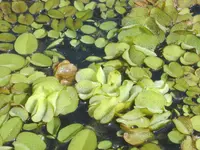
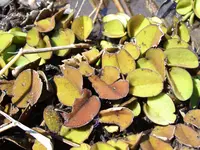
Eared watermoss, Salvinia auriculata, is a small floating fern often used in aquariums, ponds, and water gardens. It forms dense, soft mats on the water surface. The plant has paired, oval leaves with a velvety texture and tiny hair-like structures that repel water. Under the surface, it produces finely divided, root-like structures that help it absorb nutrients directly from the water. Salvinia auriculata is native to warm regions of Central and South America but is now found in many tropical and subtropical areas. It grows quickly and can become invasive in ideal conditions, which makes it easy to start but important to manage. To care for eared watermoss, provide calm water, stable warmth, and moderate to bright indirect light.

Main Plant Requirements

Care Difficulty

Moderate Care

Light Preference

Partial Shade

Water Requirements

Aquatic

Temperature Preference

Tropical / Frost Sensitive

Hardiness Zone

10–12

Soil Texture

Organic-rich, Silty

Soil pH

Acidic (5.5–6.5), Slightly acidic (6.5–7.0)

Soil Drainage

Waterlogged tolerant

Fertilization

Minimal (feed rarely)

Get Personalized Care Plan

Scan your plant to receive care tips personalized for your specific plant

Available on iOS and Android

How to Care for the eared watermoss

This floating fern prefers bright, gentle light that mimics sun over shallow water.

  • Provide 4–6 hours of bright, indirect light or soft morning sun; protect eared watermoss from strong midday and afternoon sun to avoid leaf scorch.
  • Allow dappled or partial shade for the rest of the day; plants can tolerate heavier shade but will grow slower and produce smaller leaves.
  • In summer, use filtered light under taller plants; in cooler seasons, ensure it is not fully shaded all day to maintain compact, healthy growth.

This species must stay fully aquatic, with foliage floating on the water surface at all times.

  • Use clean, still or gently moving water; avoid strong currents that flip or submerge the floating rosettes of Salvinia auriculata.
  • Watch plant color and buoyancy: pale, dry, crisping leaves indicate low water level or excessive evaporation; dark, decaying mats suggest poor water quality or stagnation.
  • In warm seasons, top up water frequently to offset evaporation; in cooler months, maintain level but reduce nutrient input to prevent dense, suffocating growth.

This warm-water fern thrives in stable, mild to warm conditions without frost exposure.

  • Aim for 72–82°F (22–28°C) for fastest growth; it can cope with 68–86°F (20–30°C) but growth slows near the edges of this range.
  • Protect from cold: below about 59°F (15°C) growth declines, and short dips under 50°F (10°C) can cause severe damage or dieback.
  • In hot spells above 86°F (30°C), provide partial shade and good water volume; avoid shallow, overheated pools that can stress and brown the foliage.

This floating fern needs high ambient humidity to keep leaf surfaces and water levels stable.

  • Aim for 70–100% humidity around the tank or pond, as dry air quickly dehydrates the delicate leaf hairs.
  • Crisping, curling, or browning of leaf edges and shrinking mats indicate humidity stress or excessive evaporation.
  • Use covered aquariums, nearby trays of water, or room humidifiers to support eared watermoss in drier indoor air.

This species grows free-floating and does not root into soil, so the water body replaces a traditional substrate.

  • Provide still or very slow-moving water with a soft, organic detritus layer rather than dense mineral soil, so fronds stay at the surface.
  • Aim for slightly acidic to neutral conditions, around pH 6.0–7.5, avoiding strongly alkaline or polluted water that damages leaf tissue.
  • Maintain low to moderate dissolved nutrients from fish waste or diluted aquatic fertilizer instead of rich mud that promotes algae over Salvinia auriculata.
  • Skim excess debris and decaying matter to keep the water column oxygenated and prevent mats from becoming waterlogged and sinking.

This fern is well suited to containers as a free-floating aquatic plant.

  • Choose wide, shallow tubs or bowls so the plant can spread as a surface mat rather than stacking in thick, shaded layers.
  • Avoid strong surface agitation from filters or fountains, which can flip the fronds and prevent them from floating correctly.
  • Use dark, stable containers outdoors to reduce light reflection and wind disturbance that might break or scatter the floating mats.

This floating fern grows well with only light feeding in controlled ponds or aquaria.

  • Use a very dilute balanced liquid fertilizer (for example 1/4-strength 10-10-10) in nutrient-poor water during the warm growing season.
  • Apply no more than every 4–6 weeks, monitoring for dark, overly lush growth or algae blooms as a sign of excess nutrients.
  • Skip feeding in winter or when growth slows, especially in unheated tanks or outdoor tubs.
  • For caring for eared watermoss, prioritize stable water quality over heavy nutrient dosing to prevent rot and invasive spread.

Pruning helps keep Salvinia auriculata from forming overly dense mats that reduce water circulation.

  • Thin out crowded, overlapping fronds during the main growing season to maintain light penetration and gas exchange at the water surface.
  • Remove all dead, yellowing, or damaged fronds with fine aquarium scissors or by gently hand-picking them from the mat.
  • Lift and discard entire clumps from fast-spreading areas to control size and keep an open, manageable shape.
  • Collect and remove all fragments from the water after pruning so unwanted pieces do not root and spread downstream.

This species is a free-floating aquatic fern, so transplanting rather than traditional repotting is the main task.

  • Move plants when they form thick rafts, shading other species or slowing water movement, or when growth stalls despite good nutrients and light.
  • Transplant in late spring to late summer, when water temperature is stable and plants are actively producing new fronds and roots.
  • Gently lift sections by hand or with a fine net, then place them onto the surface of the new pond, tub, or aquarium without burying roots.
  • Reduce stress by matching temperature, pH, and water hardness between old and new locations, and avoid sudden changes in water flow.

Salvinia auriculata is typically propagated vegetatively through division of floating mats.

  • Best results come in late spring to summer, when water is warm and plants are producing vigorous new growth.
  • Separate healthy clumps by gently pulling or cutting interconnected stems, keeping several fronds and roots on each piece.
  • Place divisions to float freely on still or slow-moving water with bright, indirect light and moderate nutrients.
  • Seed production is unreliable in cultivation, so most growers rely on division rather than sexual reproduction.

This tropical floating fern is frost sensitive and needs protection in cold climates.

  • In regions below about 50°F in winter, shift plants from outdoor ponds into indoor aquaria or heated tubs before the first frost.
  • Maintain water at 68–77°F with good light to keep small overwintering populations alive until spring.
  • In mild, frost-free areas, growth slows but plants can remain outdoors if water temperature stays stable and above freezing.

Care Tips

Surface Coverage Control

Regularly remove excess fronds so the plant covers no more than about 70–80% of the water surface, which maintains gas exchange and prevents oxygen depletion for fish and beneficial bacteria.

Flow and Circulation Management

Position the plant in areas with gentle water movement and use baffles, filter sponges, or floating rings to reduce strong surface agitation that can damage the delicate leaves.

Nutrient Load Balancing

In heavily stocked aquariums or ponds, thin the plant more often to prevent it from locking up too many nutrients, and in low-nutrient setups consider leaving a thicker mat so it can help stabilize water chemistry.

Light Access Zoning

Create open patches in the floating mat above submerged plants or equipment so light can reach below and to keep heaters, filters, and sensors from being shaded or blocked.

Quarantine and Rinse

Before adding new material, quarantine it in a separate container for 7–10 days and gently rinse under conditioned water to reduce hitchhiking snails, algae, and pests, which simplifies caring for eared watermoss in shared aquariums.

Common Pests and Diseases

Azolla weevils

This pest consists of small aquatic beetles (mainly Stenopelmus species) that chew floating leaves and young buds, leaving a lace-like appearance. Symptoms include rapid defoliation of mats in warm, still ponds or tanks.

Solution

Remove heavily infested plant sections and skim affected fragments from the water surface. For larger outdoor setups, encourage fish that browse insects, and reduce dense surface mats to limit habitat; in indoor or small containers, manual removal and refreshing part of the water are usually enough for Salvinia auriculata care instructions.

Aquatic snails

These pests feed on soft young fronds and meristems, causing ragged holes and distorted new growth. Symptoms include thinning mats where snails are present and visible grazing marks along leaf edges.

Solution

Physically remove snails and egg clutches, and reduce hiding spots by thinning plant masses and debris. In larger outdoor ponds, introduce snail-eating fish where appropriate; in tanks, use manual removal and traps rather than chemical snail killers that may harm the plant and other aquatic life.

Spider mites

These insects can appear when eared watermoss is grown in very warm, dry indoor conditions with partially exposed leaves. Symptoms include fine webbing, pale stippling, and dull, dusty-looking fronds above the waterline.

Solution

Rinse foliage gently but thoroughly under running water or with a hand sprayer, repeating every few days to break the life cycle. Increase ambient humidity over the water surface, improve air movement, and, if needed, use an insecticidal soap labeled for aquatic or riparian use, applied carefully to emergent foliage only and followed by a partial water change.

Algal overgrowth

This issue occurs when filamentous or planktonic algae outcompete the plant under high nutrients and strong light. Symptoms include green slime or cloudy water around the fronds, slowed growth, and plants that begin to yellow or fragment.

Solution

Reduce nutrient load by cutting back on fish feeding, performing partial water changes, and removing decaying organic matter. Manually remove excess algae, shade part of the water surface, and maintain a moderate, stable mat of Salvinia rather than letting it cover 100% of the surface to balance light and nutrient use.

Bacterial leaf blight

This disease appears in crowded, stagnant conditions where water quality is poor. Symptoms include water-soaked brown spots spreading across fronds, tissue collapse, and rapid decay of affected patches.

Solution

Promptly remove and discard all discolored or slimy plant material, then perform a substantial partial water change to dilute bacteria and organic load. Improve water circulation and avoid over-fertilization; maintain thinner, well-aerated mats, and if the outbreak is severe, restart with a small amount of healthy, rinsed stock in clean water.

Interesting Facts

Water‑repellent leaf hairs

The upper leaf surface bears dense, forked hairs that trap air and strongly repel water, keeping the leaf dry and buoyant even when submerged briefly.

Chain‑forming floating mats

Its floating stems branch and link together into long chains, forming dense surface mats that shade the water and can significantly reduce underwater light levels.

Vegetative spread dominance

Although it produces spores, this species spreads mainly through fragmentation of its floating stems, which allows rapid clonal expansion in calm, nutrient‑rich waters.

Botan icon

Did you know?

This species is one of the so‑called Salvinia molesta complex, a closely related group that is taxonomically challenging, and molecular studies have been used to help separate true Salvinia auriculata from its invasive relatives.

FAQs about eared watermoss

This species spreads very quickly by fragmentation, forming dense mats that can cover the water surface. Regular thinning is essential, especially in outdoor ponds, to maintain light penetration and oxygen exchange for fish and submerged plants.

Grow Healthy Plants with Botan Care

Keep your plants happy and healthy with plant identification, disease detection, and easy care guidance.

Botan plant care app — identify plants on mobile

Explore More Plants