common goldenthistle Care (Scolymus hispanicus)

Also known as: Spanish oyster thistle, Spanish Oysterplant
common goldenthistle

About common goldenthistle

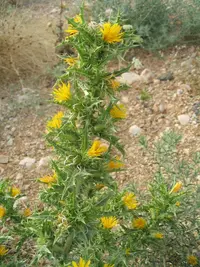
Common goldenthistle (Scolymus hispanicus) is a spiny, herbaceous perennial often grown as a hardy, drought-tolerant ornamental and traditional wild vegetable. It forms upright clumps with stiff, winged stems, sharp leaf spines, and bright yellow, thistle-like flower heads that attract pollinators.

This species is native to the Mediterranean region and thrives in dry, open fields, roadsides, and disturbed soils. It usually prefers full sun, well-drained soil, and low to moderate moisture.

Its tough, deep root system and tolerance of poor soils make it relatively easy to establish, but the strong spines can make handling and maintenance less convenient. Gardeners who understand how to care for common goldenthistle can use it in low-water, naturalistic plantings and edible landscapes.

Main Plant Requirements

Care Difficulty

Easy Care

Light Preference

Full Sun

Water Requirements

Low Water

Temperature Preference

Warm Climate

Hardiness Zone

7–10

Soil Texture

Sandy, Loamy, Rocky

Soil pH

Slightly acidic (6.5–7.0), Neutral (7.0)

Soil Drainage

Well-drained

Fertilization

Minimal (feed rarely)

Get Personalized Care Plan

Scan your plant to receive care tips personalized for your specific plant

Available on iOS and Android

How to Care for the common goldenthistle

Scolymus hispanicus thrives in bright, open sites with strong sun exposure in the ground.

  • Provide 6–8 hours of direct sun daily; full sun promotes compact growth and sturdy stems.
  • Plant where it receives morning to early-afternoon sun; light afternoon shade helps in very hot, dry regions to reduce leaf scorch.
  • The plant tolerates light partial shade (around 3–4 hours sun), but flowering of common goldenthistle decreases and stems may elongate if shade is too heavy.

This deep-rooting species prefers infrequent, thorough watering once established.

  • Water when the top 3–5 cm of soil feel dry and loose; in the field this often means longer gaps between waterings rather than frequent light splashes.
  • Use well-drained, sandy or loamy soil; standing water or compacted clay encourages root rot and yellowing leaves, especially after rain or irrigation.
  • Reduce watering in cool seasons to prevent soggy soil; wilting with dry, crumbly soil signals underwatering, while soft, yellowing foliage with wet soil suggests overwatering for Scolymus hispanicus.

This Mediterranean species favors mild to warm conditions and tolerates moderate heat once established.

  • Ideal growing temperatures are about 65–80°F (18–27°C), which support steady vegetative growth and flowering.
  • Mature plants tolerate brief drops near 25–28°F (-4 to -2°C), but repeated hard frosts can damage leaves and young shoots.
  • In hot summers above 90°F (32°C), growth may slow; mulch the soil to moderate root temperature and reduce stress during prolonged heat.

This Mediterranean thistle handles low atmospheric moisture and rarely needs special humidity management.

  • Target a broad range around 30–50% relative humidity, which matches most outdoor and household conditions.
  • Dry indoor air is usually tolerated, but prolonged heat with very low humidity can cause leaf tip browning and faster wilting.
  • If air is extremely dry during hot spells, group pots together and mulch the soil surface to reduce moisture loss from common goldenthistle.

This species prefers lean, well-drained mineral soils and is sensitive to waterlogged conditions.

  • Use a sandy or sandy-loam mix, such as 2 parts coarse sand, 1 part loam, and 1 part compost to provide both drainage and moderate fertility.
  • Aim for slightly alkaline to neutral pH, roughly 7.0–8.0, which matches many calcareous or lime-influenced garden soils.
  • Improve aeration in heavy or clayey ground by working in coarse sand or fine gravel rather than large amounts of peat-rich material.
  • Avoid compacted, boggy, or high-organic potting mixes that stay wet for long periods, as roots of Scolymus hispanicus are prone to rot in saturated substrates.

This species can be grown in containers if the pot is deep and drainage is managed carefully.

  • Select a tall, heavy pot so the deep taproot has room and the plant remains stable against wind.
  • Fill the container with a gritty mix and place a coarse layer of gravel above the drainage holes to prevent fine particles from clogging them.
  • Position the container where runoff can drain freely, since trapped saucer water around the base quickly saturates the root zone.

This Mediterranean perennial grows on poor soils, so common goldenthistle benefits from modest, not heavy, fertilization.

  • Use a light application of compost or a balanced slow‑release fertilizer (around 10‑10‑10) in early spring as new growth starts.
  • Feed in-ground plants only once per growing season; container plants can receive diluted liquid feed every 4–6 weeks.
  • Dilute liquid fertilizer to 1/2 strength to avoid excess nitrogen, which can reduce root quality and make growth weak.
  • Stop feeding in late summer so Scolymus hispanicus can harden off naturally before winter dormancy.

Pruning Scolymus hispanicus is mainly about tidying and managing spread rather than shaping.

  • Cut back spent flower stalks in late summer to reduce unwanted self-seeding and keep the plant compact.
  • Remove dead, damaged, or diseased leaves and stems with clean hand pruners to limit pests and rot.
  • Thin crowded rosettes lightly if plants compete for light, leaving strong, healthy crowns in place.
  • Wear gloves and long sleeves when cutting spiny parts to avoid injury, and dispose of sharp debris carefully.

This deep‑rooted species is usually grown in open ground, so focus on careful transplanting rather than frequent repotting.

  • Transplant young plants in early spring or early fall, when temperatures are mild and soil is evenly moist.
  • Move plants only if necessary; mature Scolymus hispanicus resents disturbance due to its strong taproot.
  • Choose a sunny, well‑drained site and dig a generous, deep hole so the taproot can sit straight without bending.
  • Water thoroughly after transplanting, then keep soil slightly moist for 1–2 weeks to limit root stress and help re‑establishment.

Propagation of Scolymus hispanicus is usually done from seed rather than vegetative methods.

  • Sow fresh seeds in late winter to early spring, indoors or under cover, for better germination.
  • Use a sandy, well‑drained seed mix and keep it lightly moist at 65–75°F with good light.
  • Cover seeds very lightly or just press into the surface, since exposure to some light can aid germination.
  • Transplant seedlings outdoors once frost risk has passed and roots fill the plug but before a strong taproot develops.

This hardy Mediterranean perennial tolerates moderate frost in well‑drained soil and usually needs little winter care in mild climates.

  • In zones with wet winters, ensure sharp drainage to prevent root rot in cold, saturated soil.
  • Apply a 3–5 cm mulch around, but not on, the crown in colder regions to buffer freeze–thaw cycles.
  • For container plants in areas below about 20°F, move pots to a sheltered, unheated but frost‑free space.

Care Tips

Thorn‑safe harvesting

Use thick gloves and long sleeves when cutting young shoots or leaves, and always cut slightly above a node so the plant can resprout cleanly without tearing the spiny stems.

Progressive flower removal

If the goal is tender edible stems rather than seed, remove developing flower heads in stages through the season to direct energy back into vegetative growth and reduce plant exhaustion.

Targeted staking method

Install short individual stakes or a low ring support early in the season to keep the spiny rosettes and stems upright, which improves air movement and makes later maintenance and harvest safer and easier.

Seed bank control

Deadhead spent flower heads before seed release and collect any dry heads in a bag when cutting, which limits unwanted self‑seeding and keeps Scolymus hispanicus care manageable in small gardens.

Rotational bed placement

Rotate planting sites every 2–3 years and avoid replanting in the same bed as other deep‑rooted Asteraceae, which helps break pest and disease cycles and supports healthier plants when growing common goldenthistle.

Common Pests and Diseases

Aphids

This pest often colonizes young stems, flower stalks, and leaf undersides, sucking sap and excreting sticky honeydew that can attract sooty mold. Symptoms include curling or distorted new growth and the presence of small soft-bodied insects in clusters.

Solution

Dislodge colonies by spraying the plant thoroughly with a strong jet of water, then, if needed, apply insecticidal soap or a light horticultural oil, making sure to coat leaf undersides and stems. Encourage natural predators such as lady beetles by avoiding broad-spectrum insecticides and maintaining plant diversity around the patch when growing common goldenthistle.

Leaf miners

These insects create winding, pale tunnels inside the leaves as larvae feed between leaf surfaces. Symptoms include serpentine trails and blotches that cause cosmetic damage and can reduce vigor in heavily affected plants.

Solution

Remove and destroy mined leaves as soon as damage is noticed to interrupt the life cycle. For repeated problems, use floating row covers early in the season to exclude egg-laying adults and, if necessary, apply a targeted systemic or translaminar product labeled for leaf miners, following label directions carefully.

Downy mildew

This disease affects foliage during cool, humid periods, causing yellow patches on the upper surface and grayish or whitish fuzzy growth on the undersides. Symptoms include leaf blotching, distortion, and premature leaf drop in severe cases.

Solution

Improve airflow by spacing plants properly and reducing overhead watering, preferably irrigating at soil level in the morning. Remove and discard affected leaves, avoid working among wet plants, and, in persistent cases, use an appropriate copper-based or other labeled fungicide as a protective spray during high-risk weather.

Powdery mildew

This disease develops on leaves and stems as a white, powdery coating, often starting on older foliage. Symptoms include dull, discolored leaves that may yellow, curl, and dry prematurely under continued infection.

Solution

Increase sun exposure where possible and avoid excess nitrogen fertilization, which can promote tender, susceptible growth. Remove heavily infected foliage and apply a labeled fungicide such as sulfur, potassium bicarbonate, or horticultural oil at the first sign of infection, ensuring thorough coverage of both leaf surfaces.

Rust

This disease appears as small orange, yellow, or brown pustules on leaf undersides, sometimes matched by pale spots above. Symptoms include gradual yellowing and weakening of foliage when infections are heavy or recurrent.

Solution

Promptly remove and dispose of affected leaves to lower spore levels and avoid overhead watering that keeps foliage wet for long periods. Where rust recurs, rotate crops away from heavily infested beds for a season, and consider preventive fungicide sprays labeled for rust on similar leafy vegetables or thistle relatives during favorable conditions.

Interesting Facts

Traditional Spanish vegetable

In parts of Spain, especially in the Madrid region and Extremadura, the blanched young leaf stalks and roots are traditionally eaten as a seasonal wild vegetable, prepared in stews and omelettes.

Mediterranean disturbance specialist

This species is strongly associated with disturbed ground such as field margins, fallows, and road verges in Mediterranean climates, where it benefits from tillage and open, sunny conditions.

Sharp but edible bracts

The flower heads are surrounded by stiff, spiny bracts that protect them from grazing animals, yet people selectively harvest the tender inner parts, an example of how to take care of common goldenthistle when foraging it from the wild.

Botan icon

Did you know?

The plant has a long history as a famine and wartime food in parts of the western Mediterranean, where knowledge of how to collect, peel, and cook its spiny shoots was passed down locally and helped rural communities supplement scarce crops in poor harvest years.

FAQs about common goldenthistle

Yes, this species is edible and traditionally used as a wild vegetable in parts of the Mediterranean. Young leaves, shoots, and peeled roots are most commonly eaten, usually cooked to reduce bitterness and soften the fibrous tissues.

Grow Healthy Plants with Botan Care

Keep your plants happy and healthy with plant identification, disease detection, and easy care guidance.

Botan plant care app — identify plants on mobile

Explore More Plants