Encourage Dense Mats
Plant several cuttings close together in shallow trays or crevices, then lightly pinch back overly tall stems once to encourage a tight, ground-hugging cushion rather than sparse, leggy growth.

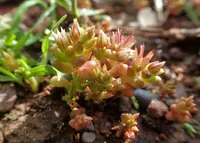
Reddish stonecrop (Sedum rubens) is a small, low-growing succulent that forms loose mats or patches of fleshy, round leaves. The foliage often shows pink to red tones, especially in bright light or dry conditions.
It is native to parts of Europe and the Mediterranean region, where it grows on rocky slopes, walls, and thin, dry soils. This background makes it quite tolerant of drought and poor substrates.
Sedum rubens is generally easy to handle for beginners who want to care for Reddish Stonecrop, as long as it receives plenty of light and well-drained soil. Its slow, compact growth habit suits rock gardens, troughs, and small containers.

Care Difficulty
Easy Care

Light Preference
Full Sun

Water Requirements
Low Water

Temperature Preference
Warm Climate

Hardiness Zone
7–10

Soil Texture
Sandy, Loamy, Rocky

Soil pH
Slightly acidic (6.5–7.0), Neutral (7.0)

Soil Drainage
Well-drained

Fertilization
Minimal (feed rarely)
Scan your plant to receive care tips personalized for your specific plant
Available on iOS and Android
This small succulent thrives in bright, open exposures typical of rock gardens and dry slopes.
This drought-tolerant succulent prefers infrequent, deep watering and fast-drying soil.
This species is adapted to warm, dry summers and cool, not severely cold, winters.
Humidity is rarely a concern for Sedum rubens, which is adapted to dry air in most homes and outdoor settings.
Sedum rubens needs very sharply drained, lean soil to prevent root and stem rot.
This species is well suited to container growing, especially in shallow, well-drained pots.
Sedum rubens needs only light feeding to maintain compact, healthy growth in poor, well-drained soils.
Sedum rubens benefits from light, periodic pruning to keep mats dense and tidy.
This species is usually grown in rock gardens or shallow containers and only needs infrequent repotting or transplanting.
Sedum rubens is commonly multiplied from small stem or leaf pieces and by division of mature clumps.
This low succulent is fairly cold tolerant in well-drained sites and usually needs minimal winter care outdoors.

Plant Health Check
Not sure what's wrong with your plant? Check your plant's health inside the app.
This species often behaves as a spring ephemeral in Mediterranean climates, completing much of its growth and flowering in late winter to spring, then shriveling and retreating to seeds and resting buds as summer drought intensifies.
Sedum rubens naturally favors calcareous substrates such as limestone walls, mortar, and rocky outcrops, where it exploits narrow crevices with very thin, alkaline, and nutrient-poor soils.
Its characteristic red tones are caused by anthocyanin pigments that increase under high light, cold, or drought, helping protect the succulent tissues from excess radiation and oxidative stress.

Sedum rubens is one of the native stonecrop species that has spontaneously colonized old human-made stone structures across southern Europe and the Mediterranean, making it a notable component of ancient wall and ruin floras where it can persist for many decades in tiny crevices.
This species forms small, low, mat-like patches that slowly widen through short stems and self-seeding. It is not usually considered aggressive and is easy to keep contained with edging or occasional lifting and thinning of clumps.
Keep your plants happy and healthy with plant identification, disease detection, and easy care guidance.