Staggered planting
Plant tuber pieces in 2–3 batches spaced 2–3 weeks apart to spread harvest time and reduce the risk of losing the entire crop to an unexpected early frost.

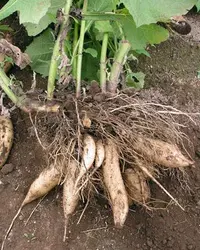
Yacón, Smallanthus sonchifolius, is a perennial root crop from the Andes, grown mainly for its crisp, sweet, tuberous roots. Above ground, it forms tall, leafy stems with broad, slightly rough leaves and small yellow sunflower-like blooms late in the season.
In mild climates it behaves as a long-season perennial, while in cooler regions it is usually grown as a tender annual from tubers or crowns. It prefers full sun, moderate moisture, and loose, well-drained soil.
The plant is generally forgiving, but needs a long, frost-free growing period and enough space for its roots to bulk up. Once these basics are met, it is relatively straightforward to care for Yacón.

Care Difficulty
Moderate Care

Light Preference
Full Sun

Water Requirements
Regular Water

Temperature Preference
Tropical / Frost Sensitive

Hardiness Zone
8–11

Soil Texture
Loamy, Sandy, Organic-rich

Soil pH
Acidic (5.5–6.5), Slightly acidic (6.5–7.0)

Soil Drainage
Moist but well-drained

Fertilization
Moderate (every 2–4 weeks)
Scan your plant to receive care tips personalized for your specific plant
Available on iOS and Android
This tuber-forming Andean crop needs strong but not harsh sun for good yields.
This species prefers consistently moist, well-drained soil rather than strict wet-dry cycles.
This crop grows best in warm, frost-free conditions with a long growing season.
Humidity plays a minor role for Smallanthus sonchifolius, which adapts well to typical outdoor conditions.
Smallanthus sonchifolius forms large, crisp tubers only in loose, deep, well-drained soil.
This species can be grown in containers if the pot is large, deep, and very stable.
This tuber-forming crop benefits from moderate, steady nutrition during its active growing season.
Smallanthus sonchifolius needs only light pruning to maintain healthy, productive growth.
This species is usually grown in beds, so care focuses on field transplanting rather than frequent repotting.
This crop is most commonly propagated from tuber pieces rather than from seed for reliable traits and yield.
This frost-tender perennial needs specific winter management in cooler climates to keep planting material viable.

Plant Health Check
Not sure what's wrong with your plant? Check your plant's health inside the app.
This species forms crisp, sweet-tasting storage roots that are eaten raw or cooked and are unusually rich in inulin-type fructooligosaccharides, a form of carbohydrate that is only partly digested by humans.
The plant was domesticated in the Andes of Peru and Bolivia, where it has been grown for centuries as a traditional root crop alongside other Andean staples such as potatoes and oca.
Its roots can taste noticeably sweeter after exposure to sunlight post-harvest, because complex carbohydrates in the tissue convert into simpler sugars over time.

The leaves of this plant are used in agronomic research as a natural source of low-calorie sweetening compounds, since extracts rich in fructooligosaccharides can impart sweetness without contributing as many digestible sugars as common table sugar.
Yes, the tuberous roots are edible and often eaten raw for their crisp, sweet, mildly fruity taste. Stems and leaves are not usually consumed. Roots are low in calories and rich in inulin-type fructooligosaccharides.
Keep your plants happy and healthy with plant identification, disease detection, and easy care guidance.