Install sturdy support
Provide strong, long-lasting trellis panels or tensioned wire along fences, as the long, heavy vines and woody stems need rigid support to prevent stem kinking and wind damage over time.

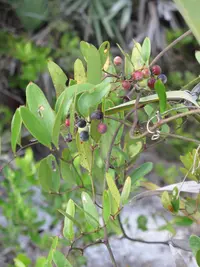
Laurel greenbrier (Smilax laurifolia) is a woody, evergreen vine native to wetlands and swamps in the southeastern United States. It often forms dense, tangled thickets in its natural habitat.
The plant has glossy, leathery, laurel-like leaves and tough, climbing stems that may bear sharp prickles. Small, inconspicuous flowers are followed by dark berries that attract wildlife.
It is adapted to moist, acidic, often poorly drained soils and tolerates periodic flooding, which influences how easy it is to grow outside its native conditions. Understanding these wetland preferences helps guide how to care for laurel greenbrier in gardens or restoration plantings.

Care Difficulty
Moderate Care

Light Preference
Partial Shade

Water Requirements
Aquatic

Temperature Preference
Warm Climate

Hardiness Zone
7–10

Soil Texture
Loamy, Silty, Organic-rich

Soil pH
Strongly acidic (4.5–5.5), Acidic (5.5–6.5)

Soil Drainage
Waterlogged tolerant

Fertilization
Minimal (feed rarely)
Scan your plant to receive care tips personalized for your specific plant
Available on iOS and Android
This wetland vine prefers bright, soft light that mimics open, swampy woods.
This species is naturally adapted to consistently moist, even boggy soils.
This vine prefers warm, humid conditions but tolerates a moderate range.
This vine tolerates a wide humidity range but benefits from moderately moist air.
This species prefers consistently moist, organic-rich, slightly acidic soil that does not dry out completely.
This species can be grown in containers if the pot is deep, stable, and kept consistently moist.
This native vine grows in poor soils and usually needs minimal feeding when grown in the ground.
Smilax laurifolia benefits from light, targeted pruning to manage size and maintain access around the planting area.
This species is usually grown in the ground, so management focuses on careful transplanting rather than frequent repotting.
Smilax laurifolia is slow and somewhat challenging to propagate, so it is not frequently multiplied in home gardens.
This evergreen vine is cold hardy in much of its native range and usually needs little special winter care in the ground.

Plant Health Check
Not sure what's wrong with your plant? Check your plant's health inside the app.
This species is an unusual combination of woody vine and shrub, forming dense, evergreen tangles in wet pine flatwoods, pocosins, and swamp margins of the southeastern United States.
Its long stems contain air-filled tissues that increase buoyancy, allowing the plant to sprawl over shrubs and small trees and even float when growing along flooded habitats.
Thickets of this species provide critical shelter and nesting structure for birds, small mammals, and reptiles in coastal plain wetlands, often forming one of the densest natural cover layers in these ecosystems.

This species is so strongly associated with acidic, nutrient-poor wetlands like Carolina bays and pocosins that its presence is often used by ecologists as an indicator of these specialized and increasingly rare habitat types.
This species is a woody vine that both climbs and sprawls. It climbs by using tendrils to hook onto nearby shrubs, trees, or structures, and also forms dense thickets from underground rhizomes and roots.
Keep your plants happy and healthy with plant identification, disease detection, and easy care guidance.