potato vine Care (Solanum laxum)

Also known as: jasmine nightshade
potato vine

About potato vine

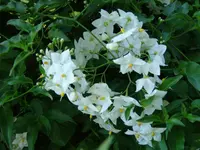
Potato vine, Solanum laxum, is a fast-growing, woody climber often used to cover fences, trellises, and walls. It stays evergreen in mild climates and can be pruned as needed. Clusters of small white star-shaped flowers with yellow centers appear over a long season, followed by decorative but inedible berries. It is native to South America but is now widely grown in warm and temperate regions. This plant is considered relatively easy to grow, as it tolerates pruning and adapts to different garden settings. To care for potato vine, provide a sunny to lightly shaded position, moderately moist, well-drained soil, and a support to climb.

Main Plant Requirements

Care Difficulty

Moderate Care

Light Preference

Full Sun

Water Requirements

Moderate Water

Temperature Preference

Warm Climate

Hardiness Zone

8–10

Soil Texture

Sandy, Loamy, Organic-rich

Soil pH

Acidic (5.5–6.5), Slightly acidic (6.5–7.0)

Soil Drainage

Moist but well-drained

Fertilization

Light (every 4–6 weeks)

Get Personalized Care Plan

Scan your plant to receive care tips personalized for your specific plant

Available on iOS and Android

How to Care for the potato vine

Solanum laxum grows best with bright, gentle sun that avoids the harshest afternoon intensity.

  • Provide 4–6 hours of sun daily, favoring morning sun with light afternoon shade, especially in hot summers.
  • Tolerates partial shade, but flowering on potato vine decreases if it receives less than 3–4 hours of direct or very bright filtered light.
  • In warm climates, give dappled or filtered light in midsummer to prevent leaf scorch, while in cooler seasons it can handle more direct exposure.

This climber prefers evenly moist but not saturated soil, with short dry periods between waterings.

  • Water when the top 3–5 cm of soil feels dry, aiming for deep soakings that reach the root zone rather than frequent light splashes.
  • Ensure soil drains freely; persistent wetness, yellowing leaves, and soft stems indicate overwatering, while limp, curling leaves and very dry soil signal underwatering.
  • In spring and summer, expect to water more often during active growth, then reduce frequency in fall and winter as growth and evaporation slow.

This species thrives in mild, frost-free conditions and reacts poorly to temperature extremes.

  • Ideal growth occurs around 60–75°F (16–24°C), which supports steady foliage and flower production without stress.
  • The plant is damaged by frost; growth slows below about 45°F (7°C) and can be killed if exposed to prolonged temperatures near or below 32°F (0°C).
  • Handles short heat spells up to about 86–90°F (30–32°C) if soil moisture is maintained, but extended higher heat may cause wilting and leaf drop.

This species grows well in typical indoor humidity but benefits from slightly moist air in heated homes.

  • Aim for 40–60% humidity to keep foliage turgid and reduce leaf-edge browning.
  • It tolerates short dry-air spells, but persistent very dry air can cause curled, crisp leaf tips or increased spider mite problems.
  • Increase humidity locally with a nearby pebble tray or grouping plants together rather than misting leaves heavily.

Solanum laxum prefers light, free-draining soil that still holds moderate moisture.

  • Use a loose loam-based mix with 40–50% compost, 30–40% peat-free potting mix, and 10–20% perlite or coarse sand for structure and drainage.
  • Target slightly acidic to neutral pH around 6.0–7.0, avoiding strongly alkaline or saline substrates that restrict nutrient uptake.
  • Improve aeration by including chunky materials such as pine bark fines, which create air gaps around roots and limit compaction over time.
  • Avoid heavy clay, unamended garden soil, or mixes that stay wet for more than 2–3 days, as these promote root rot and weak growth.

This vine is well suited to container growing when the pot supports its vigorous, climbing habit.

  • Choose a wide, heavy container that resists tipping once the top growth climbs a trellis or support wires.
  • Select thick-walled terracotta or similar porous material if extra moisture loss is needed in wet climates, or glazed pots in hot, dry areas to slow drying.
  • Provide a deep pot that allows roots to anchor below any trellis base, improving stability and reducing wind rock around the root zone.

Solanum laxum benefits from moderate feeding to support steady vine growth and flowering.

  • Use a balanced NPK fertilizer (such as 10-10-10) or slow-release granules in spring as new growth starts.
  • Feed every 4–6 weeks through the main growing season, adjusting based on vigor and soil quality.
  • Dilute liquid feeds to 1/2–1/4 strength for container-grown potato vine to prevent salt buildup in the potting mix.
  • Stop fertilizing in late summer or early fall so growth can harden before winter dormancy.

Solanum laxum responds well to thoughtful pruning that controls size and encourages flowering wood.

  • Carry out main pruning in late winter or very early spring before strong new growth starts.
  • Remove dead, damaged, or crossing stems first, then thin congested areas to improve light and airflow.
  • Shorten long, wayward shoots to maintain desired size and support a balanced, climbing framework.
  • Use clean, sharp hand pruners, cutting just above a healthy bud or side shoot at a slight angle.

This vine is more often transplanted outdoors than repotted, but container plants still need periodic attention.

  • Check containers every 2–3 years; crowded roots circling the pot drainage holes and slower growth signal the need for a larger pot.
  • Plan repotting or garden transplanting for early spring, when frosts have passed and active growth is about to begin.
  • Lift the plant gently, tease apart circling roots, and trim broken roots to reduce stress and promote new fine root growth.
  • Replant at the same soil level in a slightly larger pot or prepared ground, water thoroughly, and shade for a few days if conditions are hot.

Solanum laxum is commonly propagated from cuttings for reliable, uniform plants.

  • Take 8–12 cm softwood or semi-ripe stem cuttings in late spring or summer from non-flowering shoots.
  • Remove lower leaves, leaving 2–3 at the top, and dip the cut base in rooting hormone to improve success.
  • Insert cuttings into a free-draining mix, keep evenly moist, and maintain high humidity with a clear cover.
  • Place in bright, indirect light at 65–75°F; roots usually form within several weeks under steady warmth.

Solanum laxum has moderate frost tolerance but benefits from some winter protection in colder regions.

  • In USDA zones around 8, established plants often survive light frosts but may lose top growth in harder freezes.
  • Apply a 5–8 cm mulch layer around the root zone in late fall, keeping it slightly away from the main stems.
  • Move container plants to a bright, cool, frost-free space and reduce watering while growth is slow.

Care Tips

Early framework training

Install a sturdy trellis or wires before the plant puts on strong growth, then loosely tie new shoots with soft ties and fan them out horizontally to create a stable, well-covered framework that is easier to maintain long term.

Seasonal shoot renewal

Each late winter, remove a selection of the oldest, woody stems right down to a strong young shoot or low bud to keep flower production high and prevent the plant from becoming bare at the base.

Root-zone cooling

In hot climates, shade the root area with low groundcovers, mulch, or a light-colored stone layer to keep roots cooler and more evenly moist, which reduces stress and leaf scorch during heat waves.

Targeted wind management

In exposed sites, run horizontal wires and tie in long stems at multiple points rather than just at the base so the vine flexes as one unit in strong winds instead of snapping at single anchor points.

Planned access for pruning

When growing potato vine over fences, arches, or pergolas, leave clear access points or a narrow maintenance corridor so you can safely reach the main stems for periodic pruning, tying-in, and inspection for pests or damage.

Common Pests and Diseases

Spider mites

This pest commonly infests potato vine foliage in warm, dry conditions, causing stippling, dulling, and fine webbing on leaves. Symptoms include gradual yellowing and leaf drop when populations are high.

Solution

Rinse foliage thoroughly with a firm stream of water, including the undersides of leaves, then repeat every few days until mites are reduced. Increase humidity around the plant, remove heavily damaged leaves, and use insecticidal soap or a horticultural oil labeled for mites, applied according to directions and only in cooler parts of the day.

Whiteflies

These insects feed on the underside of leaves, leading to yellowing, weakened growth, and sticky honeydew that can support sooty mold. Infestations are especially common on lush new growth and plants in sheltered, warm spots or greenhouses.

Solution

Shake or tap branches to check for small white insects flying up, then remove heavily infested leaves and use yellow sticky traps to monitor populations. Treat remaining foliage with insecticidal soap or neem oil, ensuring full coverage of leaf undersides, and repeat applications at intervals recommended on the product label.

Aphids

These insects cluster on young shoots, buds, and leaf undersides, sucking sap and causing curling, distortion, and sticky honeydew. Ants may be present, feeding on the honeydew and protecting aphids.

Solution

Prune off heavily infested shoot tips, then hose down the plant to dislodge remaining aphids. Follow with insecticidal soap or a light horticultural oil, applied thoroughly and repeated as needed, and manage nearby ant activity to reduce re‑infestation.

Sooty mold

This disease develops as a black, powdery or velvety coating on leaves and stems, growing on the honeydew secreted by sap-sucking pests such as whiteflies and aphids. Symptoms include reduced photosynthesis, dull foliage, and overall decline if the coating becomes dense.

Solution

Address the underlying insect issue first, then gently wipe or rinse affected leaves with water to remove the fungal growth. Improve air circulation around the plant through pruning and spacing, and avoid overhead watering that keeps foliage wet for extended periods.

Bacterial leaf spot

This disease causes small, water-soaked leaf lesions that may enlarge, turn brown, and sometimes develop a yellow halo, especially during warm, humid weather. Symptoms include scattered spotting and premature leaf drop, starting on lower or crowded branches.

Solution

Promptly remove and dispose of affected leaves and any fallen debris, and avoid wetting foliage when watering. Improve airflow by thinning dense growth, space plants so leaves dry quickly, and if the problem recurs, consider using a copper-based bactericide labeled for ornamental vines, following label instructions closely.

Interesting Facts

Naturally twining climber

This species climbs by twining its young stems around supports rather than using tendrils or adhesive roots, which allows it to weave through shrubs and fences without attaching directly to surfaces.

Nightshade family relative

Solanum laxum belongs to the Solanaceae, the same family as tomato, potato, and eggplant, and shares their typical star-shaped flowers and berry-type fruits, although its fruits are considered ornamental and not grown as food.

Long flowering season

In mild, frost-free climates, this vine can produce clusters of white, star-shaped flowers over many months of the year, often from late spring well into autumn, providing extended nectar resources for pollinating insects.

FAQs about potato vine

Poor flowering usually comes from low light, heavy pruning at the wrong time, or excess nitrogen fertilizer. Provide strong outdoor light, avoid hard cuts in early summer, and use a balanced or low‑nitrogen feed to support buds.

Grow Healthy Plants with Botan Care

Keep your plants happy and healthy with plant identification, disease detection, and easy care guidance.

Botan plant care app — identify plants on mobile

Explore More Plants