Divide Mature Clumps
Every 3–4 years, lift and divide crowded clumps in early spring or early fall to maintain vigor, prevent self-shading, and produce uniform, sturdy plants.

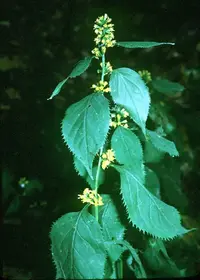
Zigzag goldenrod (Solidago flexicaulis) is a shade-tolerant perennial wildflower native to eastern North America. It naturally grows in woodlands, along forest edges, and in shaded slopes.
The plant forms upright, zigzagging stems with broad, toothed leaves and arching sprays of small yellow flowers in late summer to fall. It spreads slowly by rhizomes, creating loose clumps rather than tight groundcover.
This species is generally easy to grow if given partial shade, average moisture, and reasonably well-drained soil. Its toughness, adaptability, and ability to handle dry shade simplify how to care for zigzag goldenrod in typical garden settings.

Care Difficulty
Easy Care

Light Preference
Partial Shade

Water Requirements
Moderate Water

Temperature Preference
Cold Hardy

Hardiness Zone
3–8

Soil Texture
Loamy, Clay, Organic-rich

Soil pH
Acidic (5.5–6.5), Slightly acidic (6.5–7.0)

Soil Drainage
Moist but well-drained

Fertilization
Minimal (feed rarely)
Scan your plant to receive care tips personalized for your specific plant
Available on iOS and Android
This woodland perennial thrives with bright conditions that mimic dappled forest light.
This species prefers evenly moist, not soggy, soil once established in the garden.
This hardy North American perennial tolerates a wide outdoor temperature range once established.
This species is flexible about air moisture and usually thrives in 30–60% humidity without intervention.
This woodland perennial prefers loose, moderately fertile soil that stays evenly moist yet drains freely.
This species can be grown in containers if the pot setup manages its spreading roots and tall stems.
This native perennial usually needs little feeding, especially in-ground plantings, but light nutrition can support denser growth when growing zigzag goldenrod in lean soils.
Pruning supports neat appearance and sustained flowering on Solidago flexicaulis in garden settings.
This species is more often transplanted in beds than repotted, as it forms spreading clumps outdoors.
Solidago flexicaulis is commonly propagated by division or seed in home gardens.
This is a cold-hardy perennial that usually needs minimal winter care in its outdoor hardiness range.

Plant Health Check
Not sure what's wrong with your plant? Check your plant's health inside the app.
Unlike many goldenrod species that prefer open sunny fields, this plant naturally grows in deciduous forests and performs well in partial to full shade along woodland edges and understories.
The common name zigzag goldenrod comes from its angled stems, which bend slightly at each leaf node and give the flowering stalk a characteristic zigzag growth pattern.
This species flowers late in the growing season and provides an important nectar and pollen source for native bees, wasps, beetles, and butterflies in shaded woodland habitats when few other forest plants are blooming.

Solidago flexicaulis is one of the few goldenrod species that reliably forms stable populations in closed-canopy hardwood forests, making it an important indicator of relatively intact, mesic woodland habitat in parts of eastern North America.
This species spreads by short rhizomes and self-seeding. In average garden conditions it forms loose colonies rather than dense monocultures. In rich, moist soil it can expand more quickly, so divide or thin clumps if needed.
Keep your plants happy and healthy with plant identification, disease detection, and easy care guidance.