Match host trees
Establish the fungus only with compatible larch species (Larix spp.) and avoid mixing with non-host trees, since this mycorrhizal mushroom depends on a close root partnership to form productive colonies.

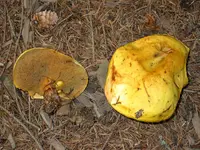
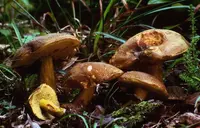
Larch bolete, Suillus grevillei, is a mycorrhizal fungus that forms a close partnership with larch trees rather than growing as a typical garden plant. It produces yellow to orange-brown caps with a slimy surface in wet weather and a sponge-like pore layer underneath instead of gills.
This species naturally occurs in temperate regions where larch is present, especially in Europe and parts of North America, usually appearing in soil around the tree’s root zone. It is considered relatively specialized, since it depends on larch roots, so attempts to care for Larch Bolete at home are usually limited to places where larch trees can grow outdoors.
In nature it favors moist, well-drained, slightly acidic soil and open, light conditions typical of larch stands.

Care Difficulty
Moderate Care

Light Preference
Partial Shade

Water Requirements
Regular Water

Temperature Preference
Cool Climate

Hardiness Zone
2–7

Soil Texture
Loamy, Sandy, Organic-rich

Soil pH
Acidic (5.5–6.5)

Soil Drainage
Moist but well-drained

Fertilization
Minimal (feed rarely)
Scan your plant to receive care tips personalized for your specific plant
Available on iOS and Android
This ectomycorrhizal fungus prefers bright, cool woodland light rather than full, exposed sun.
This species depends on consistently moist, not waterlogged, soil around its host tree roots.
This fungus favors cool to mild conditions typical of temperate larch forests.
This mycorrhizal fungus does not require managed air humidity under typical outdoor conditions.
This ectomycorrhizal mushroom relies on suitable soil around living larch roots rather than a standalone potting substrate.
This species is not suitable for container growing because it requires a living larch host and established soil ecology to form mycorrhizal associations.
Suillus grevillei forms a mycorrhizal partnership with larch trees and usually needs minimal direct fertilization when grown in suitable soil.
Suillus grevillei itself is not pruned; any management focuses on the associated larch host and site hygiene.
This fungus is rarely grown in containers; focus on establishing and transplanting the host larch in suitable, well-drained soil.
Suillus grevillei is not typically propagated in home settings because it depends on a mycorrhizal relationship with larch roots.
This species is naturally cold hardy alongside its larch host and generally needs no special winter care beyond normal tree management.

Plant Health Check
Not sure what's wrong with your plant? Check your plant's health inside the app.
This fungus forms ectomycorrhizal associations almost exclusively with larches (Larix species), meaning its fine root-like filaments wrap around larch roots and exchange mineral nutrients for sugars from the tree.
The cap surface is strongly slimy when wet and ranges from bright yellow to orange-brown, a feature that helps distinguish it from many other bolete mushrooms in mixed conifer forests.
Its yellow stem has conspicuous dark glandular dots that exude a resin-like substance, a diagnostic character mycologists use to separate it from closely related Suillus species.

In several European countries, this species is considered a characteristic indicator of planted or naturalized larch stands, so its presence is sometimes used in field surveys to confirm that inconspicuous young Larix saplings are successfully establishing in a site.
This species is generally considered edible when cooked and is often eaten in some European regions. The cap is preferred; the slimy skin and sponge layer are usually removed. Always avoid specimens from polluted or contaminated areas.
Keep your plants happy and healthy with plant identification, disease detection, and easy care guidance.