

Spore-friendly habitat
Leave a few mature fruiting bodies to age and release spores in place rather than harvesting all of them, so the mycelium can reseed the area and maintain future flushes when growing Sepia Bolete.

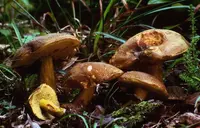
Sepia bolete, Xerocomellus porosporus, is a wild mushroom-forming fungus, not a leafy houseplant. It produces low, stout fruiting bodies with sepia to brown caps and yellowish pores underneath. The stems often show darker spotting and the flesh may slowly discolor when bruised.
This species typically occurs in woodlands and parklands in Europe, often in association with broadleaf trees such as oaks and beeches. It appears on soil and leaf litter, usually in late summer to autumn.
Because it is a mycorrhizal fungus, forming a partnership with tree roots, it is not straightforward to cultivate at home. Attempts to care for Sepia Bolete must account for its dependence on specific host trees and undisturbed soil conditions.

Care Difficulty
Hard Care

Light Preference
Partial Shade

Water Requirements
Keep Soil Moist

Temperature Preference
Cool Climate

Hardiness Zone
Unknown

Soil Texture
Loamy, Organic-rich

Soil pH
Acidic (5.5–6.5), Slightly acidic (6.5–7.0)

Soil Drainage
Moist but well-drained

Fertilization
Minimal (feed rarely)
Scan your plant to receive care tips personalized for your specific plant
Available on iOS and Android
This ectomycorrhizal fungus prefers woodland light conditions rather than full open sun exposure.
This species relies on naturally moist yet free-draining woodland or grassland soils rather than direct irrigation.
This fungus favors mild, temperate climates with moderate seasonal variation.
Humidity is not a meaningful cultivation factor for Xerocomellus porosporus, which develops outdoors in natural ground conditions rather than controlled indoor air.
This ectomycorrhizal fungus requires specific outdoor soil conditions to fruit reliably.
This species is not suitable for container growing because it depends on a stable, long-term association with tree roots in undisturbed ground.
This ectomycorrhizal fungus depends mainly on its tree host, so Sepia Bolete needs little to no direct fertilization.
Xerocomellus porosporus does not require pruning, since it is a wild ectomycorrhizal mushroom rather than a woody or leafy plant.
This species is not suited to normal pot culture, so focus on positioning and soil conditions rather than classic repotting.
Propagation of this bolete is specialized and usually left to natural spore spread and mycorrhizal development rather than home techniques.
This temperate woodland fungus is naturally cold hardy and usually needs no special winter care beyond maintaining a stable habitat.

Plant Health Check
Not sure what's wrong with your plant? Check your plant's health inside the app.
This species has unusually angular, often three- to four-sided spores, which is a key microscopic feature used by mycologists to distinguish it from similar brown boletes.
The cap often develops a fine, mosaic-like cracking pattern as it ages or dries, revealing paler flesh beneath the darker brown surface and giving it a characteristic speckled appearance.
When handled or cut, the pores and flesh may show weak, patchy blue staining rather than a strong uniform color change, which helps separate it from more intensely bluing bolete species.
This bolete is generally regarded as inedible or of very poor culinary value. Identification can be difficult, and confusion with toxic boletes is possible, so foragers are advised not to collect it for food.
Keep your plants happy and healthy with plant identification, disease detection, and easy care guidance.

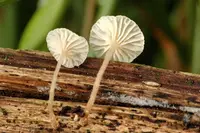
Twig Parachute
Collybiopsis ramealis
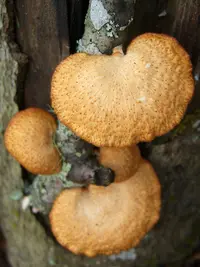
hexagonal-pored polypore
Neofavolus alveolaris
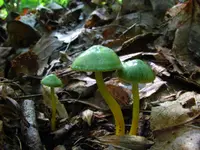
Parrot Mushroom
Gliophorus psittacinus
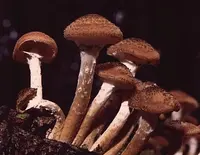
honey mushroom
Armillaria ostoyae
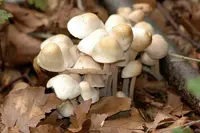
clustered toughshank
Collybiopsis confluens
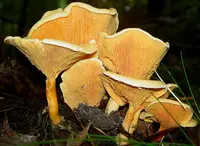
False Chanterelle
Hygrophoropsis aurantiaca
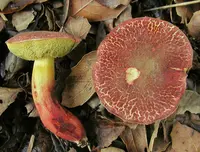
Vejvarut Paphiopedilum
Xerocomellus dryophilus
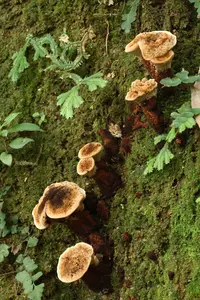
Coltricia montagnei
Coltricia montagnei