Host tree matching
Establish this mycorrhizal fungus only with compatible host trees such as Douglas-fir or other suitable conifers, planting spawn or plugs close to fine feeder roots rather than in open, root-poor soil areas.

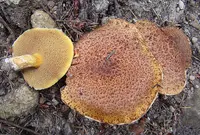
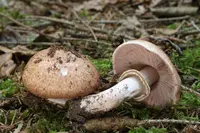
Western painted suillus (Suillus lakei) is a mycorrhizal mushroom that forms a partnership with conifer tree roots, especially Douglas-fir. It is not a houseplant but a forest-dwelling fungus that develops sturdy, reddish-brown caps with a yellowish pore surface underneath instead of gills.
This species typically appears in groups on soil rich in organic matter, often among needles and forest debris. Its growth is strongly tied to the presence of suitable host trees, which makes it difficult to cultivate in regular garden or indoor conditions.
Those who want to learn how to care for Western Painted Suillus need to understand its dependence on living tree roots, cool to mild temperatures, and consistently moist but not waterlogged forest soils.

Care Difficulty
Moderate Care

Light Preference
Partial Shade

Water Requirements
Moderate Water

Temperature Preference
Cool Climate

Hardiness Zone
5–9

Soil Texture
Loamy, Sandy, Organic-rich

Soil pH
Acidic (5.5–6.5), Slightly acidic (6.5–7.0)

Soil Drainage
Moist but well-drained

Fertilization
Minimal (feed rarely)
Scan your plant to receive care tips personalized for your specific plant
Available on iOS and Android
This bolete forms mycorrhizal partnerships with pines and depends on suitable forest light rather than direct garden-style exposure.
This mushroom relies on stable soil moisture around its pine host rather than direct watering of the fungus itself.
This species fruits best in cool to mild conditions typical of conifer forests.
Humidity is not a relevant factor for Suillus lakei, which grows naturally in outdoor conditions.
Suillus lakei thrives in well-aerated, sandy to loamy soil associated with suitable host trees.
This species is not suitable for typical container growing because it depends on forming mycorrhiza with live tree roots in the ground.
Suillus lakei is a wild, mycorrhizal fungus that usually gains nutrients from its host conifer and soil, so added fertilizer is rarely necessary.
Pruning Suillus lakei is not a standard practice, since it is a mushroom forming fungus rather than a woody or leafy plant.
Transplanting focuses on the host tree or container rather than the Suillus lakei fungus itself.
Propagation of Suillus lakei is usually left to natural spore spread in suitable conifer forests, so deliberate propagation is uncommon in home settings.
Western Painted Suillus is naturally cold hardy in its native conifer forests and normally needs no special winter care.

Plant Health Check
Not sure what's wrong with your plant? Check your plant's health inside the app.
This bolete forms ectomycorrhizal partnerships almost exclusively with Douglas-fir (Pseudotsuga menziesii), exchanging mineral nutrients and water for sugars from the tree roots.
The cap is covered by a slimy, reddish to orange-brown skin when fresh, but in dry weather this layer often cracks and peels, giving older specimens a patchy, painted appearance that inspired the common name Western painted Suillus.
Mature fruiting bodies produce a cinnamon-brown spore print, a key diagnostic feature that helps separate it from similar Suillus species in field identification.

Suillus lakei was introduced to parts of Europe and South America along with planted Douglas-fir, and is now used by mycologists as an indicator that this non-native tree has formed established ectomycorrhizal communities in those regions.
This mushroom is considered edible but is not highly valued. The slimy cap cuticle is usually peeled off before cooking. Always confirm identification with an expert, since confusing it with similar species can be risky.
Keep your plants happy and healthy with plant identification, disease detection, and easy care guidance.