arrowhead vine Care (Syngonium auritum)

arrowhead vine

About arrowhead vine

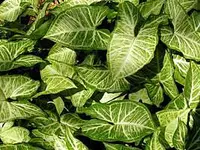
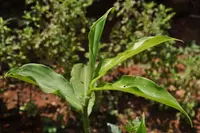
Syngonium auritum, commonly called arrowhead vine, is a tropical climbing aroid grown mainly for its lush, arrow-shaped foliage. It typically starts as a compact, bushy plant, then produces longer vines that can climb or trail when given support.

In nature, it occurs in warm, humid forests of Central and South America, where it grows as an understory plant in dappled light. Its tolerance of indoor conditions, relatively fast growth, and ability to adapt to different light levels make it approachable for many home growers. With moderate light, consistent moisture, and a well-draining potting mix, it is straightforward to care for arrowhead vine.

Main Plant Requirements

Care Difficulty

Moderate Care

Light Preference

Bright Indirect Light

Water Requirements

Moderate Water

Temperature Preference

Tropical / Frost Sensitive

Hardiness Zone

10–12

Soil Texture

Loamy, Peaty, Organic-rich

Soil pH

Acidic (5.5–6.5), Slightly acidic (6.5–7.0)

Soil Drainage

Moist but well-drained

Fertilization

Light (every 4–6 weeks)

Get Personalized Care Plan

Scan your plant to receive care tips personalized for your specific plant

Available on iOS and Android

How to Care for the arrowhead vine

Syngonium auritum prefers bright, indirect light that mimics a forest understory.

  • Provide 6–8 hours of filtered light per day, such as near an east- or north-facing window or under a light tree canopy outdoors.
  • Tolerates partial shade (2–4 hours of dappled light), but very low light causes slow growth, smaller leaves, and stretched stems.
  • Avoid hot midday or afternoon sun, which can bleach or scorch leaves; in winter, move slightly closer to windows to compensate for weaker light.

This species prefers evenly moist but not saturated soil.

  • Water when the top 2–4 cm of soil feels dry, using enough water that excess drains away, then let it drain completely.
  • Reduce frequency in winter when growth slows, but do not allow Syngonium auritum to stay dry so long that leaves droop or curl inward.
  • Watch for signs of overwatering such as yellowing lower leaves, soft stems, and a sour smell, and ensure soil is loose, well-drained, and not compacted.

Stable, warm conditions support healthy growth and root function.

  • Aim for 65–80°F (18–27°C) for best growth, with consistent temperatures day to night when possible.
  • Protect from cold; growth slows below 60°F (16°C), tissue damage can occur near 50°F (10°C), and the plant is not frost tolerant.
  • In heat above 85°F (29°C), increase air movement and monitor soil moisture more often to prevent stress and leaf edge browning.

This species prefers moderate to high humidity for sustained foliage health.

  • Aim for 50–70% humidity to keep leaves broad and lush on this arrowhead vine.
  • It tolerates short spells around 35–40%, but leaf edges may brown and tips crisp in extended dry air.
  • Increase humidity with a nearby humidifier, grouped plants, or a pebble tray rather than misting, which adds only brief moisture.

Syngonium auritum grows best in loose, airy, organic-rich substrate that drains quickly but does not dry out instantly.

  • Use a mix of roughly 40% peat or coco coir, 30% fine bark, 20% perlite, and 10% compost for both moisture holding and structure.
  • Ensure rapid drainage; water should flow through in seconds without leaving the potting mix waterlogged or compacted.
  • Aim for slightly acidic to neutral pH, around 6.0–7.0, which supports nutrient availability for steady foliage growth.
  • Avoid heavy garden soil, high-clay mixes, or containers where the mix stays soggy, since this encourages root rot and oxygen deprivation.

This species suits container culture very well, including long-term indoor display and patio growing.

  • Choose a container with slightly more width than depth to accommodate its spreading root system and prevent toppling as vines lengthen.
  • Select a stable, heavier pot material if using a moss pole or trellis, so the container does not tip as stems climb.
  • Use a pot with multiple small drainage holes instead of one large opening to prevent mix loss while still allowing quick runoff of excess water.

Syngonium auritum responds well to light, consistent feeding during the active growing season.

  • Use a balanced liquid fertilizer (for example 10-10-10 or 20-20-20) diluted to 1/4–1/2 strength for arrowhead vine indoor care.
  • Feed every 4–6 weeks in spring and summer, always on moist soil to avoid root burn.
  • Pause or reduce feeding to 1 light application in late fall and none in midwinter when growth slows.
  • Organic options like diluted compost tea or a mild slow-release fertilizer can be used sparingly at the start of spring.

Pruning Syngonium auritum helps maintain a compact, bushy shape and removes weak growth.

  • Best time is late winter to early spring before strong new growth starts.
  • Use clean, sharp scissors or pruning shears to remove dead, yellowing, or damaged leaves at the base.
  • Shorten overly long, leggy vines just above a node to encourage branching and denser foliage.
  • Pinch soft tips during the growing season to control size and maintain a fuller appearance.

This plant benefits from occasional repotting to refresh soil and support steady growth.

  • Repot every 2–3 years or when roots circle the pot, emerge from drainage holes, or growth becomes noticeably slower.
  • Choose early spring for repotting Syngonium auritum, when new growth is starting and recovery is fastest.
  • Move to a container 2–5 cm wider with drainage and a loose, well-draining aroid mix to prevent waterlogging.
  • Water thoroughly after repotting, then keep lightly moist and shaded for 3–7 days to limit transplant shock.

Syngonium auritum is commonly propagated from stem cuttings during the warm growing season.

  • Take 8–12 cm stem cuttings in spring or summer with at least 1–2 nodes and a healthy leaf.
  • Place cuttings in water or a moist, well-draining mix, keeping nodes buried and leaves above the surface.
  • Maintain bright, indirect light, 70–80°F temperatures, and high humidity to support fast root development.
  • After strong roots form, pot into small containers and keep evenly moist while new growth establishes.

This tropical vine is frost sensitive and needs mild, protected conditions in winter.

  • Keep indoor plants at 60–75°F and away from drafts, cold windows, and heating vents.
  • In USDA zones below 10, grow Syngonium auritum in containers that can be moved indoors before frost.
  • Reduce watering in winter, allowing the top layer of soil to dry slightly between waterings.
  • If grown outdoors in warm climates, apply a thin mulch layer to stabilize soil temperature.

Care Tips

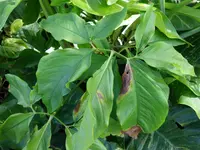
Provide climbing support

Install a sturdy moss pole or wood stake and loosely tie the vines as they elongate so the plant can climb, which encourages larger, more mature leaves and a stronger root system.

Rotate for even growth

Turn the pot 90° every 2–3 weeks to prevent one-sided, leggy growth and to keep the plant’s stems more balanced and compact.

Manage aerial roots

Direct aerial roots toward the support pole or gently tuck them into the potting mix to improve anchoring and moisture uptake instead of cutting them off routinely.

Seasonal light adjustment

In winter, move the plant slightly closer to a bright window or use a small grow light to compensate for shorter days and maintain steady growth when caring for arrowhead vine.

Prevent pest hotspots

Regularly inspect leaf undersides and tight stem junctions, wipe with a damp cloth, and isolate new or stressed plants for 1–2 weeks to reduce the risk of spider mites and scale establishing on the foliage.

Common Pests and Diseases

Spider mites

This pest feeds on the undersides of leaves, causing pale stippling, dull foliage, and fine webbing, especially in dry indoor air. Symptoms include slowed growth and leaves that look dusty or speckled.

Solution

Rinse foliage thoroughly in the shower or with a hose, focusing on leaf undersides, then let the plant dry in bright, indirect light. For persistent infestations, repeat washing every 5–7 days and use insecticidal soap or a ready-to-use horticultural oil, ensuring good coverage but avoiding spraying in strong sun or on heat-stressed plants.

Mealybugs

These insects appear as white, cottony clumps in leaf axils, along stems, and near nodes, feeding on plant sap and causing yellowing, distorted growth, and sticky honeydew. This pest often hides in the dense, vining growth and can spread between clustered plants.

Solution

Isolate the plant, then dab visible clusters with cotton swabs dipped in 70% isopropyl alcohol to break down the waxy coating. Follow up with insecticidal soap or a light horticultural oil spray every 7–10 days until no new insects appear, and prune heavily infested shoots if needed.

Bacterial leaf spot

This disease causes water-soaked, translucent spots that later turn brown and may have a yellow halo, often starting on lower or crowded leaves. Symptoms include rapid spotting during warm, humid conditions or after frequent overhead watering.

Solution

Remove and discard affected leaves, disinfecting scissors between cuts, and avoid wetting the foliage when watering. Improve air circulation, reduce crowding, and if the problem continues, discard severely affected plants to protect nearby aroids, since home-use bactericides are often only partially effective.

Anthracnose

This disease produces irregular tan to dark-brown lesions on leaves and sometimes along leaf edges, which may coalesce and cause blighted areas. Symptoms include thinning foliage and prematurely yellow or dead leaves in warm, humid environments.

Solution

Prune and discard all visibly affected leaves and any dead plant material on the soil surface, then improve air movement and reduce overhead misting. Allow the top of the potting mix to dry slightly between waterings, and in recurrent cases consider using a labeled copper-based fungicide, following the product’s indoor-use directions carefully.

Scale insects

These insects appear as small, dome-shaped brown or tan bumps on stems and leaf midribs and do not move when touched. This pest feeds on sap, leading to yellowing leaves, stunted growth, and sticky honeydew that can support sooty mold on arrowhead vine indoor care surfaces nearby.

Solution

Scrape or wipe off visible scale with a soft cloth or toothbrush, then follow with repeated applications of horticultural oil or insecticidal soap every 7–10 days to target newly hatched crawlers. Keep the plant isolated until no new bumps appear, and inspect stems and leaf bases closely during routine watering.

Interesting Facts

Distinct three-lobed leaves

Mature plants develop strongly three-lobed leaves that are broader and more paddle-shaped than most other Syngonium species, a key trait botanists use to distinguish it in the field.

Climbing aroid habit

This species is a hemi-epiphyte, meaning it can start life on the ground and later climb trees using aerial roots to reach higher light levels in its native tropical forests of Central and northern South America.

Arum-style inflorescences

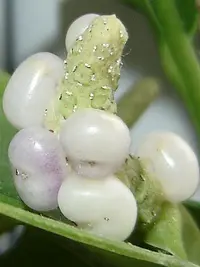
Syngonium auritum produces typical aroid flowers, with a central spadix surrounded by a pale spathe, a structure adapted for specialized pollinators rather than showy, petal-based pollination.

Botan icon

Did you know?

Molecular phylogenetic studies place Syngonium auritum within a genetically diverse clade of Neotropical aroids, and its pronounced leaf lobing is considered an advanced trait that may have evolved to optimize light capture and water shedding in dense lowland rainforest canopies.

FAQs about arrowhead vine

Yellowing leaves often result from overwatering, waterlogged soil, low light, or natural aging of older foliage. Check drainage, allow the top layer of soil to dry between waterings, and remove old yellow leaves to reduce stress.

Grow Healthy Plants with Botan Care

Keep your plants happy and healthy with plant identification, disease detection, and easy care guidance.

Botan plant care app — identify plants on mobile

Explore More Plants