

feverfew Identification (Tanacetum parthenium)

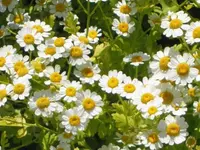
Recognize feverfew by its small daisy-like flower heads with white ray florets around yellow button centers, borne in flat-topped clusters.

The leaves are alternate, deeply lobed, and strongly toothed, and the plant forms a bushy clump on many upright branching stems, usually about 1 to 3 feet (30 to 90 cm) tall.

Tanacetum parthenium Identification

Is This feverfew?

Not sure about your plant ID? Upload a photo and check it with Botan.

Clear images work best. Avoid photos taken too close or too far away

Check the plant’s daisy-like heads, divided leaves, and branching form.

  • Forms a bushy, upright clump, often 1-3 feet (30-90 cm) tall, with many branched stems.
  • Leaves are alternate and deeply cut into rounded lobes, often about 2-3 inches (5-8 cm) long.
  • Flower heads are small daisies with a yellow button center and a ring of short white ray florets.
  • Blooms are carried in loose, flat-topped clusters at the ends of stems rather than singly.

Crush-free checking is usually enough, since the flower clusters and cut leaves are the quickest visual clues.

Feverfew shows clear visual shifts from low leafy rosettes to branched flowering stems.

  • Juvenile plant: Early plants stay basal, forming a compact rosette of soft, bright green, deeply divided leaves with rounded lobes; upright flowering stems are absent.
  • Young plant: As growth continues, stems rise above the rosette and begin branching; alternate leaves remain divided but look broader and more triangular overall.
  • Mature plant: Before bloom, the plant forms a bushy clump about 1-3 feet (30-90 cm) tall, with many slender stems and dense foliage along them.
  • Flowering stage: Stem tips carry loose clusters of small daisy-like heads, each with a yellow center and short white rays, shifting attention from foliage to the canopy.

Several feverfew selections are easy to separate by flower form, foliage color, or plant size.

  • 'Aureum': Grown mainly for bright yellow to yellow-green leaves, especially in spring, instead of the typical medium green foliage.
  • 'Golden Moss': A dwarf form that usually stays lower and denser, often around 8 to 12 inches (20 to 30 cm) tall, with finely cut golden foliage.
  • 'Plenum': Shows double flower heads with many packed white ray florets, giving a buttoned or pompon-like look rather than the usual daisy-like single blooms.
  • 'White Wonder': Produces larger single white flower heads than the typical form, making the daisy-like blooms look broader and more conspicuous.

In late spring into summer, feverfew becomes much easier to recognize when clusters of small daisy-like flower heads rise above the leafy stems. The bright white rays around yellow centers create the clearest seasonal clue. In colder periods, flowering ends and the plant may look much plainer, with only its leafy mound or sparse remaining stems visible. Where winter dieback occurs, those showy flower clusters are absent.

These plants are often mistaken for feverfew.

scentless mayweed(Tripleurospermum inodorum)

Both have white daisy-like flowers and divided leaves. Scentless mayweed usually has much finer, threadlike leaf segments, while Tanacetum parthenium has broader, toothed lobes.

corn chamomile(Anthemis arvensis)

It can resemble it in flower and general habit. Corn chamomile has more finely cut, feathery leaves; feverfew leaves are wider and more crisply toothed.

oxeye daisy(Leucanthemum vulgare)

Both carry white rays around yellow centers. Oxeye daisy has simple, mostly unlobed leaves and larger flower heads, while feverfew has clustered smaller heads and lobed leaves.

Tanacetum parthenium is native to southeastern Europe and the Caucasus. It is widely naturalized beyond that range, so location alone is not diagnostic. In its native range, it is found in disturbed places such as roadsides, field edges, and rocky ground, often near settlements. That habitat helps narrow identification because this species commonly appears as a self-seeding herb in open, human-shaped sites rather than in woodland or wetlands.

  • Skin contact: Leaves and flowers can irritate skin in some people. This contact risk is linked to sesquiterpene lactones in the plant and mainly affects humans who handle stems, leaves, or flower heads.
  • Ingestion: Tanacetum parthenium is not considered edible. Eating leaves or flowers can irritate the mouth and may upset the stomach in humans and pets.

Confirm the Species with Botan

Upload a photo to compare key details and confirm the plant before you label it or look up the right information.

FAQ

The most useful clue is the leaf. It has bright green, deeply cut, chrysanthemum-like leaves with a soft, aromatic scent when crushed. For feverfew identification, that leafy texture plus small daisy heads is the strongest combination.

More Plant Identification Guides

Identify First. Learn What Comes Next.

Use Botan to identify a plant from a photo, then get species-specific care information, safety notes, and common problems.

Botan app identifying a plant from a photo
15 Best Scary Halloween Plants and Fungi for a Spooky Garden

8 min read · 9 Oct 2026

15 Best Scary Halloween Plants and Fungi for a Spooky Garden

Want a garden that looks eerie in October? Here are 15 Halloween plants and fungi, from carnivorous traps to bleeding mushrooms. For each species, we cover its appearance, care requirements, and potential uses in your landscape.

Plant Recommendations
15 Best Scary Halloween Plants and Fungi for a Spooky Garden
10 Easy Garden Flowers to Grow

8 min read · 10 Sept 2026

10 Easy Garden Flowers to Grow

Discover 10 garden flowers that require minimal care. Learn which characteristics make plants easy to grow and follow tips on how to create a beautiful corner from beginner-friendly blooms on your property.

Beginner Guides
10 Easy Garden Flowers to Grow
How to Tell if a Plant Is Dead

6 min read · 19 Aug 2026

How to Tell if a Plant Is Dead

A plant can lose its leaves, stop growing, or collapse and still remain alive. A closer look at the stems, roots, bulbs, and tubers can show whether the plant still has a chance to recover.

Beginner Guides
How to Tell if a Plant Is Dead