


Early vine training
Install a sturdy overhead trellis or wires before the plant reaches 60–90 cm, then gently spiral young stems around supports weekly so flower clusters hang freely and do not tangle or break.

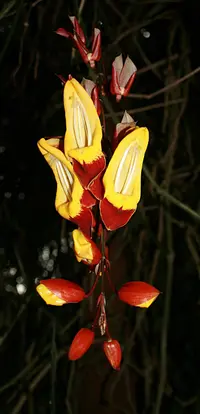
Mysore trumpetvine, Thunbergia mysorensis, is a vigorous, evergreen woody climber grown mainly for its dramatic hanging flower clusters. It produces long, trailing stems with glossy green leaves and pendant yellow and maroon blooms that attract hummingbirds in warm regions.
This species is native to the Western Ghats of India, where it scrambles through trees in moist, tropical forests. In cultivation it is usually trained over pergolas, archways, or strong trellises because of its fast growth and substantial weight.
Thunbergia mysorensis prefers bright light, consistent moisture, and free-draining soil, which makes greenhouse or conservatory conditions ideal in cooler climates. Gardeners looking to learn how to care for Mysore trumpetvine should know it needs space, support, and protection from frost to perform well.

Care Difficulty
Hard Care

Light Preference
Partial Sun

Water Requirements
Regular Water

Temperature Preference
Tropical / Frost Sensitive

Hardiness Zone
10–11

Soil Texture
Sandy, Loamy, Organic-rich

Soil pH
Acidic (5.5–6.5), Slightly acidic (6.5–7.0)

Soil Drainage
Moist but well-drained

Fertilization
Moderate (every 2–4 weeks)
Scan your plant to receive care tips personalized for your specific plant
Available on iOS and Android
This vigorous tropical climber needs bright, filtered light to flower well without leaf scorch.
This plant prefers evenly moist, well-drained soil and reacts quickly to both drought and waterlogging.
This species grows best in consistently warm, frost-free conditions typical of tropical and subtropical climates.
This species prefers moderately humid air and reacts if conditions are too dry for long periods.
Provide loose, aerated, sharply draining soil to support fast growth and prevent root problems.
This vigorous climber is suitable for container growing when the pot is chosen and managed carefully.
This vigorous vine responds well to moderate, consistent feeding during the warm growing months.
Thunbergia mysorensis benefits from planned pruning to control size and maximize flowering.
Container-grown plants and young vines need occasional repotting or transplanting to support healthy root development.
This species is most commonly propagated from semi-ripe stem cuttings taken in warm conditions.
This tropical vine is very frost sensitive and needs careful management in regions with cool or cold winters.

Plant Health Check
Not sure what's wrong with your plant? Check your plant's health inside the app.
In its native Western Ghats of India, this vine is primarily pollinated by sunbirds that hover or perch to access the long, pendant flowers, which are shaped to match the birds’ curved beaks and tongues.
The inflorescences hang downward in long chains, but each individual flower faces upward relative to the stalk, an arrangement that positions nectar and pollen optimally for visiting birds.
The flowers show a striking combination of deep maroon, yellow, and cream with a contrasting throat, a visual pattern thought to help guide bird pollinators efficiently to the nectar source.

This species is considered one of the most visually distinctive members of the genus Thunbergia and is often used in botanical gardens worldwide as a feature plant to demonstrate classic bird-pollinated flower traits, including pendant racemes, tubular corollas, and vivid bicolor displays.
Lack of flowers usually comes from insufficient maturity, too little light, or heavy pruning at the wrong time. Flowers form on new growth, so light, balanced feeding and minimal cutting after late winter support reliable bloom production.
Keep your plants happy and healthy with plant identification, disease detection, and easy care guidance.

pink honeysuckle
Lonicera hispidula
 POPULAR
Mottled spurge
Euphorbia lactea
Bushveld Grape
Rhoicissus revoilii

Morning Glory
Ipomoea tricolor 'Heavenly Blue'
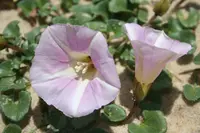
Sea Bindweed
Calystegia soldanella
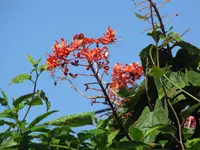
Buchanan's pagodaflower
Clerodendrum buchananii
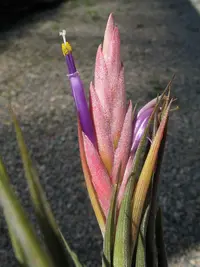
Tillandsia circinnatioides
Tillandsia circinnatioides
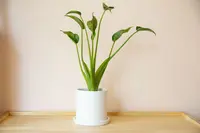
Elephant's Ear
Alocasia 'Tiny Dancers'