Tillandsia didisticha Care

Tillandsia didisticha

About Tillandsia didisticha

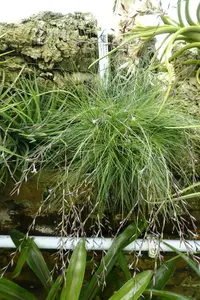
Tillandsia didisticha is an epiphytic air plant from the bromeliad family, naturally found on trees and rocks in parts of Bolivia and Argentina. It absorbs water and nutrients mainly through its leaves instead of roots.

The plant forms a rosette of narrow, often slightly arching leaves and produces showy, branched flower spikes that can be quite striking for its size. Its ability to handle periods of dryness and its minimal root system make it relatively easy to grow indoors with bright light and good air movement.

Understanding how to care for Tillandsia didisticha mainly involves providing strong indirect light, regular misting or soaking, and fast drying between waterings.

Main Plant Requirements

Care Difficulty

Moderate Care

Light Preference

Partial Sun

Water Requirements

Low Water

Temperature Preference

Tropical / Frost Sensitive

Hardiness Zone

10–12

Soil Texture

Rocky, Sandy

Soil pH

Acidic (5.5–6.5)

Soil Drainage

Well-drained

Fertilization

Light (every 4–6 weeks)

Get Personalized Care Plan

Scan your plant to receive care tips personalized for your specific plant

Available on iOS and Android

How to Care for the Tillandsia didisticha

This species prefers bright, indirect light with some direct sun at cooler times of day.

  • Provide 4–6 hours of bright, filtered light daily, such as under a shade cloth or in bright dappled shade, to support balanced leaf and flower development.
  • Allow gentle morning sun but protect from strong midday and late-afternoon sun, which can scorch leaves, cause bleaching, and lead to dry leaf tips.
  • In winter or overcast periods, increase exposure by moving slightly closer to the light source while still avoiding harsh, concentrated direct rays.

This air plant absorbs moisture through its leaves and needs thorough wetting followed by fast drying.

  • Soak or heavily mist 2–3 times per week in warm, dry weather, then let the plant dry fully within 2–4 hours to prevent rot at the base.
  • Reduce to about once weekly in cool or very humid conditions; curled, rigid leaves signal thirst, while limp, brown or black bases suggest overwatering.
  • Use rain, distilled, or low-mineral water, avoiding any standing water in leaf bases, and ensure strong air movement after each watering for Tillandsia didisticha.

This species prefers warm conditions and is sensitive to frost and prolonged cold.

  • Aim for 65–80°F (18–27°C) for steady growth, avoiding sudden swings greater than about 10°F (6°C) within a few hours.
  • Protect the plant if temperatures drop near 40°F (4°C); short dips to 40–45°F (4–7°C) are usually tolerated, but freezing quickly damages tissues.
  • In heat above 90°F (32°C), increase air circulation, shade, and watering frequency so the plant can cool through evaporation without drying out completely.

This air plant prefers moderate humidity and relies on air moisture rather than wet roots.

  • Aim for 40–60% humidity, with slightly higher levels appreciated in heated or air-conditioned rooms.
  • It tolerates short periods of drier air if watering and misting are consistent and thorough.
  • Crisping leaf tips or slow curling inwards indicate humidity stress, so increase humidity with nearby trays of water or a room humidifier.

This epiphytic species does not need traditional soil and instead requires an airy mounting or loose, fast-drying medium.

  • Avoid dense or water-holding substrates; use coarse orchid bark, chunky perlite, or lava rock if placing in a container.
  • Maintain very high aeration around the base so trapped moisture cannot sit against the plant, which encourages rot.
  • Do not bury the plant; rest it on top of the medium or mount it to cork, driftwood, or open mesh structures.
  • If water collects in any decorative filler, remove or reduce organic components so everything dries fully within a few hours.

This species can be grown in containers as a displayed air plant rather than a rooted potted plant.

  • Use shallow, wide containers or bowls to support the plant without crowding its base, leaving air space all around.
  • Choose porous materials like unglazed ceramic to allow faster evaporation if the display tends to hold residual moisture.
  • Elevate the plant on pebbles or a mesh insert inside the container so water cannot pool directly under the base after soaking.

Light feeding supports healthy growth and flowering in Tillandsia didisticha grown in containers or nutrient-poor soils.

  • Use a balanced liquid fertilizer (around 10-10-10 or 20-20-20) diluted to 25–50% strength for container-grown plants.
  • Apply every 4–6 weeks during the active growing season, after thoroughly moistening the root zone.
  • Reduce feeding to 1 light application in late winter or stop entirely in deep winter dormancy.
  • Avoid heavy compost or slow-release pellets in tight root areas to limit salt buildup and root burn.

Pruning helps maintain shape, remove damage, and encourage healthy flowering in Tillandsia didisticha.

  • Carry out light pruning in late winter or early spring before strong new growth starts.
  • Remove dead, damaged, or diseased leaves and stems back to healthy tissue with clean, sharp shears.
  • Thin crowded interior shoots to improve air flow and light penetration, which supports stronger flowering wood.
  • Disinfect tools between plants to reduce spread of fungal and bacterial problems.

Transplanting is mainly needed when container-grown Tillandsia didisticha becomes root-bound or growth declines.

  • Look for roots circling the pot, water running straight through, or slowed growth as signals to transplant.
  • Plan to move the plant to a slightly larger container every 3–4 years, preferably in early spring.
  • Gently loosen circling roots, trim only damaged sections, and keep the original soil level unchanged in the new pot.
  • Water thoroughly after transplanting, then keep in bright, indirect light for 1–2 weeks to reduce stress.

Propagation of Tillandsia didisticha is usually done by division, with seeds reserved for patient growers.

  • Divide mature clumps in late winter or early spring when several healthy offsets are present.
  • Separate offsets with clean, sharp tools, keeping a good portion of roots attached to each division.
  • Plant divisions in a well-drained mix, keep slightly moist, and provide bright, indirect light for establishment.
  • Seed propagation needs warm temperatures, consistent light, and sterile, free-draining medium, but growth is slow.

Winter care focuses on preventing freeze damage and excess moisture stress in Tillandsia didisticha.

  • Treat as frost-sensitive; aim to keep temperatures above 30–32°F, especially for young or potted plants.
  • Move containers indoors or into a sheltered greenhouse before hard frost is forecast.
  • In the ground, apply a light mulch around the base, keeping it slightly away from stems to avoid rot.
  • Water sparingly in winter, allowing the soil to drain well between light waterings.

Care Tips

Mounting strategy

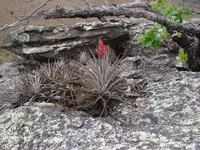
Fix plants to cork, hardwood, or open metal mesh using soft wire or nylon fishing line, leaving the base slightly away from the surface so air can circulate freely around the root zone.

Airflow optimization

Place the plant in a spot with noticeable but gentle air movement, such as near (not in front of) a fan or open window, to dry foliage within 2–3 hours after misting and reduce rot risk.

Rainwater rinses

Once a month, give the plant a thorough rinse with collected rainwater or low-mineral water outdoors to flush accumulated dust and fertilizer salts from the leaf surfaces and trichomes.

Seasonal light shift

In summer, move the plant slightly deeper into bright shade to avoid sun scorch, then return it closer to the brightest window or light source in late autumn to support stronger seasonal growth.

Offset management

Allow pups to reach at least one-third to one-half the size of the parent before gently twisting them off, which maintains a fuller clump while also providing healthy divisions for growing Tillandsia didisticha in additional locations.

Common Pests and Diseases

Mealybugs

This pest feeds on leaf bases and protected crevices, sucking sap and leaving white, cottony clusters. Symptoms include stunted growth, leaf yellowing, and sticky honeydew that can attract sooty mold.

Solution

Quarantine the affected plant, then manually remove visible clusters with a cotton swab dipped in isopropyl alcohol, taking care to reach between leaf bases. Rinse the plant thoroughly with tepid water, improve air circulation, and repeat the alcohol treatment weekly until no new insects appear; this is a core part of practical Tillandsia didisticha care instructions.

Scale insects

These insects appear as small, rounded or oval brown bumps tightly attached to leaves or the base of the plant, feeding on sap and weakening the plant over time. Symptoms include dull, yellowing foliage and reduced vigor.

Solution

Gently scrape or rub off individual scales with a cotton swab or soft brush dipped in isopropyl alcohol, then rinse the plant under a firm but not damaging stream of water. Keep the plant in bright, moving air and inspect weekly, repeating spot treatments until all scales are removed and new growth is clean.

Spider mites

This pest thrives in hot, very dry, stagnant air and feeds on leaf surfaces, causing tiny pale spots and a dusty or speckled look. Symptoms include fine webbing in leaf axils and a general loss of color and vigor.

Solution

Rinse the entire plant thoroughly under lukewarm water, focusing on leaf undersides and tight joints, then increase humidity slightly while improving air movement. For persistent infestations, repeat rinsing every few days and consider using an insecticidal soap formulated for epiphytes, always allowing the plant to dry fully within a few hours.

Fungal leaf spot

This disease develops in conditions of prolonged moisture and poor air movement, leading to dark, water-soaked spots that can turn brown or black on the leaves. Symptoms include localized lesions that may coalesce and cause tissue collapse.

Solution

Remove heavily spotted leaves or trim affected sections with sterilized scissors, then rinse the plant and allow it to dry quickly in bright, indirect light with strong air circulation. Reduce the duration of leaf wetness by watering early in the day, shaking off excess water, and avoiding constant misting; in severe cases a light application of a broad-spectrum fungicide suitable for air plants can be used.

Bacterial soft rot

This disease is favored by constant moisture trapped in the central leaf bases, causing soft, mushy, foul-smelling tissue and rapid collapse of the affected area. Symptoms include dark, wet-looking patches starting at the base and spreading outward.

Solution

At the first signs, isolate the plant, cut away all soft or discolored tissue with sterile tools, and discard severely affected plants that cannot be cleaned back to firm tissue. Adjust care by soaking or thoroughly rinsing instead of constant misting, always inverting the plant afterward to drain trapped water, and ensuring it dries completely within 2–4 hours in good air movement.

Interesting Facts

South American cliff specialist

This epiphytic species is native to Bolivia, Paraguay, Brazil, and northern Argentina, where it often grows on rocky outcrops and cliff faces, anchored in crevices with minimal organic material.

Distinctive two-branched spikes

The name didisticha refers to its characteristic inflorescence structure, in which the flower spikes are arranged in two opposite rows, forming a flattened, ladder-like spray of pink bracts and white to pale yellow flowers.

Cool-tolerant air plant

Unlike many tropical Tillandsia, this species naturally experiences cooler, drier conditions at higher elevations and can tolerate a wider temperature range, including relatively cool nights, as long as it remains dry and well ventilated.

FAQs about Tillandsia didisticha

This species usually blooms only when fully mature and seasonally ready. Inadequate air movement, irregular fertilizing with bromeliad-safe nutrients, or stress from frequent relocation can all delay flowering, even if light and moisture seem acceptable.

Grow Healthy Plants with Botan Care

Keep your plants happy and healthy with plant identification, disease detection, and easy care guidance.

Botan plant care app — identify plants on mobile

Explore More Plants