Improve Airflow
Mount plants on open wire, cork, or driftwood rather than in glass containers so moving air can dry the foliage fully between soakings and reduce rot risk.

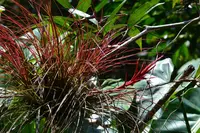
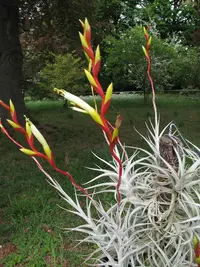
Tillandsia festucoides, commonly called fescue airplant, is an epiphytic bromeliad that grows without soil by anchoring to trees, rocks, or other structures. It absorbs water and nutrients mainly through its leaves. The plant forms slender, grassy, upright clumps with narrow gray-green leaves and produces tubular flowers on slim flower spikes. In nature, it occurs in warm regions of Mexico, Central America, and the Caribbean, often in bright, airy habitats. Its ability to tolerate dryness and its minimal root system make it relatively forgiving indoors. Understanding how to care for fescue airplant focuses mostly on airflow, light, and regular moisture rather than potting mix.

Care Difficulty
Moderate Care

Light Preference
Partial Sun

Water Requirements
Low Water

Temperature Preference
Tropical / Frost Sensitive

Hardiness Zone
10–12

Soil Texture
Sandy, Rocky, Organic-rich

Soil pH
Acidic (5.5–6.5), Slightly acidic (6.5–7.0)

Soil Drainage
Well-drained

Fertilization
Light (every 4–6 weeks)
Scan your plant to receive care tips personalized for your specific plant
Available on iOS and Android
Tillandsia festucoides thrives in bright, indirect light with some gentle direct sun each day.
Watering for this air plant focuses on thorough wetting followed by fast drying rather than constant moisture.
This species prefers warm, frost-free conditions similar to a mild tropical or subtropical climate.
This epiphytic species needs moderate to high air humidity to stay hydrated.
Tillandsia festucoides does not grow in soil and should never be potted in regular potting mix.
This species is suitable for display in containers only if it remains unpotted and fully exposed to air.
This air plant benefits from light feeding during active growth but is sensitive to excess salts.
Pruning needs for Tillandsia festucoides are minimal and focus on hygiene rather than shaping.
This epiphytic air plant is usually mounted rather than potted, so transplanting focuses on remounting over time.
Multiplying Tillandsia festucoides is commonly done through offsets rather than seed in home conditions.
This warm-climate air plant is not frost hardy and needs protection in regions with cold winters.

Plant Health Check
Not sure what's wrong with your plant? Check your plant's health inside the app.
This species forms dense tufts of very slender, strongly recurved leaves that resemble fine grass blades, which is why it is commonly called the fescue air plant.
It naturally grows in very exposed, bright sites in lowland forests and scrub, often on thin branches where wind and full sun are intense compared with many other epiphytic air plants.
Plants often start as solitary rosettes but gradually make elongated clumps along branches, as offsets form in chains and wind-driven seed dispersal allows new plants to anchor nearby in the same air stream.

In parts of its native range in Mexico and Central America, this species can form conspicuous, beard-like curtains along tree branches, creating a distinct microhabitat that shelters small invertebrates from direct sun and desiccation.
Lack of blooms usually comes from insufficient light intensity, poor air circulation, or low humidity. A mild temperature drop between day and night can also trigger flowering. Avoid heavy fertilizing, which often produces foliage instead of flowers.
Keep your plants happy and healthy with plant identification, disease detection, and easy care guidance.