Upside-down mounting
Mount the plant slightly tilted or upside down on cork, wood, or wire so excess water drains away from the crown, which reduces the risk of rot in the tight leaf bases.

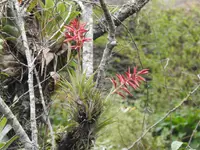
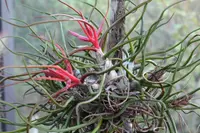
Tillandsia gymnobotrya is an epiphytic air plant from the mountainous regions of Mexico, where it often grows attached to trees or rocks rather than in soil. It forms a rosette of stiff, often slightly curved leaves that can develop attractive blush tones when approaching bloom.
This species produces a tall flowering spike with colorful bracts and tubular flowers that attract pollinators in its native habitat. It is considered moderately easy to grow for those familiar with basic air plant needs.
Good air circulation, bright filtered light, and regular moisture are the main points to understand when learning how to care for Tillandsia gymnobotrya.

Care Difficulty
Moderate Care

Light Preference
Partial Shade

Water Requirements
Moderate Water

Temperature Preference
Warm Climate

Hardiness Zone
Unknown

Soil Texture
Loamy

Soil pH
Slightly acidic (6.5–7.0)

Soil Drainage
Well-drained

Fertilization
Minimal (feed rarely)
Scan your plant to receive care tips personalized for your specific plant
Available on iOS and Android
This species prefers bright, indirect light with limited direct sun exposure.
This air plant absorbs water through its leaves and dries best with thorough but infrequent soaking.
This species prefers warm, frost-free conditions with stable temperatures through the year.
This air plant prefers moderate to high humidity but adapts to typical indoor levels if watered correctly.
Tillandsia gymnobotrya does not grow in soil and instead anchors to surfaces while absorbing water and nutrients through its leaves.
This species is suitable for container display if treated as a mounted air plant rather than a potted plant.
This epiphytic bromeliad has modest nutrient needs and benefits from light, diluted feeding during active growth.
This species needs only light grooming, mainly to remove dead material and keep the clump tidy.
As an air plant, this species is mounted rather than potted, so focus on remounting or repositioning rather than traditional repotting.
This air plant is most commonly multiplied by removing offsets, with seed propagation reserved for patient growers.
This air plant is not frost tolerant and needs protection in regions with cold winters.

Plant Health Check
Not sure what's wrong with your plant? Check your plant's health inside the app.
This species is native to high-elevation cloud forests of eastern Mexico, where it grows epiphytically on trees in cool, humid, and often foggy conditions, rather than in arid lowland habitats typical of many other air plants.
It produces a tall, often much-branched flowering stalk with green to yellow-green bracts and tubular red flowers, a structure that makes it visually and anatomically distinct from many smaller, simple-spiked Tillandsia species.
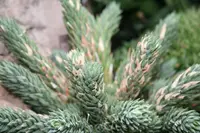
Its gray-green leaves are densely covered with specialized scale-like hairs called trichomes that rapidly absorb water and dissolved nutrients from mist and rain, an adaptation to life on tree branches with no access to soil.
Lack of flowering usually comes from insufficient light, irregular watering, or poor air circulation. Mature plants bloom once when well lit, hydrated, and ventilated. Avoid heavy fertilizer and stagnant, dim locations to support normal bloom development.
Keep your plants happy and healthy with plant identification, disease detection, and easy care guidance.