Timely seed removal
Cut and bag seed heads before they fully dry and disperse, then dispose of them in the trash rather than compost so the plant does not self-sow aggressively around the garden.

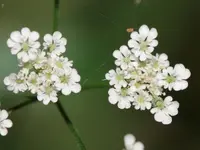
Erect hedgeparsley (Torilis japonica) is an annual herb in the carrot family, typically found in fields, roadsides, and disturbed ground. It has slender, branched stems and finely divided, fern-like leaves. In summer it produces small white flowers in flat-topped umbels, followed by burr-like seeds that cling to fur and clothing, which helps it spread. This plant is common in parts of Europe, Asia, and North America, often behaving as a self-seeding wildflower or weed. It tends to grow easily in full sun to light shade and moderately moist, well-drained soil, so care for erect hedgeparsley is generally straightforward in suitable climates.

Care Difficulty
Easy Care

Light Preference
Full Sun

Water Requirements
Moderate Water

Temperature Preference
Cold Hardy

Hardiness Zone
4–8

Soil Texture
Sandy, Loamy, Clay

Soil pH
Slightly acidic (6.5–7.0), Neutral (7.0)

Soil Drainage
Well-drained

Fertilization
Minimal (feed rarely)
Scan your plant to receive care tips personalized for your specific plant
Available on iOS and Android
This annual umbellifer prefers moderate sun exposure similar to many meadow and hedgerow species.
This species prefers evenly moist but not saturated soil, typical of many hedgerow and field plants.
This hardy annual thrives in cool to warm temperate conditions and tolerates a wide outdoor range.
Humidity is rarely a limiting factor for erect hedgeparsley grown outdoors in temperate climates.
Torilis japonica grows best in moderately fertile, well-drained mineral soils that do not stay waterlogged.
This species can be grown in containers outdoors if the pot provides stable support and fast-draining substrate.
Torilis japonica usually thrives in ordinary soil and needs only light feeding in managed plantings.
Pruning Torilis japonica is mainly done for tidiness and to limit unwanted self-seeding.
Torilis japonica is usually grown in the ground, so care focuses on careful transplanting rather than frequent repotting.
Torilis japonica is most often propagated by seed, which germinates well in suitable outdoor conditions.
Torilis japonica is a hardy annual or short-lived perennial in many temperate regions and usually needs minimal winter care.

Plant Health Check
Not sure what's wrong with your plant? Check your plant's health inside the app.
Torilis japonica is a true annual in most of its range, germinating, flowering, and setting seed within a single growing season, then dying back completely, which helps it exploit disturbed ground quickly.
Its small dry fruits are covered with stiff, hooked bristles that readily cling to animal fur and clothing, an adaptation that enables long‑distance seed dispersal along paths and field margins.
This species is strongly associated with disturbed, nitrogen-rich sites such as field edges, roadsides, and waste ground, where it can form dense stands that compete with low-growing native herbs.

In parts of Europe and North America, Torilis japonica is tracked as an invasive alien species because its efficient seed dispersal and rapid annual life cycle allow it to spread along transport corridors and into semi-natural habitats, where it can alter the composition of local plant communities.
This species self-seeds heavily and can spread quickly, especially in disturbed soils, roadsides, and open beds. In many temperate regions it is considered invasive, so remove seed heads promptly and avoid planting near natural habitats.
Keep your plants happy and healthy with plant identification, disease detection, and easy care guidance.