Mounting technique
Use a rough-textured mount such as cork or hardwood and secure the roots loosely with biodegradable twine so new roots can attach quickly and air can circulate around the root zone.

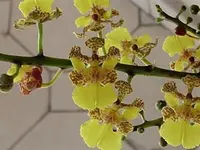
Trichocentrum cebolleta is a warm-growing epiphytic orchid, often called the onion oncidium, known for its slender, cylindrical leaves and showy, long-lasting flowers. It typically grows on trees in dry forest and scrub habitats in Central and South America, where it experiences bright light and good air movement.
This species forms compact clumps and can adapt to basket, mount, or pot culture under the right conditions. Its need for high light, regular watering with fast drying, and stable warmth makes it moderately challenging, better suited to growers with some orchid experience.
Understanding how to care for Trichocentrum cebolleta starts with providing bright conditions, free-draining media or mounting, and consistent, gentle air circulation rather than heavy, constant moisture around the roots.

Care Difficulty
Hard Care

Light Preference
Partial Sun

Water Requirements
Moderate Water

Temperature Preference
Tropical / Frost Sensitive

Hardiness Zone
Unknown

Soil Texture
Sandy, Organic-rich

Soil pH
Acidic (5.5–6.5)

Soil Drainage
Well-drained

Fertilization
Moderate (every 2–4 weeks)
Scan your plant to receive care tips personalized for your specific plant
Available on iOS and Android
This orchid prefers bright, filtered light similar to bright woodland conditions.
This species prefers frequent moisture around the roots but must dry slightly between waterings.
This orchid thrives in warm to intermediate temperatures with only slight seasonal drops.
This orchid prefers consistently humid air to support its thin, terete leaves and roots.
Trichocentrum cebolleta grows best in a very open, airy medium that drains quickly yet holds light, even moisture.
This species is well suited to container culture when root aeration and drainage are prioritized.
Feeding supports steady growth and flowering for Trichocentrum cebolleta in cultivation.
Pruning needs for Trichocentrum cebolleta are light and mainly hygienic.
Handling of Trichocentrum cebolleta should be infrequent to avoid stressing its roots.
Propagation of Trichocentrum cebolleta is usually done by careful division of mature plants.
Cold-sensitive Trichocentrum cebolleta needs mild, frost-free winter conditions.

Plant Health Check
Not sure what's wrong with your plant? Check your plant's health inside the app.
This orchid forms narrow, terete (round in cross-section) pseudobulbs that resemble chives or small onions, an adaptation that helps store water and tolerate bright, seasonally dry habitats.
The plant produces branching inflorescences with many small, yellowish to greenish flowers densely marked with reddish or brownish spots, and the blooms are often sweetly fragrant in warm conditions.
In nature it usually grows as an epiphyte on trees in seasonally dry forests, with dust-like seeds that rely on wind dispersal and symbiotic fungi to germinate and establish on new host branches.

Molecular and morphological studies have shown that this species, once placed in the genus Oncidium, is part of a distinct group adapted to high light and seasonally dry conditions, which led taxonomists to reclassify it into the genus Trichocentrum as understanding of orchid evolution improved.
Lack of flowers often comes from insufficient light intensity, too little day–night temperature difference, or nutrient imbalance. Mature plants bloom more reliably when slightly root-bound, given steady conditions, and allowed a short drier rest after growth hardens.
Keep your plants happy and healthy with plant identification, disease detection, and easy care guidance.