Encourage Low Sprawl
Pinch back the soft tips of young stems to promote side branching, which creates a denser, ground-hugging mat that suppresses weeds and shows flowers more evenly.

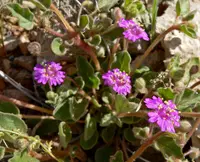
Trailing windmills (Allionia incarnata) is a low, spreading perennial or annual wildflower native to arid and semi-arid regions of the southwestern United States, Mexico, and parts of South America. It forms mats of slender stems with small, paired leaves and showy pink to purple flower clusters that open in the day and close at night.
This plant is adapted to heat, sun, and dry, rocky or sandy soils, which makes it relatively undemanding where drainage is good. It suits xeriscape and naturalistic plantings, but may struggle in very wet or heavy soils. Gardeners who care for trailing windmills mainly need to provide sun, warmth, and lean, fast-draining substrates.

Care Difficulty
Easy Care

Light Preference
Full Sun

Water Requirements
Low Water

Temperature Preference
Warm Climate

Hardiness Zone
5–11

Soil Texture
Sandy, Loamy, Rocky

Soil pH
Slightly acidic (6.5–7.0), Neutral (7.0)

Soil Drainage
Well-drained

Fertilization
Minimal (feed rarely)
Scan your plant to receive care tips personalized for your specific plant
Available on iOS and Android
Allionia incarnata thrives in bright, open conditions typical of dry, sunny habitats.
This species prefers dry to moderately dry soil and is adapted to drought-prone sites.
This desert-edge annual grows best in warm, frost-free conditions.
Humidity is not a major factor for this dryland annual and it stays healthy in most household or outdoor conditions.
This species prefers lean, fast-draining soil that mimics its native desert or semi-desert habitats.
This species can be grown in containers, especially in hot, dry climates where trailing windmills benefit from controlled drainage.
Allionia incarnata is a low-demand native that benefits from light feeding in poor soils during active growth.
Pruning Allionia incarnata is simple and mainly helps maintain a tidy, floriferous mat.
Transplanting this shallow-rooted wildflower is straightforward when timed around active growth and mild temperatures.
New Allionia incarnata plants are usually raised from seed rather than vegetative methods.
This species behaves as a tender perennial or warm-season annual and has low frost tolerance.

Plant Health Check
Not sure what's wrong with your plant? Check your plant's health inside the app.
The flowers appear three-petaled, but each “petal” is actually a whole small flower fused together, forming what botanists call a pseudanthium, or false flower head.
In much of its range, this species behaves as a short-lived annual that quickly completes its life cycle during hot, dry seasons and survives long-term only through its persistent seed bank in sandy or disturbed soils.
The magenta to pink flower clusters typically open from evening through morning and often close during the hottest part of the day, which helps reduce water loss and targets crepuscular and early-day pollinators.

This species shows unusually broad ecological tolerance for such a small wildflower, naturally occurring from arid deserts of the southwestern United States through tropical lowlands of Mexico, Central America, and into parts of South America, while also extending to warm coastal habitats of the southeastern United States.
This species spreads moderately by trailing stems and self-seeding in open, sunny, well-drained sites. It can form loose mats but is generally not considered aggressively spreading if competing vegetation and light traffic are present.
Keep your plants happy and healthy with plant identification, disease detection, and easy care guidance.