Summer dormancy handling
Mark the planting spots before foliage dies back so you avoid disturbing the corms during summer dormancy when cleaning or replanting nearby beds.

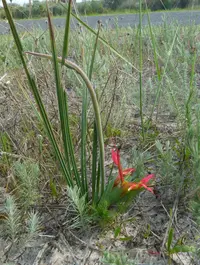
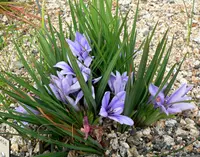
Babiana ringens, commonly called rat's-tail, is a small corm-forming perennial from the iris family native to the winter-rainfall regions of South Africa. It grows from underground storage organs and rests dry during summer dormancy.
The plant forms low, upright, sword-like leaves and a distinctive tall, bare flowering stalk, with bright tubular red flowers clustered near the base of the stem. In habitat it is adapted to dry, sandy soils, full sun, and mild, wet winters.
These drought-tolerant and sun-loving traits can make it manageable in Mediterranean or similar climates, but it dislikes heavy frost and poorly drained soil. Understanding these natural conditions helps guide how to care for Rat's-tail in gardens or containers.

Care Difficulty
Moderate Care

Light Preference
Full Sun

Water Requirements
Low Water

Temperature Preference
Warm Climate

Hardiness Zone
9–11

Soil Texture
Sandy, Loamy, Rocky

Soil pH
Acidic (5.5–6.5), Slightly acidic (6.5–7.0)

Soil Drainage
Well-drained

Fertilization
Minimal (feed rarely)
Scan your plant to receive care tips personalized for your specific plant
Available on iOS and Android
Babiana ringens thrives in bright, open sites with strong sun exposure.
Babiana ringens prefers a dryish cycle with brief, deeper soakings rather than frequent light watering.
This species is adapted to mild, dry climates with cool winters and warm, not extreme, summers.
This South African geophyte handles a wide humidity range and rarely needs special moisture control indoors.
This bulb-like plant prefers lean, fast-draining, sandy soil that mimics its native winter-rainfall habitat.
This species adapts well to container culture when drainage and seasonal moisture are carefully managed.
Babiana ringens is a low-nutrient bulb that benefits from light feeding during active growth only.
Babiana ringens needs only light pruning to keep clumps tidy and support flowering performance.
This species is usually grown in the ground, with transplanting of dormant bulbs done only when clumps become crowded.
Babiana ringens is commonly propagated from dormant bulbs and seeds rather than from cuttings.
In mild, frost-free climates this bulb requires minimal winter care once established in well-drained soil.

Plant Health Check
Not sure what's wrong with your plant? Check your plant's health inside the app.
This species has stiff, upright, leafless flowering stalks that function as perches for nectar-feeding birds, especially sunbirds, which then pollinate the horizontal flowers lower on the stem.
Unlike many irises, its showy red flowers are positioned close to the ground and off to one side of the stalk, aligning precisely with the feeding position of perching birds and improving pollen transfer efficiency.
Morphology, color, and nectar traits indicate that this species has co-evolved with long-billed sunbirds in South Africa’s Cape region, leading to a specialized bird-pollination system rarely seen in other members of the iris family.

This plant’s extreme adaptation to bird perching and pollination is so distinctive that it inspired the common name rat’s-tail, referring to its long bare stalk, and it has become a textbook example of bird-perch pollination in evolutionary ecology.
Lack of flowers usually comes from insufficient light, overcrowded or old corms, or nutrient-lean soil. Ensure a cool, dry rest after foliage dies back, then resume watering and light feeding to support bud formation next season.
Keep your plants happy and healthy with plant identification, disease detection, and easy care guidance.