Mark Dormant Spots
Flag or discreetly label the clump’s location once foliage dies back so you do not accidentally dig, divide, or compact the soil where the rhizomes are resting over summer and winter.

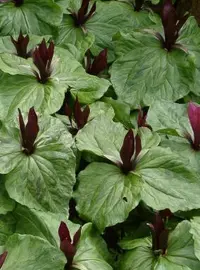
Giant wakerobin (Trillium chloropetalum) is a woodland perennial from the western United States, especially California’s moist, shaded forests. It grows from underground rhizomes and forms sturdy clumps over time. Its broad, mottled leaves and large three-petaled flowers range in color from creamy white to deep maroon, creating a strong spring focal point in shade gardens. The flowers sit just above the foliage on short stems. This species prefers cool, humus-rich, consistently moist soil and protection from hot sun, which can make it slower to establish. Once settled, it is long lived but dislikes disturbance, so care for giant wakerobin focuses on choosing a stable, sheltered planting spot from the start.

Care Difficulty
Moderate Care

Light Preference
Partial Shade

Water Requirements
Regular Water

Temperature Preference
Cold Hardy

Hardiness Zone
6–9

Soil Texture
Loamy, Silty, Organic-rich

Soil pH
Acidic (5.5–6.5), Slightly acidic (6.5–7.0)

Soil Drainage
Moist but well-drained

Fertilization
Minimal (feed rarely)
Scan your plant to receive care tips personalized for your specific plant
Available on iOS and Android
Trillium chloropetalum prefers cool, woodland-style light that mimics dappled forest shade.
Trillium chloropetalum needs evenly moist, well-drained soil that never stays waterlogged.
This woodland perennial prefers cool to mild temperatures and benefits from a marked winter chill.
This woodland perennial prefers moderately moist air but usually copes with typical outdoor humidity in its range.
This species thrives in cool, humus-rich, consistently moist but well-drained soil that mimics deciduous woodland conditions.
This species can grow in containers, but only when the pot closely reproduces a cool, deep, shaded woodland root zone.
Trillium chloropetalum is a woodland perennial that needs only light feeding in rich, humusy soil.
Trillium chloropetalum requires minimal pruning, mainly for cleanliness and disease prevention.
This trillium is best grown in the ground; transplanting is infrequent and should be done with care.
This species is usually propagated slowly by seed or by careful division of mature clumps.
This woodland perennial is generally cold hardy in most temperate gardens and needs little special winter care.

Plant Health Check
Not sure what's wrong with your plant? Check your plant's health inside the app.
This species naturally produces flowers in a wide color range, from deep maroon and purple to greenish-yellow, sometimes all within the same population, which makes field identification rely on leaf shape and habitat as well as flower color.
Its broad leaves often show pronounced marbling in shades of light and dark green, a pattern that helps the plant blend into dappled woodland light and may reduce herbivore detection in early spring.
This trillium is native to coastal and near-coastal woodlands of California, especially in the San Francisco Bay Area and surrounding regions, where it grows naturally under winter-wet, summer-dry Mediterranean-type conditions.

Genetic and field studies show that what was once treated as a single, variable giant wakerobin complex in California actually includes several closely related taxa, and this species has played a key role in understanding how localized woodland plants diversify along narrow climatic and geographic gradients.
Lack of flowering often comes from plants being too young, recently moved, or planted too deeply. Disturbance of the rhizomes, excess sun or drought, and nutrient-poor or very dry spring soil also reduce bloom formation.
Keep your plants happy and healthy with plant identification, disease detection, and easy care guidance.