Wind exposure planning
Site trees where buildings or larger evergreens break prevailing winter winds, since Himalayan hemlock foliage and branchlets can desiccate and deform under constant strong wind.

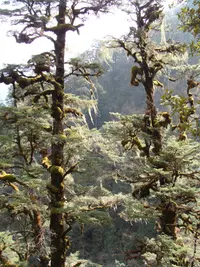
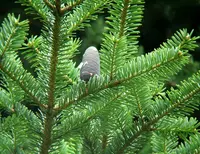
Himalayan hemlock, Tsuga dumosa, is an evergreen conifer that forms a graceful, pyramidal tree with softly drooping branches and fine, flat needles. It often has a layered, airy crown that looks lighter and more delicate than many other conifers.
This species is native to cool, moist mountain forests of the eastern Himalayas and nearby regions, where it grows on slopes and ridges. In gardens, its need for cool conditions, steady moisture, and protection from hot, drying winds can make it moderately challenging.
Gardeners who want to care for Himalayan Hemlock should provide a sheltered site with humus-rich, well-drained soil and consistent moisture to support healthy growth.

Care Difficulty
Moderate Care

Light Preference
Partial Shade

Water Requirements
Regular Water

Temperature Preference
Cold Hardy

Hardiness Zone
6–8

Soil Texture
Loamy, Silty, Organic-rich

Soil pH
Strongly acidic (4.5–5.5), Acidic (5.5–6.5)

Soil Drainage
Moist but well-drained

Fertilization
Minimal (feed rarely)
Scan your plant to receive care tips personalized for your specific plant
Available on iOS and Android
This conifer prefers cool, bright sites with some protection from harsh midday sun.
Moist, cool, well-drained soil is essential for healthy root development in this species.
This tree is adapted to cool, mountain climates and prefers moderate temperatures.
This conifer prefers cool, consistently moist air and benefits from moderately high humidity.
This species prefers cool, moist, acidic, well-aerated soil that never becomes waterlogged.
This tree is only suitable for large, long-term containers when grown as a slow specimen or bonsai outdoors.
Tsuga dumosa grows slowly and usually needs only light, well-timed feeding in cultivation.
Pruning Tsuga dumosa focuses on safety and structure rather than heavy reshaping.
Transplanting Himalayan Hemlock requires planning and gentle handling to avoid root damage.
Propagation of Tsuga dumosa is possible but slow and usually done by specialists or dedicated gardeners.
Mature Tsuga dumosa trees are generally cold hardy and need limited winter care in most temperate regions.

Plant Health Check
Not sure what's wrong with your plant? Check your plant's health inside the app.
This species is naturally restricted to cool, moist montane forests from the eastern Himalaya to northern Indochina, often forming stands on steep slopes and ridges between roughly 2,000–3,300 m where cloud and mist are frequent.
The fine, flat needles and dense, layered branches are well-suited to intercepting cloud moisture and light drizzle, which is important in its native habitat where horizontal precipitation can contribute significantly to water input.
In parts of its range, such as Bhutan and northeastern India, this tree is an important component of mixed conifer–broadleaf forests that provide cover and nesting sites for high-elevation birds like laughingthrushes and for small mammals that depend on conifer seeds and understory shelter.

In some Himalayan regions, mature stands of this species are considered indicators of relatively undisturbed old-growth forest, so their presence is used by conservation biologists to help identify and prioritize intact mountain ecosystems for protection.
This species grows slowly to moderately, typically adding about 20–30 cm of height per year under good conditions. Growth is faster in cool, moist, well-drained sites and slower in compacted, dry, or exposed locations.
Keep your plants happy and healthy with plant identification, disease detection, and easy care guidance.