



coltsfoot Identification (Tussilago farfara)

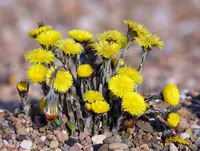
Recognize coltsfoot by its leafless flower stalks topped with a single yellow, dandelion-like flower head, each stalk covered in small scale-like bracts.

The leaves are basal, not on the flowering stems, and are broad, rounded to heart-shaped with angular lobes, often 4 to 8 inches (10 to 20 cm) across.

Tussilago farfara Identification

Identify a Plant by Photo

Take or upload a photo to confirm your plant ID with Botan.

Clear images work best. Avoid photos taken too close or too far away

Check for the low, creeping patch and the leaf shape typical of coltsfoot.

  • Leaves are rounded to heart-shaped with shallow angular lobes, often like a small hoof print.
  • Leaf edges are irregularly toothed, and the blade is usually 2–8 inches (5–20 cm) across.
  • The leaf stalk attaches at the notch, not the center, and each leaf rises singly from the base.
  • Flower heads are yellow and daisy-like, about 1 inch (2.5 cm) wide, borne one per stalk.

Check both the leaf base and single flower stalks for a confident visual match.

Coltsfoot shows clear stage-to-stage visual shifts, especially between flowering stems and later leaves.

  • Flowering stage: Flowering stems appear before leaves, short and scaly, each topped by a solitary yellow dandelion-like head about 1 inch (2.5 cm) across.
  • Fruiting stage: After flowering, the head elongates into a white puffball of silky seed hairs, while the stem remains leafless and visibly bracted.
  • Young plant: Once flowers fade, basal leaves emerge on long stalks, rounded to heart-shaped with angular lobes and a white-felted underside unlike the flowering stem.
  • Mature plant: Later plants carry broad basal leaves often 4-8 inches (10-20 cm) wide, forming a low clump with coarse texture and no upright leafy stems.

In early spring, coltsfoot often flowers before its leaves appear. Look for short flowering stems with yellow, dandelion-like heads, then for fluffy seed heads soon after bloom. The hoof-shaped leaves emerge later in spring and enlarge into early summer. This flower-first, leaf-later pattern is one of the clearest seasonal clues for recognizing the species.

A few early-blooming yellow composites can be mistaken for coltsfoot.

common dandelion(Taraxacum officinale)

Both have yellow flower heads and toothed basal leaves. Dandelion flowers rise on smooth, leafless stalks after the leaf rosette is present. Tussilago farfara flowers earlier, often before the leaves, and its flower stalks carry small scale-like bracts.

butterbur(Petasites hybridus)

Both are in the daisy family and later make broad, rounded leaves. Butterbur leaves become much larger, often 2 feet (60 cm) or more across, and its flower clusters are dense spikes, not single dandelion-like heads.

Tussilago farfara is native across much of Europe and temperate Asia. It is most often found in disturbed, open ground such as streambanks, roadsides, ditches, spoil heaps, and bare clay or gravelly slopes. That habitat can help with identification because it often appears in recently exposed soil rather than stable meadow or forest settings. Finding it in cool, open, weedy places is a useful clue when separating it from similar yellow-flowered composites.

  • Toxic compounds: Tussilago farfara contains pyrrolizidine alkaloids in its leaves and flowers. These compounds are harmful if ingested by humans or pets and are linked to liver damage.
  • Herbal use concern: The safety issue is ingestion, not normal skin contact. Because the plant has a history of medicinal use, correct identification matters so toxic plant parts are not taken internally.

Scan. Check. Confirm.

Use Botan to compare a photo and help verify the plant, so you can move forward with more confidence.

FAQ

The best clue is the timing and leaf shape. Yellow dandelion-like flower heads appear before the leaves, then round to heart-shaped leaves emerge with angular teeth and a white, felted underside. This is central to coltsfoot identification.

More Plant Identification Guides

From Plant ID to Plant Info

Identify a plant from a photo with Botan, then review species-specific care information, safety notes, and common problems.

Botan app identifying a plant from a photo
Best Bedroom Plants – Top 10 to Grow in Your Space

8 min read · 8 Jul 2026

Best Bedroom Plants – Top 10 to Grow in Your Space

Discover the top 10 houseplants that are suitable for growing in your bedroom. Compare their light and water needs, pet safety, and benefits. Find out where best to place greenery in your relaxation space and what species to avoid.

Plant Recommendations
Best Bedroom Plants – Top 10 to Grow in Your Space
20 Funny Plant Names That Make You Laugh

8 min read · 16 Oct 2026

20 Funny Plant Names That Make You Laugh

Some plants carry names that sound like jokes. This guide explains the origins of 20 funny plant names. You will also see which of these plants you can grow at home.

Plant Recommendations
20 Funny Plant Names That Make You Laugh
Can Plants Grow With Artificial Light?

6 min read · 15 Sept 2026

Can Plants Grow With Artificial Light?

Plants can grow under artificial light when the setup provides a suitable spectrum, enough intensity, and sufficient daily exposure. This guide explains how artificial lighting compares with sunlight, which options work indoors, and how to match a setup to houseplants.

Plant Care
Can Plants Grow With Artificial Light?