
Plantain Identification (Musa × paradisiaca)

To recognize Plantain, look for a tall herb with a layered pseudostem made of tightly wrapped leaf bases and a crown of huge, paddle-shaped leaves arranged in one plane.

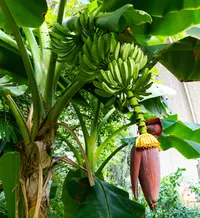
Its hanging flower spike carries thick, purple bracts above rows of developing fruits, often on stems 6 to 20 feet (1.8 to 6 m) tall.

Musa × paradisiaca Identification

Is This Plantain?

Not sure about your plant ID? Upload a photo and check it with Botan.

Clear images work best. Avoid photos taken too close or too far away

Check the overall form first, then leaves, flowers, and fruit.

  • Grows as a tall clump, often 6-20 feet (1.8-6 m) high, with no true woody trunk.
  • The “stem” is a thick pseudostem made of tightly wrapped leaf bases, upright and smooth-sided.
  • Leaves are huge, paddle-shaped, and arranged in a spiral at the top; blades often reach 6-9 feet (1.8-2.7 m) long.
  • Flowering stalks hang downward, bearing rows of flowers beneath large reddish-purple bracts.
  • Fruits form in hanging clusters of elongated, angled bananas with a thick peel.

Split, tattered leaf edges are also common on older leaves.

Plantain shows clear structural changes from a leafy shoot to a flowering and fruiting pseudostem.

  • Juvenile plant: Early growth forms a low rosette of upright leaves arising tightly from the base, without an obvious trunklike pseudostem or hanging reproductive shoot.
  • Young plant: As leaves stack and overlap, a stout green pseudostem becomes evident, and blades lengthen into broad paddles often reaching 3-6 feet (0.9-1.8 m).
  • Flowering stage: A single thick stalk pushes from the pseudostem center, then bends outward with large maroon bracts that lift back to expose rows of flowers.
  • Fruiting stage: After flowering, the same hanging axis carries clustered hands of long, angular bananas, while the pseudostem stops producing new leaves and later declines.

Plantain and related Musa × paradisiaca clones include several forms that can be picked out by foliage pattern, stem color, and plant size.

  • 'Ae Ae': Leaves are strongly variegated with broad cream-white and green sectors, unlike the plain green typical form.
  • 'Dwarf Cavendish': Shorter stature, usually about 6 to 10 feet (1.8 to 3 m), and young leaves often show reddish to maroon blotches.
  • 'Red Dacca': Pseudostems and fruit develop a red to reddish-purple cast instead of the usual green or yellow tones.

In frost-free areas, Musa × paradisiaca keeps a crown of large green leaves year-round, so seasonal identification clues are limited. The main visible shift comes when flowering stalks and hanging clusters of fruit appear, most often in warm months. In regions with cool winters, cold can shred or kill leaves, leaving a cut-back or collapsed pseudostem.

Several large tropical plants can be mistaken for Plantain at a glance.

banana(Musa acuminata)

Often confused because both make tall clumps with broad paddle-shaped leaves. The quickest check is the fruit: Musa acuminata usually bears sweeter dessert bananas, while plantains are typically larger, firmer, and more angular.

hardy banana(Musa basjoo)

It has the same leafy pseudostems and overall banana look. Musa basjoo is usually grown for foliage, and its fruits are short, seed-filled, and not plantain-like; the plant also tends to make a looser clump with many offsets.

Confirm It from a Photo

Use Botan to identify or verify your plant from a photo, which helps reduce mix-ups before you label or buy another one.

FAQ

The best clue is the huge paddle-shaped leaves rising from a thick pseudostem, which is a trunk-like stack of leaf bases. For Plantain identification, mature plants also carry hanging clusters of angular, starchy fruits.

More Plant Identification Guides

One Photo. More About Your Plant.

Identify a plant from a photo with Botan, then get plant details, care information, and common problems for that species.

Botan app identifying a plant from a photo
Best Bedroom Plants – Top 10 to Grow in Your Space

8 min read · 8 Jul 2026

Best Bedroom Plants – Top 10 to Grow in Your Space

Discover the top 10 houseplants that are suitable for growing in your bedroom. Compare their light and water needs, pet safety, and benefits. Find out where best to place greenery in your relaxation space and what species to avoid.

Plant Recommendations
Best Bedroom Plants – Top 10 to Grow in Your Space
Best Water for Plants – How to Choose the Right Type

7 min read · 13 Aug 2026

Best Water for Plants – How to Choose the Right Type

Rainwater, filtered, distilled, and tap water affect plants differently. Learn which types support healthy growth and which cause slow damage. Match each to your plants and discover how to easily improve tap water quality.

Plant Care
Best Water for Plants – How to Choose the Right Type
Top 5 Best Indoor Plants for Air Quality

5 min read · 11 Sept 2026

Top 5 Best Indoor Plants for Air Quality

Indoor plants can make a room feel fresher thanks to their air-purifying qualities. Here are 5 of the most suitable choices for your routine and living space.

Plant Recommendations
Top 5 Best Indoor Plants for Air Quality