Dormancy leaf management
When leaves yellow and drop at the start of summer dormancy, remove only fully dry leaves by hand to improve airflow while leaving any green tissue intact so stored resources in the caudex are not wasted.

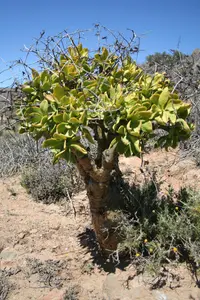
Butter Tree (Tylecodon paniculatus) is a deciduous succulent shrub known for its thick, bottle-shaped trunk and peeling, butter-yellow bark. It stores water in its swollen stem, which helps it survive long dry periods.
This species is native to arid, rocky slopes in South Africa and Namibia, where it experiences cool, dry winters and hot summers. It often drops its leaves in summer dormancy, which is normal for the plant.
Its slow growth, seasonal leaf loss, and sensitivity to excess moisture make it better suited to patient growers. Bright light, very free-draining soil, and careful watering are key to how to care for Butter Tree.

Care Difficulty
Moderate Care

Light Preference
Full Sun

Water Requirements
Low Water

Temperature Preference
Tropical / Frost Sensitive

Hardiness Zone
10–11

Soil Texture
Sandy, Loamy, Rocky

Soil pH
Slightly acidic (6.5–7.0), Neutral (7.0)

Soil Drainage
Well-drained

Fertilization
Minimal (feed rarely)
Scan your plant to receive care tips personalized for your specific plant
Available on iOS and Android
Tylecodon paniculatus prefers bright, strong light that mimics its native arid habitat.
This succulent stores water in its trunk and branches, so watering must be infrequent and carefully controlled.
This species favors warm, dry conditions and is sensitive to prolonged cold and frost.
Humidity is rarely a concern for Tylecodon paniculatus, which evolved in very arid habitats.
Tylecodon paniculatus needs a very fast-draining, mineral-rich substrate to avoid root and stem rot.
This species adapts well to container growing when the pot is chosen for both drainage and stability.
This drought-adapted succulent needs only light feeding to stay healthy in containers.
Pruning Tylecodon paniculatus is mainly corrective, helping maintain a stable, compact framework.
Container-grown plants benefit from occasional repotting to prevent root congestion and soil exhaustion.
Propagation is usually done from semi-hardwood stem cuttings or seeds under controlled conditions.
Winter care focuses on preventing cold damage and managing this species’ cool-season growth cycle.

Plant Health Check
Not sure what's wrong with your plant? Check your plant's health inside the app.
This species is a deciduous winter-growing succulent from the winter-rainfall regions of South Africa and Namibia, dropping its leaves and resting in the hot, dry summer months. Its growth cycle is synchronized with cool, moist winters, which is opposite to many common houseplants.
Mature plants develop a thick, water-storing trunk covered by smooth bark that peels in thin, papery flakes. The peeling exposes fresh yellow-green tissue, which helps reflect sunlight and may reduce heat load on the stem surface.
The plant produces loose panicles of tubular, often reddish to greenish-yellow flowers at the tips of bare branches in late winter to spring. These flowers are adapted for nocturnal moth pollination, with nectar and scent available mainly at night.

In its native arid habitat, this species often grows on rocky slopes and cliff faces, where its thick caudiciform trunk anchors into crevices and allows it to survive with very little soil and highly erratic rainfall over many decades.
Flowering often fails if the plant does not experience a cool, dry winter rest. Excess water or fertilizer in dormancy, or too much shade, can suppress flower bud formation the following season.
Keep your plants happy and healthy with plant identification, disease detection, and easy care guidance.