


Controlled branching
Pinch or cleanly cut just the soft tips of longer stems in late spring to encourage compact, branched growth and a sturdier, tree-like structure over time.

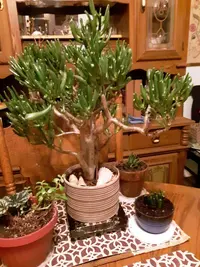
Finger jade, Crassula ovata 'Gollum', is a compact succulent shrub grown mainly as a houseplant or patio container plant. It belongs to the jade plant group and stores water in its thick, tubular leaves.
The leaves are glossy, finger-like, often with reddish tips, and grow on woody stems that slowly form a small tree-like shape. In ideal conditions it may produce small, star-shaped white or pale pink flowers.
This cultivar originates from selections of jade plants native to South Africa, adapted to bright, dry environments with well-drained, gritty soil. Its drought tolerance and slow growth make it a forgiving plant once you understand how to care for Finger Jade, especially for owners who tend to underwater rather than overwater.

Care Difficulty
Easy Care

Light Preference
Partial Sun

Water Requirements
Low Water

Temperature Preference
Tropical / Frost Sensitive

Hardiness Zone
10–11

Soil Texture
Sandy, Loamy, Rocky

Soil pH
Slightly acidic (6.5–7.0), Slightly alkaline (7.0–7.5)

Soil Drainage
Well-drained

Fertilization
Minimal (feed rarely)
Scan your plant to receive care tips personalized for your specific plant
Available on iOS and Android
Crassula ovata 'Gollum' grows best with bright light and some direct sun each day.
This succulent stores water in its leaves and needs infrequent but thorough watering.
This plant prefers warm, stable conditions and does not tolerate hard frost.
Humidity is rarely a concern, as this succulent tolerates dry indoor air well.
This plant needs a very fast-draining, mineral-rich substrate that prevents water from sitting around the roots.
This species is very suitable for container growing due to its compact, slow-growing, woody form.
Crassula ovata 'Gollum' benefits from light, controlled feeding to support compact, healthy growth.
Pruning helps Crassula ovata 'Gollum' keep a sturdy, branched form and prevents top-heavy growth.
Repotting maintains root health and stability in container-grown Crassula ovata 'Gollum'.
Crassula ovata 'Gollum' is commonly propagated from stem or leaf cuttings taken from healthy plants.
Winter care for Crassula ovata 'Gollum' focuses on avoiding frost damage and excess moisture.

Plant Health Check
Not sure what's wrong with your plant? Check your plant's health inside the app.
This cultivar forms elongated, tubular leaves with a small pore-like opening at the tip, a mutation of the typical flat leaves of Crassula ovata that gives it a coral or sea-anemone appearance.
Individual leaves can range from slightly spoon-shaped to strongly trumpet-shaped, often on the same plant, reflecting variable expression of the leaf-tubing mutation along stems and over time.
Its compact internodes, thickened trunk, and fine branching structure mean it is widely used in dry-climate bonsai, where pruning highlights the gnarled woody base and clustered tubular foliage.

This cultivar arose as a horticultural sport of the common jade plant, meaning it originated from a spontaneous mutation selected and stabilized by growers rather than from wild populations, so it is not known as a naturally occurring form in its native South African habitat.
This species usually flowers only when mature, slightly root-bound, and exposed to strong light and cool, dry conditions in winter. Lack of blooms often relates to youth, insufficient light, or overly warm, moist winter conditions.
Keep your plants happy and healthy with plant identification, disease detection, and easy care guidance.

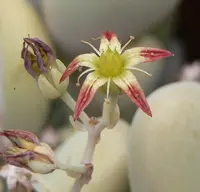
Jewel-leaf plant
Graptopetalum amethystinum
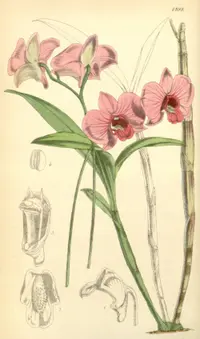
Cooktown orchid
Dendrobium bigibbum
 POPULAR
Flaming Katy
Kalanchoe blossfeldiana
Cigar plant
Cuphea ignea
Silver torch cactus
Cleistocactus strausii
Spider Plant
Chlorophytum comosum 'Variegatum'
 POPULAR
Emerald-Ripple Peperomia
Peperomia caperata
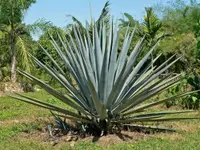
blue agave
Agave tequilana