Use stable anchor
Attach bubbles gently to a stable piece of live rock or coral-safe epoxy so the thallus base is fixed and not rolling in currents, which reduces mechanical damage and splitting.

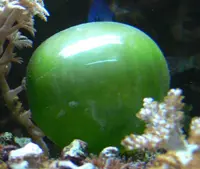
Bubble algae, or Valonia ventricosa, is a large single-celled green alga often kept as a curiosity in marine aquariums. Each sphere is actually one giant cell, usually smooth and glossy, ranging from pea-sized to much larger under ideal conditions.
In nature it occurs in shallow tropical and subtropical seas, attached to rock, coral, or other hard surfaces. It can multiply quickly in nutrient-rich water, which makes it both fascinating and sometimes invasive in reef tanks.
For hobbyists who want to learn how to care for bubble algae in a controlled setting, stable saltwater conditions, moderate light, and consistent water quality are the main considerations.

Care Difficulty
Moderate Care

Light Preference
Partial Shade

Water Requirements
Aquatic

Temperature Preference
Tropical / Frost Sensitive

Hardiness Zone
Unknown

Soil Texture
Organic-rich

Soil pH
Slightly alkaline (7.0–7.5)

Soil Drainage
Waterlogged tolerant

Fertilization
Minimal (feed rarely)
Scan your plant to receive care tips personalized for your specific plant
Available on iOS and Android
Valonia ventricosa thrives in bright, indirect marine light that mimics shallow reef conditions.
In aquaria, Valonia ventricosa depends on stable, clean, well-circulated saltwater rather than soil moisture.
This marine alga prefers stable, mild tropical water temperatures with little daily fluctuation.
This marine alga experiences stable, very high humidity in nature, so air moisture is rarely a limiting factor in aquaria.
This species is not grown in soil, but on hard substrates within a stable saltwater system.
This alga can be maintained in containers such as marine aquaria or small marine specimen tanks when stability is prioritized over decoration.
Valonia ventricosa, commonly called bubble algae, gains most nutrients from dissolved minerals in seawater and usually does not need added fertilizer in home aquaria.
Valonia ventricosa rarely needs pruning, but limited removal can help manage space and light in marine aquaria.
Transplanting Valonia ventricosa is uncommon but may be done when rearranging live rock or adjusting aquascape design.
Propagation of Valonia ventricosa is usually passive, since this alga spreads readily under stable marine conditions.
Valonia ventricosa in indoor marine aquaria does not require traditional winter care but depends on stable warm-water parameters year-round.

Plant Health Check
Not sure what's wrong with your plant? Check your plant's health inside the app.
Each bubble of this green alga is usually a single, giant cell that can reach several centimeters in diameter, making it one of the largest known unicellular organisms on Earth.
The spherical thallus is a thin-walled, hollow cell filled with fluid under gentle internal pressure, which helps it maintain a near-perfect round shape even in moving seawater.
Its glossy, sometimes iridescent surface comes from a smooth cell wall and a thin layer of microorganisms on the outside, which can scatter and reflect light in shallow tropical waters.
This species has multiple nuclei and chloroplasts distributed inside a single giant cell, so it functions more like a tiny multicellular colony in one compartment than a typical microscopic alga.
Growth is usually slow to moderate. A single cell enlarges over months, often reaching visible marble size in 3–6 months. Rate depends on light intensity, nutrient availability, water movement, and overall aquarium stability.
Keep your plants happy and healthy with plant identification, disease detection, and easy care guidance.