Optimize mounting
Mount plants on open-slatted baskets or rafts with chunky, long-lasting media like large-grade bark and charcoal so roots dry quickly yet have firm anchoring points for safe handling and display.

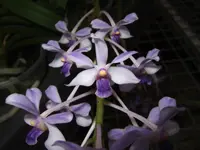
Vanda coerulescens is a small to medium epiphytic orchid that typically grows on trees, forming exposed aerial roots and upright, narrow leaves. It is valued for its delicate, often bluish to lilac flowers carried on arching stems. Native to the eastern Himalayas and parts of Southeast Asia, it usually experiences bright light, moving air, and distinct seasonal changes in moisture. These traits make it moderately challenging for beginners, as it dislikes stagnant conditions and needs consistent humidity without staying waterlogged. Understanding how to care for Vanda coerulescens starts with recreating its airy, tree-dwelling habitat rather than growing it in regular potting soil.

Care Difficulty
Hard Care

Light Preference
Partial Sun

Water Requirements
Regular Water

Temperature Preference
Tropical / Frost Sensitive

Hardiness Zone
12–13

Soil Texture
Sandy, Rocky, Organic-rich

Soil pH
Acidic (5.5–6.5)

Soil Drainage
Well-drained

Fertilization
Heavy (weekly, diluted)
Scan your plant to receive care tips personalized for your specific plant
Available on iOS and Android
This orchid thrives in bright, indirect light that mimics high, filtered forest canopies.
Watering should balance frequent moisture at the roots with excellent air movement and fast drainage.
This species prefers intermediate to warm conditions with a distinct drop in temperature at night.
This orchid needs high humidity to maintain healthy roots and blooms.
Vanda coerulescens grows best without traditional soil, in a very open, highly aerated medium.
This species is well suited to container growing when mounted or placed in slatted baskets rather than standard pots.
This orchid benefits from consistent, dilute feeding during active growth for reliable flowering.
Pruning focuses on hygiene and light shaping rather than size control for this monopodial orchid.
Repotting is infrequent and mainly done to refresh media or improve root space and airflow.
Propagation is possible but slow and is usually done by separating offsets rather than by seed at home.
This tropical orchid is frost-sensitive and needs warm, protected conditions in winter in most climates.

Plant Health Check
Not sure what's wrong with your plant? Check your plant's health inside the app.
This species is native to montane forests of northeastern India, Myanmar, and nearby regions, where it grows on trees in cool, misty habitats at moderate elevations.
Its flowers show a distinct pale blue to lilac-blue coloration, which is relatively rare among orchids and contributed to early horticultural interest in breeding blue-flowered vandas.
Compared with many related vandas, it stays relatively small and typically flowers in late winter to spring, often producing several dangling racemes of many small, fragrant blooms.

Vanda coerulescens has been used as a parent in orchid hybridization to introduce bluish coloration and compact growth into vanda-type hybrids, making it influential in the development of modern blue and pastel vanda cultivars.
This species typically flowers in late winter to spring, producing one main flush of blooms. Under stable warmth, high light, and consistent feeding, it can occasionally rebloom later in the year on strong, mature plants.
Keep your plants happy and healthy with plant identification, disease detection, and easy care guidance.