Use open baskets
Mount plants in slatted wooden baskets or open mesh pots with large chunks of orchid bark or charcoal so roots dry quickly and receive maximum air movement, which is critical for growing Vanda tricolor successfully.

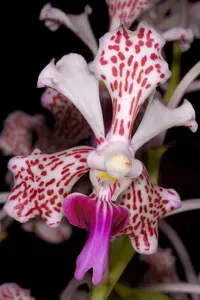
Vanda tricolor is a warm-growing epiphytic orchid, usually found clinging to tree branches with thick, exposed roots. It produces upright, strap-like leaves and striking, often fragrant flowers with spotted or banded patterns.
This species is native to Southeast Asia, especially Indonesia and nearby regions, where it grows in bright, humid forest conditions with good air movement. It demands stable warmth, strong but filtered light, and high humidity, so it is considered moderately challenging for beginners.
Understanding how to care for Vanda tricolor starts with providing airy support for its roots and avoiding typical potting soil, since it prefers to grow almost bare-root or in very coarse media.

Care Difficulty
Hard Care

Light Preference
Partial Sun

Water Requirements
Regular Water

Temperature Preference
Tropical / Frost Sensitive

Hardiness Zone
12–13

Soil Texture
Sandy, Organic-rich

Soil pH
Acidic (5.5–6.5)

Soil Drainage
Well-drained

Fertilization
Heavy (weekly, diluted)
Scan your plant to receive care tips personalized for your specific plant
Available on iOS and Android
This orchid needs bright, abundant light that mimics exposed tree canopy conditions.
Watering should balance frequent moisture at the roots with excellent air movement and drainage.
Temperature should reflect a warm to intermediate, frost‑free climate for stable growth and flowering.
This orchid needs consistently high humidity to perform well in cultivation.
This epiphytic orchid grows best in a very open, airy rooting medium rather than conventional soil.
This species is suitable for container growing when given an open basket or pot that mimics its epiphytic habit.
This epiphytic orchid benefits from regular, dilute feeding during active growth for sustained flowering.
Pruning focuses on hygiene and light shaping rather than size control for this monopodial orchid.
This orchid is usually grown in baskets or mounted, and repotting is infrequent but important when overcrowded.
Vegetative propagation is possible but slow and should be done only on strong, established plants.
This tropical orchid has low cold tolerance and needs careful indoor management during winter in most climates.

Plant Health Check
Not sure what's wrong with your plant? Check your plant's health inside the app.
The flowers release their strongest fragrance in the late afternoon and evening, with a sweet, spicy scent that is especially noticeable in warm, still air.
Each flower typically shows cream to pale yellow petals densely marked with reddish-brown spots, a pattern that acts as a visual cue for specific insect pollinators in its native range.
This species often grows as an epiphyte on trees in montane forests of Java and nearby regions, where it experiences bright light, strong air movement, and pronounced day–night temperature drops.

Some natural populations of this orchid show distinct regional forms with noticeably different flower colors and spot density, and these geographic variants have been important in horticulture and in understanding how to take care of Vanda tricolor in cultivation.
Lack of flowering usually comes from insufficient light, too little temperature difference between day and night, or inadequate feeding. Provide strong, filtered light, a cooler night drop of about 10°F, and regular balanced orchid fertilizer to restore blooms.
Keep your plants happy and healthy with plant identification, disease detection, and easy care guidance.