Water Level Management
In pond or container culture, keep the crown just at or slightly above the water surface and adjust water depth seasonally so stems stay submerged by 2–5 cm but do not allow the growing point to drown.

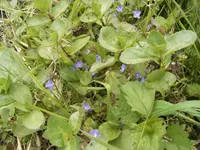
Brooklime, Veronica beccabunga, is a low-growing aquatic or semi-aquatic perennial often found along stream edges, pond margins, and wet ditches. It forms dense mats of glossy, spoon-shaped leaves on creeping stems that root at the nodes.
The plant produces small blue flowers with pale centers, usually held just above the foliage in loose clusters. Its vigorous growth and tolerance of constant moisture make it useful for naturalistic water gardens and wildlife-friendly plantings.
Brooklime prefers consistently wet soil, cool to mild temperatures, and at least moderate light. Once established in a suitable wet spot, it is generally easy to maintain, and learning how to care for Brooklime mainly involves managing its spread and keeping the site moist.

Care Difficulty
Easy Care

Light Preference
Partial Shade

Water Requirements
Aquatic

Temperature Preference
Cold Hardy

Hardiness Zone
4–9

Soil Texture
Loamy, Silty, Organic-rich

Soil pH
Slightly acidic (6.5–7.0), Neutral (7.0)

Soil Drainage
Waterlogged tolerant

Fertilization
Minimal (feed rarely)
Scan your plant to receive care tips personalized for your specific plant
Available on iOS and Android
Veronica beccabunga prefers bright, soft light typical of stream edges and wet meadows.
This wetland species needs consistently moist to saturated conditions to stay healthy.
This plant is a cool- to mild-climate species that tolerates a wide outdoor temperature range.
This semi-aquatic species prefers consistently very humid air and is sensitive to extended dryness.
Veronica beccabunga thrives in saturated, organic-rich substrates that stay wet rather than in typical potting soil.
This species is suitable for containers if pots are managed to stay constantly wet or shallowly submerged.
This moisture-loving perennial grows well in nutrient-rich, wet soil and usually needs only light feeding.
Pruning helps keep Veronica beccabunga dense, healthy, and within bounds in wet areas or water features.
This species is more often transplanted in wet ground or pond margins than repotted in traditional containers.
Veronica beccabunga is commonly propagated to establish groundcover along streams, ponds, or boggy beds.
This cold-hardy perennial usually needs minimal winter care in most temperate climates.

Plant Health Check
Not sure what's wrong with your plant? Check your plant's health inside the app.
This species naturally roots in shallow, slow-moving water and along stream margins, where its creeping stems form dense mats that stabilize soft, muddy substrates.
It thrives in nutrient-rich and even mildly polluted waters, and can be used as an indicator of damp, base-rich habitats such as calcareous springs and ditches.
The fresh leaves have historically been eaten in small amounts as a slightly bitter salad herb in parts of Europe, although they are not widely used in modern cuisine.

In several parts of Europe, this species has been recorded as a winter-green plant, continuing slow growth and retaining foliage under cool, low-light conditions when many other streamside herbs die back completely.
This species spreads steadily by creeping stems and self-seeding, especially in consistently damp soil. In small gardens, edge planting areas, thin out runners, or grow it in contained zones to prevent unwanted expansion.
Keep your plants happy and healthy with plant identification, disease detection, and easy care guidance.