Select Host Trees
Establish plants only on compatible host species such as olive, pomegranate, or certain ornamental shrubs, and avoid weak or diseased hosts so the mistletoe and host can coexist long term.

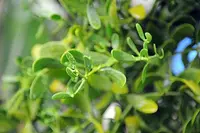
Red-berried mistletoe, Viscum cruciatum, is a perennial evergreen hemiparasitic shrub that lives attached to the branches of host trees and shrubs. It draws water and minerals from its host but still performs photosynthesis in its own leaves.
Plants form compact, rounded clumps of smooth green stems with small, paired leaves and showy bright red berries. In nature, it occurs mainly in Mediterranean regions, especially in parts of Spain, Portugal, and North Africa.
Its parasitic lifestyle and specific host requirements make it challenging to cultivate in gardens or containers. Anyone who wants to learn how to care for Red-berried Mistletoe needs to understand its host plant compatibility and mild, relatively dry climate preference.

Care Difficulty
Hard Care

Light Preference
Full Sun

Water Requirements
Low Water

Temperature Preference
Warm Climate

Hardiness Zone
8–10

Soil Texture
Sandy, Loamy, Organic-rich

Soil pH
Slightly acidic (6.5–7.0), Neutral (7.0)

Soil Drainage
Well-drained

Fertilization
Minimal (feed rarely)
Scan your plant to receive care tips personalized for your specific plant
Available on iOS and Android
This hemiparasitic shrub prefers bright, mild sun conditions on its host tree.
Water needs focus on avoiding both drought stress and prolonged saturation around the host branch.
This species prefers mild Mediterranean-type conditions with limited frost exposure.
This hemiparasitic shrub tolerates a range of humidity but grows best in moderately moist air.
Viscum cruciatum relies on a host plant rather than soil, but a suitable medium for the host is still important.
This species can be maintained in containers only when grown on a suitable potted host plant, and this approach is somewhat specialized.
This hemiparasitic shrub relies mainly on its host tree and usually needs no additional fertilizer in cultivation.
Pruning Viscum cruciatum is mainly corrective, aimed at controlling spread and maintaining host tree health.
This species is almost always grown on outdoor host trees rather than in containers, so focus on careful transplanting of infested branches instead of repotting.
Propagation of this mistletoe is specialized and usually done by seed on suitable host trees rather than by cuttings or division.
Established plants on hardy host trees need little specific winter care in mild climates, as the species tolerates light frost.

Plant Health Check
Not sure what's wrong with your plant? Check your plant's health inside the app.
This species produces bright red berries in winter that are especially conspicuous against its evergreen host trees, making it one of the few European mistletoes with red rather than white fruits.
Its sticky berries are eaten mainly by birds, which wipe the seeds onto branches; the seeds then germinate on the bark and send a specialized organ called a haustorium into the host to tap water and nutrients.
This mistletoe is naturally restricted to warm Mediterranean-type climates, where it grows mainly on shrubs and small trees rather than the broad range of hosts used by related species in cooler parts of Europe.

This plant is a hemiparasite, meaning it performs photosynthesis in its own green leaves but relies on host plants primarily for water and dissolved minerals, allowing it to survive high-light, drought-prone Mediterranean habitats where fully parasitic species might fail.
This species is naturally outdoor and semi-parasitic, relying on host trees for water and minerals. It performs far better outdoors, attached to suitable hosts, than in pots or as a long-term indoor ornamental.
Keep your plants happy and healthy with plant identification, disease detection, and easy care guidance.