crimson glory vine Care (Vitis coignetiae)

About crimson glory vine

Crimson glory vine, Vitis coignetiae, is a vigorous deciduous climbing vine grown mainly for its dramatic autumn foliage. It develops large, rounded leaves that turn intense shades of red, orange, and purple in fall.

This species is native to East Asia, especially Japan and nearby regions, where it scrambles over trees and rocks. In gardens it needs strong support, such as a pergola, fence, or sturdy wall.

It grows fast and can become very large, so space and regular pruning are important for control. For those learning how to care for crimson glory vine, it generally prefers sun to light shade, evenly moist soil, and good drainage.

Main Plant Requirements

Care Difficulty

Moderate Care

Light Preference

Full Sun

Water Requirements

Moderate Water

Temperature Preference

Cold Hardy

Hardiness Zone

4–8

Soil Texture

Loamy, Clay, Organic-rich

Soil pH

Acidic (5.5–6.5), Slightly acidic (6.5–7.0)

Soil Drainage

Moist but well-drained

Fertilization

Minimal (feed rarely)

Get Personalized Care Plan

Scan your plant to receive care tips personalized for your specific plant

Available on iOS and Android

How to Care for the crimson glory vine

This vigorous climber prefers ample outdoor light to develop dense foliage and strong autumn color.

  • Provide 6–8 hours of direct sun daily; in hotter regions, aim for morning sun with light afternoon shade to reduce leaf scorch.
  • Crimson glory vine tolerates partial shade (4–5 hours sun), but fall color and growth become less intense with less light.
  • In summer, protect from reflected heat off walls or paving; in cooler climates, choose a south- or west-facing site for stronger seasonal light.

This hardy vine prefers consistently moist but not saturated soil, especially during its main growing season.

  • Water when the top 3–5 cm of soil feels dry, applying a slow, deep soak so moisture reaches the full root zone.
  • In spring and summer, monitor weekly during dry spells; reduce watering in fall, and in winter rely mostly on natural rainfall unless conditions are unusually dry.
  • For Vitis coignetiae, yellowing soft leaves and persistent wet soil indicate overwatering, while dull, curling leaves and dry, cracked soil signal underwatering.

This cold-hardy vine thrives outdoors in temperate climates with distinct seasonal changes.

  • Active growth is strongest at 60–80°F (16–27°C), with good vigor during warm, bright months.
  • Mature plants tolerate winter lows near -20°F (-29°C) when well established and mulched, making them suitable for many cold regions.
  • Heat above 90°F (32°C) combined with drought can stress vines, so maintain soil moisture and consider light afternoon shade during heatwaves.

Humidity is not a major factor for Vitis coignetiae, which tolerates a wide range of outdoor conditions.

Vitis coignetiae prefers deep, moist, well-drained loam that supports strong root development and vigorous top growth.

  • Aim for a loamy soil with moderate organic matter that retains moisture yet stays friable and aerated.
  • Ensure drainage is free by avoiding compacted clay; amend heavy ground with coarse sand and compost to improve structure.
  • Target a slightly acidic to neutral pH around 6.0–7.0, adjusting with lime or sulfur only if a test shows extremes.
  • Avoid waterlogged or very shallow, stony soils that restrict root penetration and increase drought stress risk.

This species can be grown in large containers, but it demands careful setup to handle its vigorous, climbing growth.

  • Choose a very heavy, wide-based pot to prevent tipping as the vine gains height and catches wind on a support structure.
  • Use a deep container to accommodate a substantial root volume, which helps maintain even moisture during hot, dry periods.
  • Install a firmly anchored trellis or obelisk directly in the pot so the root mass stabilizes the support as the vine matures.

This vigorous vine usually needs only modest feeding when grown in average garden soil.

  • Apply a light layer of garden compost or well-rotted manure around the root zone in early spring to support new growth.
  • Use a balanced slow-release fertilizer (around 10-10-10) once in spring if soil is poor, following label rates and avoiding overapplication.
  • In containers, feed with a balanced liquid fertilizer at 1/2 strength every 4–6 weeks during the growing season.
  • Stop feeding crimson glory vine in late summer so new shoots harden off before winter dormancy.

Pruning Vitis coignetiae manages its size, supports structure, and improves foliage display.

  • Carry out main pruning in late winter while the plant is dormant and leafless for clear visibility of stems.
  • Remove dead, damaged, or crossing canes first, then thin congested growth to improve light and airflow.
  • Shorten overly long shoots to maintain the desired framework on trellises, arbors, or fences.
  • Use clean, sharp bypass pruners and make angled cuts just above healthy buds to reduce infection risk.

This large, vigorous climber is usually grown in the ground, so transplanting is more relevant than routine repotting.

  • Transplant in early spring or early fall when temperatures are mild and soil is workable.
  • Look for signs such as poor vigor, roots circling the planting hole, or a vine outgrowing its support area before moving it.
  • Lift with a generous root ball, keeping as much soil intact as possible to limit root disturbance and stress.
  • Replant at the same depth in well-drained soil, water thoroughly, then keep evenly moist for several weeks until established.

Vitis coignetiae is most reliably propagated by vegetative methods rather than seed.

  • Take semi-ripe or hardwood cuttings in late summer or late winter, using 10–15 cm pieces with several nodes.
  • Insert cuttings into a free-draining mix, keep evenly moist, and maintain high humidity and warmth (around 68–75°F) for rooting.
  • Use simple layering in spring by pegging a flexible stem to the soil, covering a section with soil, and severing once roots form.
  • Seed propagation is possible but slow; stratify seeds in moist medium at 34–41°F for several months before sowing.

This vine is generally cold hardy in many temperate regions and needs only modest winter care once established.

  • Tolerates typical winter frosts in USDA zones around 5–8, though young plants are more vulnerable.
  • Apply a 5–8 cm mulch layer over the root zone in late fall to moderate soil temperature and retain moisture.
  • For first- or second-year plants, consider wrapping the base with breathable fleece in very cold or exposed sites.
  • Move container-grown plants into a sheltered, unheated but frost-free or slightly protected area during severe cold spells.

Care Tips

Sturdy Support Setup

Install a permanent, heavy-duty trellis or tensioned wire system before the vine matures, as older stems become woody and difficult to reposition without damage.

Autumn Color Management

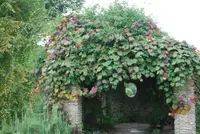
Plan and maintain a clear vertical surface or arbor where foliage can remain until late fall, since intense autumn color develops best when leaves are left undisturbed and not shaded by overhanging trees.

Ventilated Canopy Training

Train main stems horizontally along wires, then space side shoots 20–30 cm apart to create an open, airy canopy that reduces fungal problems and makes pruning and inspections easier.

Root Zone Protection

Apply a 5–8 cm layer of inert mulch such as shredded bark around but not against the base to buffer soil temperature and moisture, which stabilizes growth in hot summers and colder regions.

Seasonal Structure Check

Inspect and reinforce fixings, anchors, and ties each late winter, since the mature vine becomes very heavy and requires secure attachment to prevent structural damage when growing crimson glory vine over walls or pergolas.

Common Pests and Diseases

Grape berry moth

This pest feeds on flower clusters and berries, causing webbing, shriveling, and premature fruit drop. Symptoms include small holes in berries and frass (insect droppings) inside clusters.

Solution

Monitor flower clusters and young fruit weekly, hand-remove and destroy infested clusters, and encourage natural predators by maintaining plant diversity around the vine. In larger plantings, use pheromone traps to time targeted applications of Bacillus thuringiensis (Bt) or other selective products, and keep vines pruned and trellised to reduce dense, sheltered growth.

Grape phylloxera

This pest forms galls on leaves and can also damage roots, leading to reduced vigor and early leaf yellowing. This insect is particularly associated with Vitis species and can weaken plants over time.

Solution

Inspect leaves regularly and remove heavily galled foliage, then dispose of it in the trash to reduce populations. In landscapes, the most effective long-term Vitis coignetiae care strategy is to grow plants on phylloxera-resistant rootstocks and maintain strong plant health through proper watering, mulching, and pruning so vines tolerate minor infestations.

Downy mildew

This disease causes yellow, oil-like spots on upper leaf surfaces and white, downy growth on the underside, especially during wet, cool weather. Infected leaves may brown, curl, and fall prematurely, reducing vigor and autumn color display.

Solution

Improve airflow by pruning and training vines on a support, avoid overhead watering, and water only at the base in the morning. Remove and dispose of infected leaves, and in regions with frequent outbreaks, apply a registered copper or phosphonate fungicide preventively during extended wet periods, following label directions closely.

Powdery mildew

This disease appears as white, powdery patches on leaves, young shoots, and sometimes fruit, often in warm, dry conditions with poor airflow. Symptoms include distorted new growth, reduced photosynthesis, and a general decline in vine vigor if left unmanaged.

Solution

Thin dense growth and train vines to an open structure to increase light and air movement, and avoid excess nitrogen fertilization that promotes very soft, susceptible shoots. Remove heavily infected leaves, and when needed, apply sulfur, potassium bicarbonate, or other labeled fungicides at the first sign of symptoms, repeating as directed while conditions favor infection.

Botrytis bunch rot

This disease, caused by Botrytis cinerea, affects flower clusters and berries in humid, cool to mild weather, leading to soft, gray, moldy fruit. Symptoms include water-soaked lesions on berries that quickly collapse and may dry into mummified fruit remaining on the clusters.

Solution

Keep vines pruned and trellised so clusters hang in good airflow, and remove excess foliage that shades and traps moisture around bunches. Promptly remove and destroy infected clusters and mummified fruit, avoid overhead irrigation near flowering and ripening, and in high-pressure areas consider preventive fungicide sprays timed to bloom and early fruit set according to local extension guidance.

Interesting Facts

Spectacular autumn color

This vine is especially valued for its dramatic autumn foliage, when large, coarse leaves often shift from green to intense red, scarlet, and purple tones, a trait that is more pronounced than in many other Vitis species.

Native to East Asia

Vitis coignetiae is naturally distributed in Japan, Korea, and parts of the Russian Far East, where it grows in mountain forests and forest edges, climbing over trees and shrubs up to the canopy.

Large, textured leaves

Its leaves can reach 20–30 cm across, with a distinctly rough, almost felted underside, which helps reduce water loss and provides some protection against herbivory and environmental stress.

Botan icon

Did you know?

The species name coignetiae honors the French plant collectors Charles and Marie Coignet, whose material introduced this vine to European horticulture in the late 19th century, making it a notable example of historically documented plant exploration.

FAQs about crimson glory vine

Growth is moderate in most gardens. Expect about 30–60 cm of new stem growth per year once established, sometimes more in nutrient-rich, evenly moist soil. Young plants often grow slowly while roots develop deeply.

Grow Healthy Plants with Botan Care

Keep your plants happy and healthy with plant identification, disease detection, and easy care guidance.

Botan plant care app — identify plants on mobile

Explore More Plants