Shelter From Wind
Site young trees where they are protected from prevailing winds or use a temporary windbreak fence, since repeated mechanical stress dries needles and can distort the narrow crown over time.

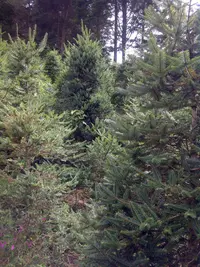
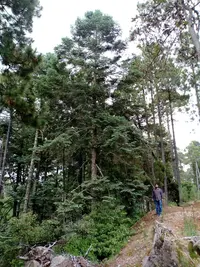
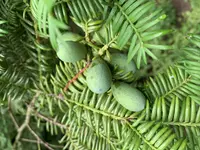
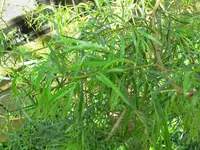
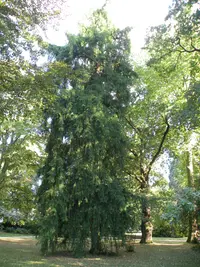
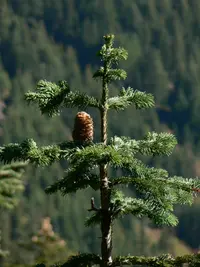
Guatemalan fir, Abies guatemalensis, is an evergreen coniferous tree native to high-elevation cloud forests of Guatemala and nearby regions of Central America. It is typically tall and narrow, with dense, symmetrical branches and glossy dark-green needles that create a fine, formal outline. Cones are upright on the branches, a typical trait of true firs. In cultivation it prefers cool, humid conditions, consistent moisture, and deep, well-drained, slightly acidic soil. This species is not widely grown, and its need for stable, cool temperatures can make it challenging outside suitable climates. Gardeners who want to care for Guatemalan Fir often focus on matching its natural mountain conditions as closely as possible.

Care Difficulty
Hard Care

Light Preference
Partial Shade

Water Requirements
Regular Water

Temperature Preference
Warm Climate

Hardiness Zone
9–11

Soil Texture
Loamy, Silty, Organic-rich

Soil pH
Strongly acidic (4.5–5.5), Acidic (5.5–6.5)

Soil Drainage
Moist but well-drained

Fertilization
Minimal (feed rarely)
Scan your plant to receive care tips personalized for your specific plant
Available on iOS and Android
This highland conifer prefers bright, cool conditions with protection from harsh exposure.
This species prefers consistently moist but never waterlogged soil, especially while establishing outdoors.
This montane fir performs best in cool, stable climates with mild seasonal variation.
This species prefers moderately moist air but tolerates typical outdoor humidity in mild climates.
Abies guatemalensis needs deep, moist, well‑drained soil with a stable structure.
This species can be grown in containers for several years, mainly as a young tree or in cooler regions.
This high-elevation conifer grows best in moderately fertile, well-drained soil and benefits from light, targeted feeding in cultivation.
Abies guatemalensis needs minimal pruning, mainly to maintain health and a single strong leader.
This species is usually field-grown or in large containers and should be transplanted infrequently and with care.
Propagation of this fir is technically possible but slow and usually handled by specialist nurseries.
This highland species prefers mild, cool climates and can suffer in areas with severe or prolonged frost.

Plant Health Check
Not sure what's wrong with your plant? Check your plant's health inside the app.
This fir is naturally restricted to cool, moist montane and cloud forests in Guatemala, Mexico, Honduras, and El Salvador, often between roughly 2,400–3,200 m, where frequent fog supplies much of its moisture.
The species is listed as Critically Endangered on the IUCN Red List due to heavy logging, habitat loss, and overharvesting for timber and Christmas trees, which have fragmented and reduced its natural populations.
Mature trees form part of the upper canopy in Central American cloud forests, where their dense, layered branches intercept cloud moisture and provide habitat structure for epiphytes, birds, and insects.

This species has been included in international conservation efforts under CITES Appendix I, which strictly regulates its trade because wild populations have declined so severely from exploitation and habitat destruction.
This species grows slowly to moderately, usually adding about 20–30 cm of height per year in suitable conditions. Growth is faster in deep, cool, moist, well‑drained soil and cooler, high-elevation climates than in low, warm sites.
Keep your plants happy and healthy with plant identification, disease detection, and easy care guidance.