


Use Shading Rocks
Place flat stones or slate around the moss to buffer temperature swings and reduce surface evaporation, creating a more stable microclimate for caring for abietinella moss in outdoor trays or rock gardens.

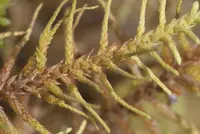
Abietinella abietina, commonly called abietinella moss, is a small, evergreen moss that forms low, feathery mats. Its shoots resemble tiny conifer branches, giving a fine, textured look.
This moss naturally occurs in cool, temperate regions, often on dry, calcareous soils, rocky slopes, and open woodland sites. It prefers stable, undisturbed locations and does not compete well with fast, tall vegetation.
Abietinella abietina is generally considered moderate in difficulty to grow, as it needs consistent moisture but also good air circulation and periods without standing water. Understanding how to care for abietinella moss starts with providing cool conditions, gentle light, and a firm, well-drained surface.

Care Difficulty
Moderate Care

Light Preference
Partial Shade

Water Requirements
Keep Soil Moist

Temperature Preference
Cold Hardy

Hardiness Zone
2–7

Soil Texture
Sandy, Loamy, Organic-rich

Soil pH
Strongly acidic (4.5–5.5), Acidic (5.5–6.5)

Soil Drainage
Moist but well-drained

Fertilization
Minimal (feed rarely)
Scan your plant to receive care tips personalized for your specific plant
Available on iOS and Android
This moss prefers bright but gentle light that mimics open woodland or heathland conditions.
This species requires consistently moist conditions but is sensitive to stagnant water.
This moss is cold-hardy and tolerates a broad outdoor temperature range when moisture is adequate.
This moss prefers consistent moisture and moderate humidity rather than very dry air.
This species thrives in loose, well‑aerated, moist but free‑draining substrates.
This moss can be grown in shallow containers when moisture and drainage are carefully controlled.
This moss is adapted to nutrient-poor habitats and usually needs no additional fertilizer in garden or container culture.
Abietinella abietina needs almost no structural pruning, but light tidying can keep mats even and healthy.
This species is usually grown as a ground or stone cover, so focus on gentle transplanting rather than frequent repotting.
This moss is most often propagated vegetatively by dividing small mats rather than from spores.
This moss is generally cold hardy in temperate climates and needs little special winter care in the ground.

Plant Health Check
Not sure what's wrong with your plant? Check your plant's health inside the app.
This moss forms flat, fan-shaped shoots with closely overlapping leaves that resemble tiny conifer branches, which explains its common name, heath fern moss.
The species is strongly associated with dry, acidic, nutrient-poor habitats such as heaths, open pine forests, and rocky outcrops, where it tolerates conditions that many other mosses cannot endure.
It occurs across boreal and temperate regions of the Northern Hemisphere, including parts of Europe, Asia, and North America, but often in scattered, localized populations rather than as a continuous distribution.
Growth is generally slow to moderate. In suitable, consistently moist conditions, it may extend 1–3 cm per year, forming denser carpets rather than tall shoots. Disturbance, foot traffic, and drying out will noticeably reduce growth.
Keep your plants happy and healthy with plant identification, disease detection, and easy care guidance.

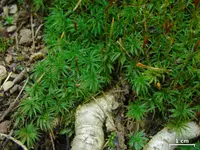
atrichum moss
Atrichum altecristatum
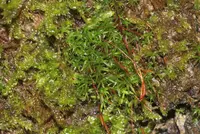
Red Beard-moss
Bryoerythrophyllum recurvirostrum
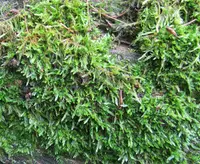
callicladium moss
Callicladium haldanianum
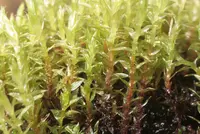
common green bryum moss
Bryum pseudotriquetrum
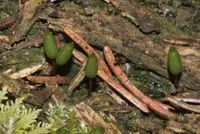
buxbaumia moss
Buxbaumia viridis
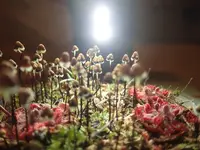
Asterella drummondii
Asterella drummondii
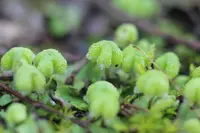
California asterella
Asterella californica
calliergonella moss
Calliergonella cuspidata