Encourage Bushy Form
Pinch or lightly tip-prune young shoots in late winter before flowering to promote a denser, wind-resistant canopy instead of tall, sparse growth.

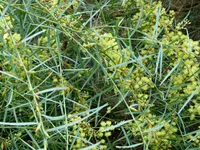
Flinders Range wattle (Acacia iteaphylla) is an evergreen shrub or small tree with fine, weeping foliage and pale yellow, ball-shaped flowers. It often forms a dense, arching screen that suits informal hedges or windbreaks. Native to South Australia, it is adapted to dry, rocky hillsides and poor soils. The plant tolerates drought once established and usually needs minimal maintenance, which makes it appealing for low-input gardens. It prefers a sunny, open position with well-drained soil and benefits from protection from waterlogged sites. Understanding how to care for Flinders Range Wattle starts with providing light, drainage, and space for its natural spreading habit.

Care Difficulty
Easy Care

Light Preference
Full Sun

Water Requirements
Low Water

Temperature Preference
Warm Climate

Hardiness Zone
8–10

Soil Texture
Sandy, Loamy, Rocky

Soil pH
Slightly acidic (6.5–7.0), Slightly alkaline (7.0–7.5)

Soil Drainage
Well-drained

Fertilization
Minimal (feed rarely)
Scan your plant to receive care tips personalized for your specific plant
Available on iOS and Android
This shrub prefers full sun but tolerates some light shade, especially in hot regions.
This drought-tolerant shrub prefers infrequent, deep watering once established.
This species thrives in mild, dry climates with warm summers and cool, frost-light winters.
This dry-climate shrub usually grows well in typical indoor humidity without special measures.
Acacia iteaphylla prefers mineral, sharply drained soil that mimics dry hillside or rocky habitat.
This species can adapt to container growing when given a stable, free-draining setup.
This drought-adapted shrub needs only modest feeding, so focus on light, infrequent nutrients rather than heavy fertilizer use when caring for Flinders Range Wattle.
Light, well-timed pruning keeps Acacia iteaphylla dense, tidy, and flowering well without stressing the plant.
This species is usually grown in the ground, so focus on careful transplanting of young plants and occasional pot shifts for nursery-grown specimens.
New Acacia iteaphylla plants are most often raised from seed, with cuttings used less frequently.
This wattle is moderately frost tolerant once established but benefits from some winter attention in colder regions.

Plant Health Check
Not sure what's wrong with your plant? Check your plant's health inside the app.
This species develops long, pendulous branchlets that create a soft, cascading habit, which distinguishes it from many more upright Australian wattles.
It typically flowers in late winter to early spring in mild climates, producing dense clusters of pale yellow, globular blooms that provide one of the earliest seasonal nectar and pollen sources for insects.
In its native South Australian range, it often appears on disturbed or rocky slopes, where its deep root system stabilizes soil and its leaf litter contributes organic matter to poor, shallow substrates.

In parts of South Australia, this species has become a noted environmental weed outside its natural range because its prolific seed production and bird-dispersed seeds allow it to spread into bushland and outcompete local native shrubs.
Growth is usually fast. In suitable climates it often adds 30–90 cm per year, especially in the first 3–5 years. Rate slows as it matures and in poorer soils or harsher, exposed sites.
Keep your plants happy and healthy with plant identification, disease detection, and easy care guidance.