Wind training
In the first 2–3 years, allow young plants to flex in moderate wind or gently shake the stem by hand weekly to encourage a shorter, sturdier trunk and deeper root system in exposed sites.

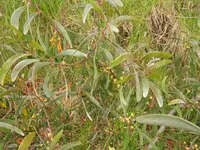
Koaoha, Acacia koaia, is a small, slow-growing Hawaiian native tree related to the more widely known koa. It typically has a compact, dense crown and stiff, narrow leaf-like phyllodes that give it a tidy, architectural look. In the wild it grows in dry, open habitats on older lava or rocky soils, where it has adapted to tough, nutrient-poor conditions.
Its slow growth and strong drought tolerance can make it durable but less forgiving of overwatering or heavy, rich soils. Gardeners who learn how to care for koaoha usually focus on providing strong light, good drainage, and relatively low, steady moisture.

Care Difficulty
Moderate Care

Light Preference
Full Sun

Water Requirements
Low Water

Temperature Preference
Warm Climate

Hardiness Zone
10–11

Soil Texture
Sandy, Loamy, Rocky

Soil pH
Slightly acidic (6.5–7.0), Neutral (7.0)

Soil Drainage
Well-drained

Fertilization
Minimal (feed rarely)
Scan your plant to receive care tips personalized for your specific plant
Available on iOS and Android
Acacia koaia thrives in strong, direct light that reflects its native dry, open habitats.
Acacia koaia prefers infrequent, deep watering that allows the soil to dry between events.
This dryland tree tolerates heat well but is sensitive to cold and especially to frost.
This dryland Hawaiian species handles low humidity well and rarely needs special humidity management indoors.
Acacia koaia prefers lean, very fast-draining, slightly acidic to neutral soil that mimics rocky Hawaiian dry forest conditions.
This species can be grown in containers when young or as a small specimen if given a stable, very free-draining setup.
Acacia koaia is adapted to nutrient-poor soils and needs only light, occasional feeding in cultivation.
Acacia koaia benefits from light, structured pruning to maintain a strong framework and safe form.
This species is usually grown in the ground, so management focuses on careful transplanting of young plants rather than frequent repotting.
Acacia koaia is most reliably propagated from seed, as vegetative methods are slow and less predictable.
This warm-adapted species has limited frost tolerance and needs protection outside mild coastal or subtropical climates.

Plant Health Check
Not sure what's wrong with your plant? Check your plant's health inside the app.
The wood of this species is extremely hard and fine-grained, historically valued in Hawaii for tools, weapons, and traditional crafts where dimensional stability and durability were essential.
This tree is naturally adapted to low-elevation, dry leeward forests in Hawaii, tolerating relatively low rainfall compared with the more widespread Acacia koa that favors wetter habitats.
Natural populations have declined severely due to grazing, land conversion, and habitat degradation, and today the species survives mainly in scattered, protected dry-forest remnants.

Historically, the very dense, straight-grained wood of this species was especially prized for making traditional Hawaiian weapons and implements, because it could hold sharp edges and withstand heavy impact without easily splintering.
Propagation is usually done from fresh seed that has been scarified with hot water or lightly abraded, then sown in a very free-draining mix. Germination is often high, but seedlings grow slowly and need strong light and good airflow.
Keep your plants happy and healthy with plant identification, disease detection, and easy care guidance.