Wind-firm training
In the first 2–3 years, leave some low lateral branches on the trunk to act as wind buffers, only lifting the canopy gradually so the tree develops a strong, tapered trunk that resists storm damage.

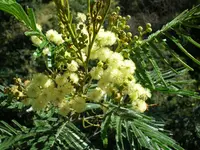
Black wattle, Acacia mearnsii, is a fast-growing evergreen tree commonly used for timber, tannin production, windbreaks, and erosion control. It belongs to the legume family and can fix nitrogen in the soil, which improves site fertility over time.
The tree typically forms a rounded crown with fine, feathery foliage and showy, pale yellow, ball-shaped flower clusters, followed by dark seed pods. It is native to southeastern Australia but is now widely planted and naturalized in many warm-temperate and subtropical regions.
Compared with many ornamental trees, it is relatively easy to establish, but it can become invasive in suitable climates. Those who want to learn how to care for black wattle should note its preference for full sun, well-drained soil, and moderate to low water once established.

Care Difficulty
Moderate Care

Light Preference
Full Sun

Water Requirements
Low Water

Temperature Preference
Warm Climate

Hardiness Zone
8–10

Soil Texture
Sandy, Loamy, Clay

Soil pH
Acidic (5.5–6.5), Slightly acidic (6.5–7.0)

Soil Drainage
Well-drained

Fertilization
Minimal (feed rarely)
Scan your plant to receive care tips personalized for your specific plant
Available on iOS and Android
This fast-growing tree thrives in bright, open conditions with long daily sun exposure.
This species prefers briefly moist but free-draining soil and does not tolerate prolonged saturation.
This species prefers mild, frost-free climates but adapts to a broad warm range once established.
This species tolerates a wide humidity range and rarely needs special humidity management in typical outdoor conditions.
This species prefers freely draining, moderately fertile mineral soils and strongly dislikes waterlogged or compacted ground.
This fast-growing tree is only moderately suitable for containers and is best kept in pots for temporary or juvenile stages.
This nitrogen-fixing tree needs only light feeding in most garden soils, so focus on modest support rather than heavy fertilization for black wattle.
Pruning Acacia mearnsii helps maintain a safe, balanced canopy and supports healthy flowering wood.
This fast-growing tree is usually moved from containers to the ground while still young to minimize transplant shock.
New plants are most often raised from seed, with some additional pre-treatment needed for reliable Acacia mearnsii germination.
This species tolerates only light frost and benefits from basic winter protection in cooler regions.

Plant Health Check
Not sure what's wrong with your plant? Check your plant's health inside the app.
The bark of Acacia mearnsii contains very high levels of condensed tannins and has been one of the most important global sources of commercial vegetable tannin, especially for leather production.
As a legume, this species forms symbiotic root nodules with nitrogen-fixing bacteria, allowing it to enrich poor soils and rapidly colonize disturbed sites.
Many populations show serotiny, where hard-coated seeds remain dormant in the soil and germinate in large numbers after fire or heat exposure, giving the species a strong advantage in fire-prone habitats.

In parts of South Africa, Acacia mearnsii has become one of the most widespread and studied invasive tree species, significantly altering water runoff, reducing streamflow, and prompting large-scale mechanical and biological control programs to protect native ecosystems and water resources.
This is a very fast-growing tree. In suitable outdoor conditions it often puts on 1–2 m of height per year, especially during its first 5–7 years, then growth gradually slows as the canopy matures.
Keep your plants happy and healthy with plant identification, disease detection, and easy care guidance.