narrow-leaf wattle Care (Acacia mucronata)

Also known as: Variable sallow wattle, Narrow-leaved wattle
narrow-leaf wattle

About narrow-leaf wattle

Narrow-leaf wattle (Acacia mucronata) is an evergreen shrub or small tree from southeastern Australia, valued for its fine foliage and soft yellow, pompom-like flowers. Plants usually form a slender, upright shape with dense, narrow leaves that give a light, feathery look.

In nature it grows in open forests and along stream edges, where soils are free-draining and conditions are mild. It adapts well to temperate gardens and suits screens, shelterbelts, or informal plantings.

This species grows quickly and is generally tough once established, but young plants need protection from waterlogged soil and severe frost. To care for narrow-leaf wattle, provide full sun, moderate moisture, and well-drained soil with low to moderate fertility.

Main Plant Requirements

Care Difficulty

Moderate Care

Light Preference

Full Sun

Water Requirements

Low Water

Temperature Preference

Warm Climate

Hardiness Zone

8–10

Soil Texture

Sandy, Loamy, Rocky

Soil pH

Acidic (5.5–6.5), Slightly acidic (6.5–7.0)

Soil Drainage

Well-drained

Fertilization

Minimal (feed rarely)

Get Personalized Care Plan

Scan your plant to receive care tips personalized for your specific plant

Available on iOS and Android

How to Care for the narrow-leaf wattle

Acacia mucronata grows best in bright, open conditions with protection from extreme afternoon heat.

  • Provide 6–8 hours of direct sun daily, ideally with morning sun and light afternoon shade in hotter regions to reduce leaf scorch.
  • Tolerates light or dappled shade, but dense shade leads to sparse growth, fewer flowers, and weaker stems over time.
  • In summer, young plants benefit from filtered light during the hottest hours, while in winter, ensure maximum sun exposure for strong seasonal growth of narrow-leaf wattle.

This species prefers moderately dry conditions and is sensitive to waterlogged soil.

  • Allow the top 3–5 cm of soil to dry before watering, using finger-checks or a trowel to assess moisture rather than a fixed schedule.
  • In the first 1–2 growing seasons, water deeply but infrequently, then reduce frequency once roots are established and new growth appears robust.
  • Yellowing, soft foliage and a sour soil smell suggest overwatering, while dull, curling leaves and premature leaf drop indicate the plant needs more water; always ensure sharp drainage.

This plant is adapted to mild, temperate climates with cool winters and warm, dry summers.

  • Optimal growth occurs around 60–80°F (16–27°C), with steady shoot and root development in this range.
  • Mature plants can tolerate brief drops to about 25°F (−4°C), but young plants are more vulnerable and may suffer damage below 30°F (−1°C).
  • Tolerates dry summer heat up to about 95°F (35°C) if soil is not waterlogged, but prolonged frost or freezing winds can cause dieback, especially on exposed sites.

This species tolerates a wide humidity range and generally thrives in typical indoor and outdoor air.

  • Aim for 30–60% humidity; narrow-leaf wattle usually copes well with drier indoor air.
  • Watch for browned leaf tips and increased leaf drop as signs of humidity stress combined with drought.
  • If air is very dry and hot, group plants together and use a pebble tray to slightly raise local humidity.

This plant prefers free-draining, slightly sandy soil that does not stay wet after watering.

  • Use a mix of 50–60% sandy loam with 20–30% coarse sand and 10–20% fine bark or gravel to keep structure open.
  • Aim for slightly acidic to neutral pH around 6.0–7.0, avoiding strongly acidic or lime-rich substrates unless locally adapted.
  • Improve aeration and drainage by adding coarse, angular materials rather than fine peat that compacts and holds excess water.
  • Avoid heavy clay, waterlogged spots, or very rich organic mixes that encourage weak, lush growth and root problems for Acacia mucronata.

This species can be grown in containers, but only if the pot setup controls rapid root growth and top weight.

  • Choose a deep, heavy container that resists tipping, as the woody canopy becomes top-heavy over time.
  • Select a pot material like thick terracotta to slightly increase evaporation and prevent prolonged saturation around the root zone.
  • Raise the container on pot feet so drainage holes remain unobstructed and excess water clears quickly from the bottom layer.

Acacia mucronata adapts to poor soils and usually needs only light, targeted feeding in cultivation.

  • Use a low-rate, slow-release native or low-phosphorus fertilizer in early spring to support new growth.
  • Apply at half the label rate to avoid burning fine roots and stressing this relatively low-nutrient-adapted species.
  • In containers, use a balanced NPK liquid at 1/4–1/2 strength every 4–6 weeks in spring–summer only.
  • Stop feeding in fall–winter, as growth slows and excess nutrients can cause weak, frost-prone shoots in narrow-leaf wattle.

Pruning Acacia mucronata focuses on safety, structure, and access to light rather than heavy shaping.

  • Carry out formative and maintenance cuts in late winter to very early spring, before active growth in most climates.
  • Remove dead, diseased, crossing, or inward-growing branches to improve airflow and reduce fungal problems.
  • Thin congested interior branches to maintain a balanced framework and prevent top-heavy, wind-vulnerable crowns.
  • Use clean, sharp bypass secateurs or a pruning saw, making smooth cuts just outside the branch collar.

This species is usually grown in the ground, so management centers on careful transplanting of young plants.

  • Transplant in late winter to early spring when soil is moist and temperatures are mild, reducing shock.
  • Look for roots circling the pot, slow growth, or the plant drying out rapidly as cues a container specimen needs a larger root zone.
  • Shift up only 1 pot size, teasing out circling roots gently and keeping the root ball as intact as possible.
  • Water deeply after planting, mulch 5–8 cm around (not against) the stem, and shade temporarily in hot, windy weather.

Propagation of this wattle is usually done from seed, with pre-treatment to improve germination.

  • Collect mature, dry seed pods and store seeds cool and dry until late winter or early spring sowing.
  • Use hot-water treatment: pour near-boiling water over seeds, soak 12–24 hours, and discard any that do not swell.
  • Sow in a free-draining, low-phosphorus mix, just covered, and keep at 64–75°F with even, light moisture.
  • For cuttings, use semi-ripe shoots in late summer in a propagator with high humidity and bottom heat, though success rates vary.

Acacia mucronata is best suited to mild, frost-light climates and needs protection in colder regions.

  • In-ground plants tolerate brief light frosts but may be damaged by prolonged freezes below about 23°F.
  • Apply a 5–8 cm mulch layer over the root zone in late fall to moderate soil temperature and moisture swings.
  • Wrap young trunks with breathable horticultural fleece in colder areas to reduce bark damage and dieback.
  • Move container-grown plants indoors or into a cool, bright, frost-free space before hard frosts arrive.

Care Tips

Wind-hardening young plants

Expose young plants to increasing wind over 2–3 weeks (or use a fan in sheltered sites) so stems lignify and are less likely to snap once planted in an open, exposed position.


Root-run management

Install a 30–40 cm deep root barrier or plant at least 3–4 m away from drains, paving, and foundations to prevent the vigorous root system from lifting hardscape or invading pipes as the tree matures.

Low-branch training

While the plant is young, selectively retain a few well-spaced lower branches to break wind and shade the trunk, which reduces sunscald risk and produces a more stable, wind-firm framework.

Short-lived replacement planning

Treat this species as a relatively short-lived small tree and succession-plant younger individuals every 10–15 years so screening, habitat value, and structure are maintained as older trees begin to decline.

Nitrogen-fixation support

Avoid disturbing or removing too much soil around the base so root nodules and their nitrogen-fixing bacteria remain intact, which supports healthy growth and reduces fertilizer needs when caring for narrow-leaf wattle.

Common Pests and Diseases

Acacia psyllids

These insects feed on young foliage and shoots, causing curling, distortion, and sticky honeydew that can lead to sooty mold on narrow-leaf wattle.

Solution

Prune and dispose of heavily infested shoots, then hose down foliage to remove nymphs and honeydew; if needed, apply insecticidal soap or a light horticultural oil, ensuring thorough coverage of the undersides of leaves and repeating every 7–10 days until new growth appears clean.

Gall rust

This disease causes swollen, woody galls on stems and branches, which can distort growth and weaken parts of the plant over time.

Solution

Prune out affected stems well below the galls during dry weather, disinfect pruning tools between cuts, and maintain good spacing and airflow around plants to reduce humidity that favors infection; dispose of infected material in the trash, not in compost.

Armillaria root disease

Symptoms include gradual decline, yellowing foliage, branch dieback, and in advanced cases, white fungal sheets under the bark near the base of the plant.

Solution

Remove and destroy severely affected plants including as much root material as possible, avoid replanting susceptible woody species in the same spot, improve drainage, and keep mulch and organic debris away from the base to limit moisture that favors the fungus.

Borers

These insects tunnel into stems and larger branches, leading to wilting of individual branches, frass (sawdust-like material), and sometimes branch dieback.

Solution

Prune out and destroy affected branches showing tunneling or exit holes, keep the plant vigorous with proper watering and no excess nitrogen, and avoid wounding the trunk or main stems, which makes entry easier for borers.

Scale insects

This pest forms small, dome-shaped or flat bumps on stems and leaf stalks, excreting honeydew that encourages sooty mold and can reduce plant vigor.

Solution

Wipe or gently scrub small infestations off stems with a cloth dipped in soapy water, encourage natural predators such as lady beetles, and for heavier infestations use horticultural oil sprays applied thoroughly to coat the insects, repeating as label directions allow; this supports Acacia mucronata care by keeping sap-feeding pressure low.

Interesting Facts

Tasmanian–Victorian native

This species is naturally found in south‑eastern Australia, especially in moist forests and along watercourses in Tasmania and Victoria, where it often forms dense thickets on well‑drained, acidic soils.

Phyllodes, not leaves

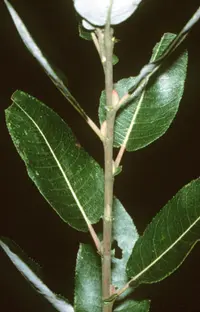
Mature plants typically develop phyllodes, which are leaf‑like flattened petioles that replace true leaves and reduce water loss while still performing photosynthesis.

Winter–spring flowering

It produces slender, rod‑shaped clusters of bright yellow flowers mainly from late winter to spring in its native range, providing an important early‑season pollen source for insects.

Botan icon

Did you know?

Like many Australian wattles, Acacia mucronata forms symbiotic relationships with nitrogen‑fixing bacteria in its root nodules, allowing it to enrich poor soils by converting atmospheric nitrogen into forms usable by plants.

FAQs about narrow-leaf wattle

This species is evergreen, keeping its fine, linear foliage year-round. Old phyllodes may shed gradually, but the plant does not have a pronounced dormant season, so it provides consistent screening and shelter in mild to cool climates.

Grow Healthy Plants with Botan Care

Keep your plants happy and healthy with plant identification, disease detection, and easy care guidance.

Botan plant care app — identify plants on mobile

Explore More Plants