Control Spreading Edge
Use a flat spade 5–8 cm deep around the patch once or twice a year to slice off runners and keep this mat-forming plant from invading paths or nearby beds.

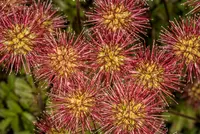
Acaena juvenca is a low-growing perennial groundcover from the Rosaceae family, forming dense, finely textured mats. It typically has small, divided leaves and inconspicuous flower heads that develop into burr-like seed clusters.
This species is native to parts of South America, often found in open, cool habitats with good drainage. Its creeping habit allows it to fill gaps between stones or in open soil, making it useful in rock gardens and informal edges.
Once established, it is generally resilient, but it needs free-draining soil and dislikes prolonged waterlogging. Understanding how to care for Acaena juvenca focuses on providing enough light, moderate moisture, and protection from extreme heat in warmer climates.

Care Difficulty
Moderate Care

Light Preference
Partial Sun

Water Requirements
Moderate Water

Temperature Preference
Cool Climate

Hardiness Zone
Unknown

Soil Texture
Loamy

Soil pH
Slightly acidic (6.5–7.0)

Soil Drainage
Well-drained

Fertilization
Minimal (feed rarely)
Scan your plant to receive care tips personalized for your specific plant
Available on iOS and Android
This groundcover prefers bright conditions but tolerates some shade, especially in warmer climates.
This plant prefers consistently moist but not saturated soil, especially during its main growing season.
This hardy perennial copes well with cool conditions but benefits from moderate temperatures during active growth.
This species tolerates a wide humidity range and usually does not need special humidity management outdoors.
Acaena juvenca prefers free-draining, moderately fertile soil that never stays waterlogged.
This species can be grown in containers if drainage and horizontal space for spreading growth are considered.
This groundcover from nutrient-poor habitats needs only light feeding in managed gardens.
Pruning is mainly used to keep this mat-forming plant tidy and within bounds.
This species is usually grown as a groundcover, so transplanting in the garden is more relevant than container repotting.
New plants are most often produced by division, making expansion of a planting straightforward.
This hardy perennial usually needs minimal winter attention in typical temperate climates.

Plant Health Check
Not sure what's wrong with your plant? Check your plant's health inside the app.
Acaena juvenca is naturally restricted to New Zealand, where it occurs mainly in montane to subalpine grasslands and open habitats, often on well-drained, stony or gravelly soils.
Compared with several other Acaena species that have strongly barbed, animal-dispersed burrs, A. juvenca has comparatively less-armed fruits, which reduces long-distance animal transport and helps keep populations more localized.
In its native range, A. juvenca occupies gaps in tussock and short grass communities, helping to stabilize loose substrates and contributing to low, ground-covering vegetation structure in these cool, open ecosystems.
This mat-forming species can spread steadily by surface stems and self-seeding, but is usually manageable in gardens. Regular edging, dividing clumps, and removing unwanted seedlings help keep it within bounds and prevent it smothering neighboring plants.
Keep your plants happy and healthy with plant identification, disease detection, and easy care guidance.