Succession Sowing
Stagger sowing every 2–3 weeks in early spring so flowering continues longer instead of peaking all at once and fading quickly.

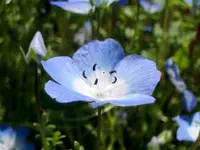
Baby blue eyes, Nemophila menziesii, is a low-growing annual wildflower native to coastal and foothill regions of western North America, especially California. It forms soft, branching mounds with finely divided green leaves and many cup-shaped, sky-blue flowers often marked with white centers.
The plant is commonly used in spring bedding, meadows, and containers where a cool, mild climate is available. It grows quickly from seed and has a short life cycle, which makes it easy to replace but less suited to long, hot summers.
This species prefers full sun to light shade, moist but well-drained soil, and cool conditions. Simple habits and modest needs make it straightforward to learn how to care for baby blue eyes.

Care Difficulty
Moderate Care

Light Preference
Partial Sun

Water Requirements
Regular Water

Temperature Preference
Cool Climate

Hardiness Zone
3–10

Soil Texture
Sandy, Loamy, Organic-rich

Soil pH
Acidic (5.5–6.5), Slightly acidic (6.5–7.0)

Soil Drainage
Moist but well-drained

Fertilization
Minimal (feed rarely)
Scan your plant to receive care tips personalized for your specific plant
Available on iOS and Android
Nemophila menziesii prefers cool, bright conditions with gentle sun exposure for best flowering.
This species prefers evenly moist, well-drained soil that never stays soggy for long periods.
This cool-season annual thrives in mild temperatures and struggles with intense heat or hard frost.
Humidity is rarely a concern, as this species thrives in typical outdoor air conditions of 30–60% without special adjustment.
This annual prefers light, well‑drained soil that stays evenly moist but never waterlogged.
This species is well suited to shallow containers and hanging baskets outdoors.
Nemophila menziesii is a low-feeding annual that needs only modest nutrition for good flowering.
Nemophila menziesii needs minimal pruning, focused on tidying and extending bloom.
This delicate annual is more often transplanted into beds or containers once than repotted repeatedly.
Nemophila menziesii is most commonly propagated from seed rather than cuttings or division.
This cool-season annual usually completes its life cycle before harsh winter and requires little true winter care.

Plant Health Check
Not sure what's wrong with your plant? Check your plant's health inside the app.
The pale blue petals with white centers also contain ultraviolet patterns that guide native bees and other pollinators toward the nectar and pollen, improving pollination efficiency in its short spring flowering window.
This species germinates with cool, moist weather, grows quickly, then completes its life cycle before summer drought, a classic adaptation to the Mediterranean-type climate of coastal California and the western United States.
In the wild it often grows on sandy or gravelly slopes and coastal bluffs, where its fine root system and low biomass allow it to exploit brief spring moisture in relatively nutrient-poor soils.

In some years, dense natural populations of this species contribute to California’s so-called superblooms, where vast hillsides and open spaces turn visibly blue from a distance due to millions of individual flowers opening at the same time.
This species is usually grown as a cool-season annual, completing its life cycle in 1 year. In mild coastal climates it may self-seed, giving the impression of a short-lived perennial ground layer.
Keep your plants happy and healthy with plant identification, disease detection, and easy care guidance.