Wind‑firm staking
Install 3–4 strong stakes around the clump and tie stems loosely in a figure‑eight pattern as they elongate to prevent wind snap on these very tall, hollow canes.

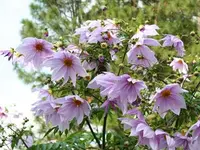
Tree dahlia, Dahlia imperialis, is a tall, fast-growing perennial from the mountains of Central America. It forms thick, cane-like stems topped with sprays of soft, pastel flowers. In mild, frost-free climates it can reach small tree-like proportions and create a striking seasonal screen. The plant tends to flower in late autumn, which may limit blooming in colder regions. It prefers a sunny, sheltered spot with rich, well-drained soil and steady moisture. Understanding how to care for Tree Dahlia mainly involves managing its size, staking the hollow stems, and protecting it from frost and strong wind.

Care Difficulty
Moderate Care

Light Preference
Full Sun

Water Requirements
Regular Water

Temperature Preference
Tropical / Frost Sensitive

Hardiness Zone
8–11

Soil Texture
Loamy, Sandy, Organic-rich

Soil pH
Acidic (5.5–6.5), Slightly acidic (6.5–7.0)

Soil Drainage
Moist but well-drained

Fertilization
Moderate (every 2–4 weeks)
Scan your plant to receive care tips personalized for your specific plant
Available on iOS and Android
Dahlia imperialis needs strong outdoor light to build tall, sturdy stems and flower well.
Dahlia imperialis prefers evenly moist, well-drained soil that never stays soggy.
This species grows best in mild, frost-free climates with warm days and cool nights.
Dahlia imperialis grows well in moderate humidity and copes with typical household levels.
Dahlia imperialis prefers deep, loose, well-drained soil that still holds consistent moisture.
This species can be grown in containers, but only in large, very stable setups.
Dahlia imperialis responds well to moderate, balanced nutrition during active growth.
Thoughtful pruning helps Dahlia imperialis stay upright, manageable, and floriferous.
Tree dahlia is usually grown in the ground, so focus on transplanting clumps rather than frequent repotting.
Dahlia imperialis is commonly propagated from tuber division and stem cuttings.
Tree dahlia is frost-sensitive and needs protection in colder climates.

Plant Health Check
Not sure what's wrong with your plant? Check your plant's health inside the app.
This species can reach 5–8 m tall in mild climates, forming thick, bamboo-like hollow stems that give it a tree-like appearance despite being a herbaceous perennial.
Unlike many garden dahlias, this species typically flowers in late autumn to early winter, producing large, pale lavender to pink, nodding flower heads when many other ornamentals have finished blooming.
Flowering is triggered by decreasing day length, a short-day photoperiodic response that helps synchronize bud formation with the cooler, late-season conditions in its native montane habitats.

Dahlia imperialis was first described scientifically in the 19th century from high-altitude regions of Central America, where local communities traditionally valued its tall, straight, hollow stems as a lightweight construction and craft material.
Lack of flowers usually comes from insufficient sun, too much summer dryness, or frost cutting buds before they open. Excess nitrogen fertilizer also favors tall leafy growth instead of blooms, especially in shorter growing seasons.
Keep your plants happy and healthy with plant identification, disease detection, and easy care guidance.