Rock crevice planting
Plant in narrow rock crevices or between stable stones so roots stay cool and anchored, which mimics its natural alpine habitat and improves long-term survival.

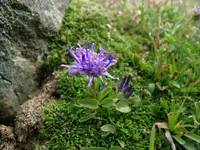
Rosette-leaved rampion, Phyteuma globulariifolium, is a compact alpine perennial forming low, dense rosettes of leaves with rounded clusters of violet-blue flowers on short stems. It has a neat, cushion-like habit that suits rock gardens, crevice plantings, or the front of a sunny border. In nature, it grows on rocky slopes and alpine meadows in parts of Europe, where conditions are cool, bright, and well drained. This background makes it generally hardy but less tolerant of heat, waterlogging, or very rich soils. Gardeners who care for Rosette-leaved Rampion should focus on providing sun, moderate moisture, and gritty, free-draining soil.

Care Difficulty
Moderate Care

Light Preference
Partial Sun

Water Requirements
Moderate Water

Temperature Preference
Cold Hardy

Hardiness Zone
4–7

Soil Texture
Loamy, Rocky, Sandy

Soil pH
Slightly acidic (6.5–7.0), Neutral (7.0)

Soil Drainage
Well-drained

Fertilization
Minimal (feed rarely)
Scan your plant to receive care tips personalized for your specific plant
Available on iOS and Android
This alpine perennial prefers bright, cool conditions that mimic open mountain meadows.
This species prefers consistently moist but not saturated soil, especially during active growth.
This alpine plant is adapted to cool summers and cold winters with reliable snow cover.
This alpine species tolerates typical indoor humidity and rarely needs special humidity management.
Phyteuma globulariifolium prefers cool, moist but sharply drained soil that mimics alpine conditions.
This species can be grown in containers if the potting setup strongly favors drainage and root coolness.
This alpine perennial needs only light feeding, as Rosette-leaved Rampion is adapted to lean, rocky soils.
Phyteuma globulariifolium needs minimal pruning, mainly to keep clumps tidy and flowering well.
This species is usually grown in rock gardens or alpine beds, so focus on careful transplanting rather than frequent repotting.
Phyteuma globulariifolium is commonly propagated by seed or careful division of mature clumps.
This alpine perennial is generally cold hardy and needs only modest winter care in most temperate climates.

Plant Health Check
Not sure what's wrong with your plant? Check your plant's health inside the app.
This species is naturally restricted to high mountain regions of the central and southern Alps, where it grows on siliceous rocky slopes, alpine grasslands, and crevices above the treeline.
The plant forms a tight, ground-hugging rosette of tough, leathery leaves that helps it resist wind, cold, and mechanical damage in exposed alpine habitats.
Its dense, almost globe-shaped violet-blue flower clusters distinguish it from many other rampions that have more elongated inflorescences, making it a useful identification marker for Phyteuma globulariifolium plant care and field recognition.
This alpine perennial usually flowers in late spring to mid-summer, depending on altitude and local climate. Individual flower heads last about 1–2 weeks, while the overall blooming period for a clump can extend 3–5 weeks.
Keep your plants happy and healthy with plant identification, disease detection, and easy care guidance.