Narrowleaf angelon Care (Angelonia angustifolia)

Narrowleaf angelon

About Narrowleaf angelon

Narrowleaf angelon (Angelonia angustifolia) is a compact, bushy flowering plant often grown as a warm-season annual in garden beds and containers. It is valued for its narrow, lance-shaped leaves and upright spikes of small, snapdragon-like flowers in shades of white, pink, purple, or bi-color. Native to Mexico and Central America, it thrives in sunny, hot conditions and continues to bloom steadily through warm weather. The plant tolerates heat and short dry periods well, which makes it relatively low-maintenance. To care for Narrowleaf angelon successfully, provide plenty of sun, well-drained soil, and avoid prolonged waterlogging.

Main Plant Requirements

Care Difficulty

Easy Care

Light Preference

Full Sun

Water Requirements

Moderate Water

Temperature Preference

Tropical / Frost Sensitive

Hardiness Zone

9–11

Soil Texture

Sandy, Loamy, Organic-rich

Soil pH

Acidic (5.5–6.5), Slightly acidic (6.5–7.0)

Soil Drainage

Well-drained

Fertilization

Light (every 4–6 weeks)

Get Personalized Care Plan

Scan your plant to receive care tips personalized for your specific plant

Available on iOS and Android

How to Care for the Narrowleaf angelon

Angelonia angustifolia needs bright, direct sun to flower heavily and stay compact.

  • Provide 6–8 hours of full sun daily; morning and early afternoon sun (before 3 p.m.) give the best bloom density and stronger stems.
  • The plant tolerates light afternoon shade, especially in very hot summers, but deep shade leads to lanky growth and sparse flowers in Narrowleaf angelon.
  • In cloudy or shorter-day seasons, choose the sunniest available spot and avoid obstruction from nearby plants or structures that cast long shadows.

Angelonia angustifolia prefers evenly moist, not saturated, soil with brief drying between waterings.

  • Water when the top 2–4 cm of soil feels dry, then soak thoroughly so moisture reaches the full root zone and excess drains away.
  • Use free-draining soil; standing water or constantly soggy ground causes yellowing leaves, limp stems, and root rot, especially in cooler weather.
  • In peak summer heat, watch for wilting or dull, folded leaves as a cue to water, but reduce frequency in cooler seasons when growth slows.

This species grows best in warm, frost-free conditions and is usually treated as a warm-season annual in cooler climates.

  • Aim for daytime temperatures of 70–85°F (21–29°C) and nights above 60°F (16°C) for strongest flowering and compact growth.
  • Plants are damaged by cold; growth stalls below about 55°F (13°C), and frost at 32°F (0°C) or lower can kill stems and roots.
  • Heat tolerance is good up to about 95°F (35°C) if soil moisture is maintained; mulch can buffer root temperatures during hot, dry spells.

Angelonia angustifolia handles a wide humidity range but grows best in moderately dry to average air.

  • Aim for 30–50% humidity, similar to most heated or air-conditioned homes.
  • Tolerates dry air well; leaves usually stay firm and upright without extra humidity for Narrowleaf angelon.
  • Humidity stress shows as limp growth and edge browning; increase humidity with nearby water trays rather than misting leaves.

Angelonia angustifolia prefers airy, sharply draining soil that does not stay wet around the roots.

  • Use a light mix of 50–60% all-purpose potting mix with 20–30% perlite plus 10–20% coarse sand for structure and drainage.
  • Aim for slightly acidic to neutral pH, roughly 6.0–7.0, which supports nutrient uptake and stable growth.
  • Improve aeration by avoiding compaction; fill containers loosely and avoid pressing the mix down hard around the roots.
  • Avoid heavy clay, peat-only, or constantly soggy substrates, which promote root rot and weak, pale foliage.

This species is well suited to container growing outdoors in warm seasons.

  • Choose a pot at least 20–25 cm wide so roots can spread enough to support continuous flowering.
  • Use a stable, heavier container material where wind is common because plants can become top-heavy when in full bloom.
  • Ensure drainage holes are fully open and raise the pot on feet or bricks so excess water clears quickly after rain or watering.

Angelonia angustifolia responds well to light, consistent feeding during warm active growth.

  • Use a balanced liquid fertilizer (e.g., 10-10-10 or 20-20-20) at 1/2 strength every 2–3 weeks in spring and summer.
  • Alternatively, apply a slow-release balanced granule at planting time for Narrowleaf angelon in containers or beds.
  • Supplement with a thin layer of finished compost around the root zone, keeping it off the stems.
  • In fall and winter, when growth slows, reduce feeding to once every 6–8 weeks or stop completely.

Pruning supports compact growth and extended flowering in Angelonia angustifolia.

  • Pinch or shear back spent flower spikes every few weeks in the growing season to encourage new blooms.
  • In mid to late summer, lightly trim leggy stems by 1/3 to keep plants dense and bushy.
  • Remove dead, diseased, or storm-damaged stems at the base using clean, sharp scissors or hand pruners.
  • In mild climates, tidy plants at the end of the season, but avoid cutting into woody, hardened stems too hard.

Angelonia angustifolia is often grown as an annual but can be transplanted or repotted when rootbound.

  • Check containers for roots circling the drainage holes, compacted soil, or slowed growth as signals to repot.
  • Plan transplanting for spring after frost, or early summer, and usually no more than every 1–2 years in containers.
  • Choose a pot 2–5 cm wider with fresh, well-draining mix; handle the root ball gently to limit tearing.
  • Water thoroughly after moving, keep in bright but not harsh sun for several days, and maintain even moisture to reduce stress.

Angelonia angustifolia is commonly propagated by softwood stem cuttings and sometimes by seed.

  • Take 7–10 cm non-flowering cuttings in late spring or early summer from healthy shoots.
  • Remove lower leaves, dip the cut end in rooting hormone, and insert into moist, sterile, well-draining medium.
  • Maintain high humidity and bright, indirect light at 70–80°F until roots form in 2–4 weeks.
  • Sow seeds indoors 6–8 weeks before last frost on the surface of the mix, since they need light to germinate.

Angelonia angustifolia is frost-sensitive and often grown as a warm-season annual in cold climates.

  • In zones with frost, treat outdoor plants as seasonal and replant each year or overwinter cuttings indoors.
  • Before first frost, move containers inside to a bright, cool room kept above 55°F.
  • Reduce watering in winter so the soil dries slightly between waterings, preventing root rot.
  • In mild climates, apply a light mulch around the base to buffer temperature swings and protect roots.

Care Tips

Encourage Bushy Habit

Pinch back soft shoot tips when plants are 10–15 cm tall to encourage branching and create a fuller flowering mound rather than a few lanky stems.

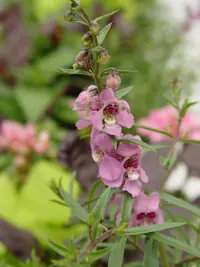
Timed Deadheading

Remove spent flower spikes just as the lowest blooms fade by cutting back to the first set of healthy leaves to trigger faster reblooming and keep the plant compact.

Heat-Stress Management

In very hot, dry spells, add a 2–3 cm layer of fine bark or compost mulch around the root zone (not touching stems) to buffer soil temperatures and reduce stress on the plant.

Container Rotation Strategy

Rotate containers by 90° every 7–10 days so all sides receive equal light, which helps maintain even growth and prevents the plant from leaning or opening up on one side.

Seasonal Refresh Cutback

In mid to late summer, shear plants back by about one-third, then water and feed lightly to rejuvenate tired specimens and extend the blooming season when growing Narrowleaf angelon.

Common Pests and Diseases

Aphids

These insects feed on tender shoots and flower spikes, causing distorted growth and sticky honeydew that can lead to sooty mold on narrowleaf angelonia.

Solution

Rinse colonies off stems and buds with a strong but controlled stream of water, then apply insecticidal soap or a neem oil spray, making sure to coat the undersides of leaves; repeat every 5–7 days until populations drop and encourage natural predators such as lady beetles outdoors.

Spider mites

These pests thrive on angelonia during hot, dry periods, causing fine speckling on leaves, a dull grayish cast, and sometimes fine webbing between stems and foliage.

Solution

Increase humidity around plants, hose down foliage to dislodge mites, then use insecticidal soap or horticultural oil, applied thoroughly to leaf undersides and repeated at 5–7 day intervals while monitoring for new damage.

Botrytis blight

This disease causes tan to brown spots on petals and leaves, blighted flower spikes, and gray fuzzy mold on wet or crowded angelonia plants.

Solution

Remove and discard all affected flowers and foliage, improve spacing and airflow, avoid overhead watering, and if conditions stay cool and damp consider using a labeled fungicide on foliage and flower spikes according to package directions.

Powdery mildew

This disease appears as a white, powdery coating on leaves and stems, leading to yellowing, leaf distortion, and reduced flowering under humid, stagnant air conditions.

Solution

Prune to open the plant canopy, water at soil level, avoid crowding, and treat with a sulfur or potassium bicarbonate fungicide labeled for ornamentals if the white coating continues to spread.

Leaf spot

Symptoms include small brown or purplish lesions on foliage that may enlarge, merge, and cause premature yellowing and drop of angelonia leaves, especially in warm, wet weather.

Solution

Remove and discard spotted leaves, water early in the day at soil level so foliage dries quickly, improve air circulation, and in persistent cases apply a copper-based or chlorothalonil fungicide labeled for ornamental leaf spots, following all label directions.

Interesting Facts

Snapdragon-like pollination

The narrow, two-lipped flowers require insects to land and push their way in, similar to true snapdragons, which helps ensure that only suitably sized pollinators transfer pollen efficiently.

Heat and sun specialist

Native to warm regions of Mexico and Central America, this species continues blooming reliably in high light and summer heat that often cause many bedding plants to stall.

Continuous flowering habit

Unlike many ornamentals that bloom in short flushes, this plant forms new flower spikes steadily over long warm seasons when spent blooms are removed and growing conditions remain stable.

FAQs about Narrowleaf angelon

Insufficient light, excess nitrogen fertilizer, or old, unpruned stems commonly reduce flowering. Ensure strong sun, use a balanced or bloom-boosting fertilizer, and regularly remove spent flower spikes to encourage continuous bud formation and better Angelonia angustifolia care.

Grow Healthy Plants with Botan Care

Keep your plants happy and healthy with plant identification, disease detection, and easy care guidance.

Botan plant care app — identify plants on mobile

Explore More Plants