Control Spreading Edges
Install a shallow root barrier or edging strip 5–8 cm deep around beds to prevent this stolon-forming groundcover from invading lawns or nearby plantings while still allowing dense mat formation inside its zone.

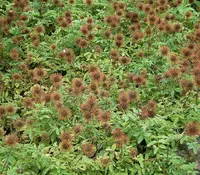
Two-spined acaena (Acaena ovalifolia) is a low, spreading perennial often used as a groundcover. It forms dense mats of small, divided, often bronze or green leaves. In summer it produces rounded flower heads that mature into spiky, burr-like seed balls, which give the plant its common name. It is native to South America, especially Chile and Argentina, and adapts well to cool, temperate climates. The plant is generally undemanding but can spread quickly in suitable conditions, so it needs space and some monitoring. It prefers well-drained soil with moderate moisture and benefits from light to partial sun exposure, which simplifies how to care for Two-spined Acaena in many gardens.

Care Difficulty
Moderate Care

Light Preference
Full Sun

Water Requirements
Moderate Water

Temperature Preference
Cold Hardy

Hardiness Zone
7–9

Soil Texture
Sandy, Loamy, Rocky

Soil pH
Acidic (5.5–6.5), Slightly acidic (6.5–7.0)

Soil Drainage
Well-drained

Fertilization
Minimal (feed rarely)
Scan your plant to receive care tips personalized for your specific plant
Available on iOS and Android
This low mat-forming perennial prefers cool, bright positions with some protection from harsh midday sun.
This groundcover prefers steady moisture but is sensitive to waterlogged soil.
This hardy perennial tolerates a wide temperature range but grows best in cool to mild conditions.
This species handles a wide humidity range and usually does not need special humidity management outdoors or in most homes.
Acaena ovalifolia prefers loose, well-drained mineral soil that still retains moderate moisture.
This species can be grown in containers, especially for controlling spread or highlighting its foliage and burr-like fruits.
Acaena ovalifolia grows well in modest soils and benefits from light feeding during the active season.
Pruning Acaena ovalifolia focuses on tidying the mat and maintaining healthy, dense growth.
This species is usually grown as a groundcover, so transplanting in the landscape is more common than repotting.
Acaena ovalifolia is commonly propagated by division, runners, or seed to expand groundcover areas.
This hardy groundcover tolerates typical winters in many temperate regions and usually needs minimal special care.

Plant Health Check
Not sure what's wrong with your plant? Check your plant's health inside the app.
This species develops spherical seed heads covered in stiff, hooked spines that readily cling to wool and fur, an adaptation that allows its seeds to travel long distances on grazing mammals in its native southern South American range.
It is naturally distributed in southern Chile and Argentina, often in open, windswept sites and grasslands influenced by cool, oceanic climates, which shapes its tolerance of cold and exposure compared with many other ornamental groundcovers.
The foliage often shows bronzy to reddish tones, especially in strong light or cooler temperatures, which contrasts with the green leaf background and makes the spiny seed heads more visually prominent in the landscape.

This species has been documented as locally invasive in some temperate regions outside its native range, where its efficient burr-based seed dispersal and dense mat-forming growth can allow it to outcompete low-growing native vegetation.
This species is usually semi-evergreen. In mild climates it keeps most foliage through winter, though some leaves may brown or thin out. In colder regions it can die back partially and re-sprout from the crown in spring.
Keep your plants happy and healthy with plant identification, disease detection, and easy care guidance.