Control Spreading Edges
Use a hand fork or hori-hori knife once or twice a year to slice and lift any runners that creep into paths or neighboring plants, then replant useful pieces where groundcover is needed.

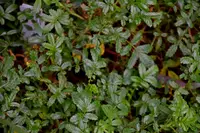
Pale biddy-biddy, Acaena pallida, is a low, mat-forming perennial often used as a groundcover. It belongs to the rose family but lacks showy blooms. The plant spreads by creeping stems with small, divided, grey-green leaves that create a soft, textured carpet. In summer it produces modest flower heads followed by burr-like seed pods that can cling to fur or clothing. Acaena pallida is native to cool, open habitats in the Southern Hemisphere, where it experiences good light, free-draining soils, and regular moisture. Its tough, spreading habit makes it fairly easy to manage if given sun and drainage, but it can be slow to establish. Gardeners who care for pale biddy-biddy value it for filling gaps between stones or pavers.

Care Difficulty
Moderate Care

Light Preference
Partial Sun

Water Requirements
Moderate Water

Temperature Preference
Cool Climate

Hardiness Zone
7–9

Soil Texture
Sandy, Loamy, Rocky

Soil pH
Slightly acidic (6.5–7.0), Neutral (7.0)

Soil Drainage
Well-drained

Fertilization
Minimal (feed rarely)
Scan your plant to receive care tips personalized for your specific plant
Available on iOS and Android
This compact groundcover prefers bright, cool conditions with some protection from harsh midday sun.
This species prefers evenly moist, free-draining soil and does not tolerate waterlogged conditions.
This hardy groundcover tolerates a wide temperature range but grows best in cool to mild conditions.
This species handles typical outdoor humidity well but benefits from moderately moist air in hot, dry climates.
This plant prefers freely draining, moderately fertile soil that never remains waterlogged.
This species can be grown in containers if the pot and substrate are managed to stay well drained and stable for its spreading habit.
This groundcover needs only modest feeding, as pale biddy-biddy is adapted to lean, well-drained soils.
Light pruning keeps Acaena pallida dense, tidy, and healthy without heavy intervention.
This species is usually grown as a groundcover, so transplanting established clumps is more common than container repotting.
This plant is commonly propagated to extend groundcover patches or share with other gardeners.
Acaena pallida is generally cold hardy in temperate climates and needs only minimal winter attention in the ground.

Plant Health Check
Not sure what's wrong with your plant? Check your plant's health inside the app.
Acaena pallida is naturally restricted to New Zealand, where it occurs in a limited range of subalpine to montane habitats rather than being widespread like several other Acaena species.
The species is named for its noticeably paler, often grey-green foliage compared with many related bidibid species, a feature that helps distinguish it in the field.
Acaena pallida is typically found in open, disturbed, or sparsely vegetated ground such as tussock grasslands and rocky slopes, where its low, mat-forming habit helps it occupy gaps between larger plants.
This ground-hugging species spreads steadily via surface stems and rhizomes, forming a low mat. It is usually manageable, but in light soils it can edge into nearby spaces, so use edging or occasional trimming where boundaries matter.
Keep your plants happy and healthy with plant identification, disease detection, and easy care guidance.