Wind-hardy shaping
In exposed gardens, lightly thin and selectively shorten long, whippy shoots on the windward side during dormancy to reduce sail effect and lower the risk of branch tearing in storms.

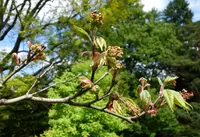
Campbell's maple, Acer campbellii, is a medium to large deciduous tree valued for its elegant form and colorful seasonal foliage. It develops a rounded to broadly spreading crown with smooth gray bark on young branches that becomes rougher with age.
This species occurs naturally in montane forests of the Himalayas and parts of Southeast Asia, where it grows in cool, moist conditions. In cultivation it is considered moderately demanding because it prefers sheltered sites, consistent moisture, and mild climates without extreme heat or drought.
Gardeners who care for Campbell's Maple usually focus on providing humus-rich, well-drained soil and dappled to full sun exposure, depending on local climate. It is best suited to temperate gardens and larger outdoor spaces rather than small containers or very dry regions.

Care Difficulty
Moderate Care

Light Preference
Partial Shade

Water Requirements
Moderate Water

Temperature Preference
Cool Climate

Hardiness Zone
7–9

Soil Texture
Loamy, Silty, Organic-rich

Soil pH
Acidic (5.5–6.5), Slightly acidic (6.5–7.0)

Soil Drainage
Moist but well-drained

Fertilization
Minimal (feed rarely)
Scan your plant to receive care tips personalized for your specific plant
Available on iOS and Android
This high-altitude maple prefers bright, gentle light rather than harsh, all-day sun.
This species prefers consistently moist, cool soil that never stays waterlogged.
This maple is adapted to cool, mountain-like climates and dislikes extreme heat or severe lowland frost.
This maple prefers moderately moist air but usually manages in typical outdoor garden humidity.
This species prefers cool, evenly moist, well-structured soil that does not stay waterlogged.
This maple can be grown in large containers for some years, especially in cooler climates.
Acer campbellii benefits from light, balanced feeding in nutrient-poor or container conditions, but established trees in good soil often need little fertilizer.
Pruning Acer campbellii focuses on safety, structure, and light management rather than heavy reshaping.
Campbell's Maple is usually grown in the ground; transplanting young trees at the right time limits stress and supports strong establishment.
Acer campbellii is typically propagated by seed or grafting, and success can be moderate rather than high for home growers.
This maple is moderately cold hardy but young Acer campbellii trees benefit from some winter protection in colder regions.

Plant Health Check
Not sure what's wrong with your plant? Check your plant's health inside the app.
This maple is naturally distributed in montane forests of the central and eastern Himalayas, from Nepal and Sikkim through Bhutan into southwestern China, where it grows on cool, moist slopes and valleys at moderate to high elevations.
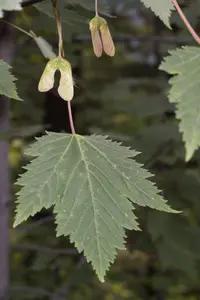
Unlike many other Asian maples with finely divided foliage, this species typically has relatively broad, three‑lobed leaves with shallow sinuses and a smooth to slightly toothed margin, which helps distinguish it from related Himalayan maples in the field.
In parts of its native range it forms part of mixed broadleaf forests together with species of Rhododendron, Quercus, and Magnolia, contributing to multi-layered forest structure and providing seasonal leaf litter that supports soil organisms.

In its native Himalayan range, this maple can develop a tall, straight trunk and broad crown that make it locally valued as a shade and landscape tree around mountain settlements, where it is sometimes planted near paths and houses for shelter and seasonal color.
This species is moderately fast-growing, often adding 30–60 cm of height per year once established. Growth is quickest in deep, moist, well-drained soil with consistent moisture and shelter from strong, drying winds.
Keep your plants happy and healthy with plant identification, disease detection, and easy care guidance.